
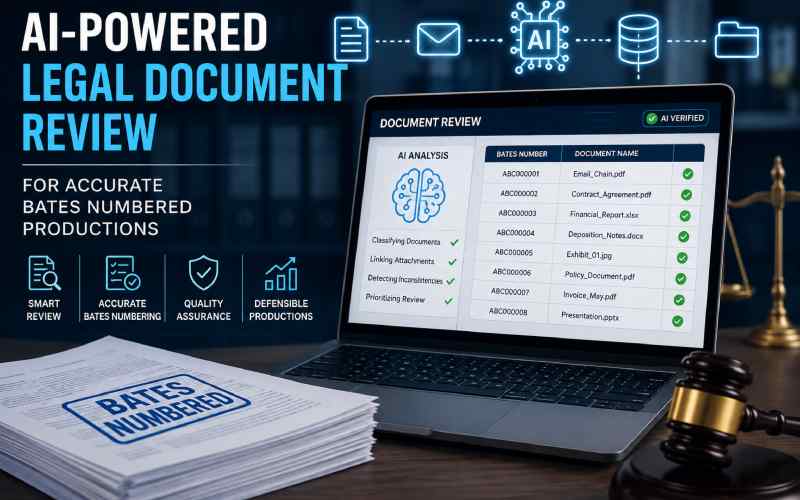
Legal discovery depends on precision because every produced page may support an argument, deposition question, or court filing. A numbering gap, duplicate identifier, or mismatched attachment can create confusion across counsel and litigation teams. Accurate Bates-numbered productions therefore require more than a final stamp applied after review.
Artificial intelligence adds structure when collections contain emails, contracts, spreadsheets, images, and native files. It can classify content, connect attachments, and detect inconsistencies. The result is a production workflow that supports speed while preserving professional judgment. This article will give you better clarity.
Stronger Control Over Responsive Material
Large discovery sets demand a review method that keeps evidence organized from collection onward. The legal document review ai helps teams identify responsive records, group related files, and prioritize material for attorney attention. Automated analysis can compare text, metadata, dates, custodians, and request language, reducing the risk that relevant pages remain buried in a large collection. Counsel still makes the final call, but the review queue becomes clearer. This structure matters. Bates numbering should follow the approved production set. Once reviewers confirm responsiveness, the system can preserve document order and prepare a reliable export sequence.
Consistent Bates Numbering Across Every File
AI-supported quality checks can examine numbering patterns before service and flag defects that spot checks may miss. Such as:
- Gaps, duplicate values, malformed prefixes, and incorrect page ranges.
- Missing stamps on converted pages or placeholder records.
- Attachment sequences that do not follow the parent document.
- Load-file values that differ from visible page identifiers.
These checks protect citation accuracy because each reference must lead to the same page. A clean sequence also simplifies depositions, exhibit lists, privilege discussions, and supplemental productions. Legal teams can correct exceptions before opposing counsel receives the files.
Better Treatment of Families, Metadata, and Native Files
Email families require careful handling because a message and its attachments may carry separate page ranges. AI can map those relationships, retain parent-child links, and confirm that attachments appear after the associated message when required. It can also detect files that need native production, slipsheets, or special treatment.
Metadata deserves equal attention. Review platforms can compare custodian names, sent dates, file paths, confidentiality designations, and extracted text against the production load file. This comparison supports validation.
Faster Quality Assurance Before Service
AI can support a repeatable preproduction checklist alongside a well-designed technical integration.:
- Confirm that every exported page has a unique identifier.
- Match beginning and ending Bates values to document records.
- Verify redaction labels, confidentiality legends, and searchable text.
- Reconcile production totals with the review database and transmittal letter.
This process gives attorneys a focused exception report. Human review can concentrate on anomalies, privilege risks, and strategic concerns. Counsel retains final authority over the production.
Defensible Productions That Support Case Strategy
Reliable productions improve more than an administrative order. Precise identifiers let attorneys cite evidence quickly, trace a document to its custodian, and respond confidently when a page is questioned. The U.S. Courts reported 303,563 federal district court civil filings in fiscal year 2025, a 4 percent increase, illustrating the scale of litigation activity.
A documented AI-assisted workflow can record review decisions, export settings, validation results, and corrective actions. The resulting audit trail demonstrates reasonable process control. It also provides valuable support if production accuracy later becomes an issue.
AI review brings discipline to complex discovery collections. Accurate Bates numbering strengthens citations, cooperation, and courtroom readiness. Attorney oversight turns automated checks into dependable legal productions.

Julian Thorne is a distinguished Technical Strategist and Fintech Analyst with over 6 years of experience in digital payment architectures. Specializing in the integration of high-performance gateways like Xendit, he focuses on optimizing the intersection of gamification and online ticketing systems. Julian’s expertise lies in deconstructing complex payment flows and enhancing sales effectiveness through data-driven insights. His recent work deeply explores the evolution of digital event platforms in 2026, providing actionable strategies for global summits and large-scale ticketing infrastructures.
Learn more about our team OR Get in touch