Searching for gamification software turns up three overlapping terms: software, platform, and tools, often used interchangeably by vendors even though they describe different things. That inconsistency makes comparison shopping harder than it needs to be. This guide clarifies the terminology, breaks down what gamification software actually needs to do well, and maps the main categories to real platform examples.
Gamification Software vs. Platform vs. Tools
These three terms get used loosely across the industry, but the distinction matters when you are comparing options.
| Term | What It Usually Means | Example |
| Gamification software | The general category: any application that adds game mechanics to a task | A points-and-badges plugin added to an LMS |
| Gamification platform | A broader system other tools plug into, often with APIs and multi-team support | An enterprise engagement platform connecting sales, training, and support |
| Gamification tools | Individual, often narrower features or add-ons | A single leaderboard widget or a spin-the-wheel popup builder |
For a breakdown of gamification by business use case rather than by software type, see our guide to gamification solutions, which covers marketing, training, sales, and education applications in more depth.
Core Features That Separate Good Gamification Software From Weak Software
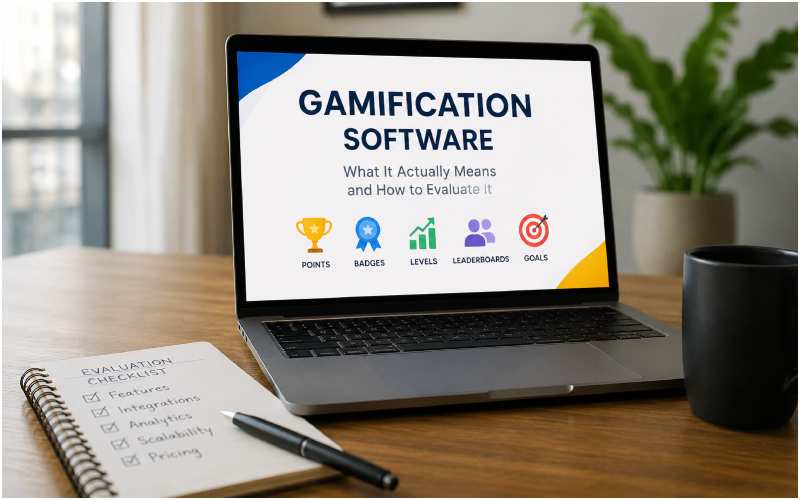
Most gamification software converges on the same base mechanics: points, badges, levels, and leaderboards. The features that actually determine whether the software works long-term sit underneath those mechanics.
No-Code or Low-Code Campaign Building
Teams without developer resources need to launch and edit campaigns directly. Software that requires a developer for every change to a points structure or reward tier slows adoption and often gets abandoned after the first few weeks.
Behavioral Analytics, Not Just Activity Counts
Tracking how many points were earned is not the same as tracking whether behavior actually changed. Stronger gamification software connects engagement data to an outcome metric, a QA score, a sales number, a course completion rate, rather than reporting engagement as an end in itself.
Integration Depth
Gamification software that sits disconnected from the systems already in use, a CRM, an LMS, a support ticketing tool, tends to create duplicate data entry and gets deprioritized quickly. API access and native integrations matter more than the visual polish of the leaderboard.
Personalization
Static challenges that look the same for every user wear out fast. Software that adapts difficulty, rewards, or pacing based on individual behavior sustains engagement longer than a one-size-fits-all points system.
Gamification Software by Category
The right software depends heavily on which business function it needs to support. The table below maps common categories to their optimization focus and a few platforms operating in that space.
| Category | What It Optimizes For | Example Platforms |
| Marketing & campaigns | Lead capture, conversions, no-code campaign building | Trigger, Triggerbee, Drimify, Qualifio |
| Sales performance | Leaderboards, streaks, real-time coaching data | LevelEleven, Spinify |
| Workforce & call center | Connecting recognition to QA scores and KPIs | Centrical, Hoopla |
| Customer engagement & loyalty | Points, rewards, referral and advocacy programs | Bunchball Nitro, Kangaroo |
| Corporate training | Course completion tied to points, levels, and badges | TalentLMS, Attensi |
This is not an exhaustive vendor list, and pricing and feature sets change frequently enough that a specific comparison would be outdated within months. Treat platform names here as a starting point for your own research, not a final recommendation.
Questions to Ask Before Choosing Gamification Software
- Does the tool require a developer to launch or edit a campaign, or can a non-technical team member manage it?
- Does the analytics dashboard connect engagement data to a real business outcome, or does it only report activity?
- What systems does it need to integrate with, and does the vendor support that integration natively?
- Is pricing based on total users, active users, or a flat platform fee, and how does that scale as your team grows?
- Can you test the core mechanics with a free tier or trial before committing to a contract?
Frequently Asked Questions
Is gamification software the same as a gamification platform?
Not always. Software usually refers to the general category, while a platform typically implies a broader system built for multiple teams or use cases, often with API access. Many vendors use the terms interchangeably, so check the feature set rather than the label.
What are gamification tools used for?
Gamification tools usually refer to individual features or narrower add-ons, such as a single leaderboard widget or a spin-the-wheel campaign builder, rather than a full platform.
Is free gamification software worth using?
Free tiers are useful for testing whether a mechanic actually changes behavior before committing budget. Most free tiers cap users or features, so treat them as a trial rather than a long-term solution once you see results.
Julian Thorne is a distinguished Technical Strategist and Fintech Analyst with over 6 years of experience in digital payment architectures. Specializing in the integration of high-performance gateways like Xendit, he focuses on optimizing the intersection of gamification and online ticketing systems. Julian’s expertise lies in deconstructing complex payment flows and enhancing sales effectiveness through data-driven insights. His recent work deeply explores the evolution of digital event platforms in 2026, providing actionable strategies for global summits and large-scale ticketing infrastructures.

Julian Thorne is a distinguished Technical Strategist and Fintech Analyst with over 6 years of experience in digital payment architectures. Specializing in the integration of high-performance gateways like Xendit, he focuses on optimizing the intersection of gamification and online ticketing systems. Julian’s expertise lies in deconstructing complex payment flows and enhancing sales effectiveness through data-driven insights. His recent work deeply explores the evolution of digital event platforms in 2026, providing actionable strategies for global summits and large-scale ticketing infrastructures.
Learn more about our team OR Get in touch