
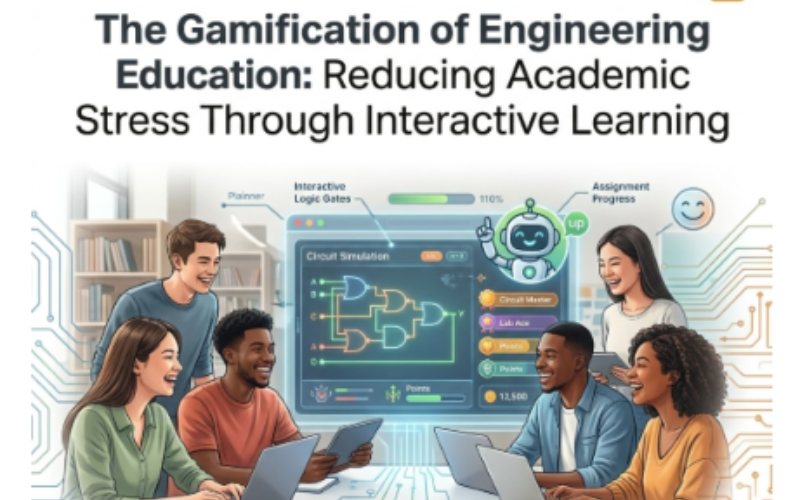
The Gamification of Engineering Education: Reducing Academic Stress Through Interactive Learning
Engineering programs are notoriously intense. University undergraduates worldwide regularly balance complex mathematical theories, rigorous lab assignments, and tight project deadlines. When traditional learning methods rely solely on heavy textbooks and passive lectures, burnout and academic stress naturally skyrocket.
To combat this, universities are embracing a major shift: gamified education. By turning abstract concepts into interactive, game-like challenges, engineering students can learn by doing. This approach transforms high-stakes testing environments into low-stakes spaces where making mistakes is just part of the game.
Shifting From Static Logic to Real-Time Simulations
The jump from reading a textbook to understanding physical computer hardware is one of the toughest challenges for early-stage engineering students. Memorizing truth tables or Boolean algebra on paper often feels completely disconnected from real-world systems. This gap is exactly where interactive software changes the game.
When learning digital logic, working with real-time software allows you to build, test, and troubleshoot circuits on a screen before touching actual hardware. For undergraduates facing strict laboratory deadlines, using dedicated logisim assignment help provides an ideal way to master complex circuit layout architectures, clear up conceptual confusion, and finish demanding university coursework with far less stress. Rather than just memorizing theoretical gate behaviors, you can watch input signals pass through virtual gates instantly. Seeing immediate visual feedback turns a frustrating trial-and-error process into an engaging, visual puzzle.
Why Gamified Frameworks Protect Student Mental Health
In a typical engineering curriculum, making a single mistake in a physical lab can cause costly component damage or set a project back by several weeks. This fear of failing creates a constant undercurrent of anxiety. Gamification completely changes this dynamic by introducing a “safe failure” framework.
When educational tasks are structured with clear levels, rapid feedback loops, and point systems, the underlying psychology shifts. A mistake is no longer an academic failure; it is simply a prompt to reload the level and try a new strategy. This mindset is crucial for maintaining motivation when tackling notoriously difficult subjects.
| Traditional Engineering Learning | Gamified & Interactive Learning |
| Focuses on passive listening and rote memorization | Prioritizes experiential learning and active problem-solving |
| Delays feedback until midterms or final grading periods | Provides instant visual feedback on errors and design flaws |
| Carries high stakes, which increases student stress and anxiety | Offers safe-to-fail virtual environments that lower stress |
| Features rigid, linear module progress paths | Includes adaptive, personalized learning milestones |
Bridging the Gap: From Hands-On Models to Technical Writing
Active, hands-on learning helps students grasp complex ideas, but it also highlights a secondary challenge. An engineering student might successfully build a brilliant simulation or solve a tough coding puzzle, but translating that visual success into a formal, graded academic essay or lab report requires an entirely different set of skills.
Many undergraduates run into a wall during this exact transition. They understand the practical engineering mechanics perfectly, but they struggle to structure their technical arguments to meet strict university grading rubrics.
When documentation pressures mount alongside heavy weekly workloads, structured writing guidance can help students build stronger technical reports without added stress. Resources like MyAssignmentHelp offer formatting references, literature review structures, and editing guidance that many students use to strengthen their own writing. This kind of support works best as a learning aid alongside your own analysis, not a replacement for it.
This section is provided in partnership with MyAssignmentHelp.
Long-Term Benefits for Career Readiness
The advantages of interactive, gamified platforms extend far beyond getting through final exams. Modern global tech companies do not expect engineers to sit at desks and memorize static equations. They look for professionals who can test ideas quickly, adapt to software environments, and collaborate on dynamic digital platforms.
By engaging with virtual sandboxes, complex simulators, and interactive modeling tools during university, you build a mental framework focused on continuous iteration. You learn to view complex bugs as challenges to solve rather than roadblocks, preparing you directly for the realities of modern engineering careers.
Frequently Asked Questions
Q.1 What exactly is gamification in engineering education?
Ans: Gamification means bringing game-design elements, like immediate feedback, interactive levels, progression badges, and virtual simulations, into academic courses. It shifts learning from passive reading to active, trial-and-error problem solving.
Q.2 How do visual tools like simulation software reduce student stress?
Ans: Simulators let you test theories and build complex designs risk-free. Because you cannot break physical components or ruin expensive lab equipment, the anxiety around failing disappears, making it easier to learn from mistakes.
Q.3 Why do engineering students often struggle with technical essays?
Ans: Engineering programs focus heavily on mathematical models and practical design. Because of this, students often get less practice writing long-form analytical reports, making it highly stressful to translate visual lab data into formal academic papers.
Q.4 Can writing resources help with complex engineering coursework?
Ans: Yes. Structured writing guidance can help you organize lab results, design rationales, and theoretical arguments more clearly, which supports stronger technical reports. Using these as a reference alongside your own work, rather than a substitute for it, tends to produce the best learning outcome.
Julian Thorne is a distinguished Technical Strategist and Fintech Analyst with over 6 years of experience in digital payment architectures. Specializing in the integration of high-performance gateways like Xendit, he focuses on optimizing the intersection of gamification and online ticketing systems. Julian’s expertise lies in deconstructing complex payment flows and enhancing sales effectiveness through data-driven insights. His recent work deeply explores the evolution of digital event platforms in 2026, providing actionable strategies for global summits and large-scale ticketing infrastructures.

Julian Thorne is a distinguished Technical Strategist and Fintech Analyst with over 6 years of experience in digital payment architectures. Specializing in the integration of high-performance gateways like Xendit, he focuses on optimizing the intersection of gamification and online ticketing systems. Julian’s expertise lies in deconstructing complex payment flows and enhancing sales effectiveness through data-driven insights. His recent work deeply explores the evolution of digital event platforms in 2026, providing actionable strategies for global summits and large-scale ticketing infrastructures.
Learn more about our team OR Get in touch