Imagine opening a learning app because you want to develop a new skill. The first lesson is short, your progress is easy to follow, and you receive useful feedback after answering a few questions. Completing the lesson feels satisfying because you can see what you have achieved.
Now imagine using another app that keeps asking you to collect points, maintain a daily streak, and compete with strangers on a leaderboard. At first, the experience might feel exciting. After a while, however, those features could become more annoying than helpful.
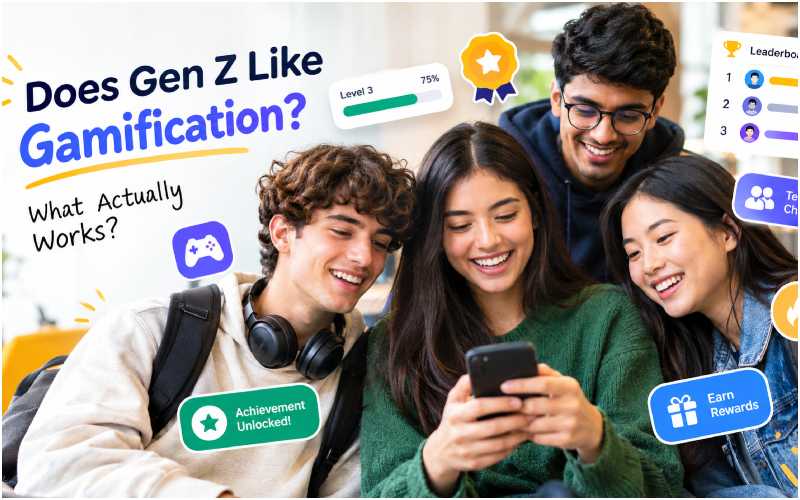
Both experiences use gamification, but they can produce very different reactions. So, does Gen Z like gamification? The short answer is that many Gen Z users can enjoy it, provided the experience offers something meaningful. Points, badges, challenges, and leaderboards can make an activity more engaging, but adding these features does not automatically make an experience enjoyable.
Gen Z generally refers to people born between 1997 and 2012, although the exact birth years vary by source. The generation includes teenagers, university students, early-career professionals, and people with very different interests and responsibilities.
A student learning a new subject may appreciate progress tracking. Someone attending a professional conference may prefer networking challenges. Another person may simply want to complete a task without competing against anyone. That is why businesses, educators, and event organizers should avoid treating Gen Z as one group with identical preferences. The better question is which types of gamification help a particular audience accomplish something they value.
Why Does Gamification Appeal to Gen Z?
Gamification is the use of game-design elements in activities that are not games. These elements can include points, levels, progress bars, achievements, challenges, feedback, and social competition.
The idea is straightforward. An activity can become easier to approach when people understand what they need to do, receive feedback about their progress, and have a reason to continue.
Consider an online course with ten lessons. Without progress indicators, a learner may have little idea how much work remains. A simple progress bar and clear lesson milestones can make the course easier to navigate.
The educational content has not changed. What has changed is how the learner understands and experiences the process.
This distinction matters because gamification is not automatically motivating. A badge has little value if it represents an insignificant action. A leaderboard can discourage people who feel they cannot catch up. A daily streak may encourage consistency but become frustrating when someone misses a day.
For Gen Z audiences, the design should support the purpose of the activity. If the goal is learning, the experience should help people understand and remember information. If the goal is networking, the mechanics should make it easier to connect with others.
The game elements are tools, not the main objective.
What Makes Gamification Enjoyable for Gen Z?
1. Visible Progress
People often find it easier to continue an activity when they can see how far they have come.
Imagine completing a course that teaches digital marketing. A progress tracker shows the modules you have finished, while short quizzes help you identify topics that need more attention.
This provides a practical reason to return. You are not collecting points just for the sake of collecting them. You are building a skill and seeing the results of your effort.
The same idea can work in event applications, employee training, and fitness platforms. A progress indicator is useful when it communicates genuine progress rather than encouraging people to spend more time on a screen.
2. Achievements That Mean Something
Badges can recognize effort, but their value depends on what they represent.
A badge earned after completing a difficult learning module may feel more meaningful than one awarded for opening an application. Similarly, a conference achievement connected to attending educational sessions may be more useful than a badge earned by repeatedly scanning random QR codes.
If every small action receives the same reward, users may eventually stop caring about the rewards.
A better approach is to connect achievements with milestones, useful actions, or demonstrated skills. People should understand why they earned a badge and what it says about their participation.
3. Freedom to Choose
Not everyone enjoys the same type of competition.
Some users like comparing scores with friends. Others prefer setting personal targets and improving at their own pace. Some enjoy collaborative challenges but dislike public rankings.
A well-designed gamified experience can accommodate these differences.
For example, a learning platform could offer a personal progress goal alongside an optional team challenge. Both options encourage participation, but users can choose the approach that suits them.
Giving people reasonable choices can make an experience more comfortable and inclusive. It also avoids the assumption that every young user wants to compete publicly.
4. Immediate and Helpful Feedback
Feedback can make an ordinary task more useful.
Suppose a learner answers a question incorrectly. Simply displaying a red cross tells the learner that something went wrong, but it does not explain why.
A short explanation of the correct answer provides more value. It helps the learner understand the mistake and try again with better knowledge.
The same principle applies to professional training, quizzes, and event activities. Good feedback explains what happened and helps people decide what to do next.
Fast feedback is useful because it supports improvement, not merely because it appears immediately.
5. Social Interaction
Gamification can give people a reason to interact, cooperate, and share an experience.
A team challenge at a conference, for example, may encourage attendees to discuss a problem and work toward a common result. A collaborative classroom activity can help students learn from one another.
However, social features need careful design. Public leaderboards can create pressure, especially when people have different levels of experience or access to resources.
If the goal is cooperation, rewarding teamwork makes more sense than ranking every participant individually.
The most effective mechanic depends on the outcome the organizer wants to achieve.
Why Points and Badges Sometimes Fail
Adding game mechanics is easy. Creating a genuinely useful experience requires more thought.
One common mistake is rewarding activity instead of results. If a platform awards points for every click, users may learn to click more without gaining anything valuable.
Another problem is excessive competition. A leaderboard might motivate the highest-ranked participants while leaving everyone else feeling that catching up is impossible.
Streaks can create similar problems. They may encourage a regular habit, but they can also turn an enjoyable activity into an obligation. If users feel punished for taking a break, they may stop participating altogether.
There is also the issue of unnecessary complexity. An application with several types of points, multiple currencies, badges, levels, and confusing rules may require more effort to understand than the original task.
Before adding a feature, ask what purpose it serves. Does it help users learn, make progress, collaborate, or complete an important task?
If a feature does none of these things, it may not deserve a place in the experience.
A useful test is to imagine removing the points and badges. Would the activity still provide value? If the answer is no, the underlying experience may need improvement before more game mechanics are introduced.
Does Gen Z Like Gamification in Education?
Education is an important area for gamification because learning often requires repeated practice, feedback, and sustained attention.
A student may understand a concept after one explanation but struggle to apply it independently. Short challenges and practice quizzes can help the student identify gaps in understanding before moving forward.
Teachers can also use team-based activities to encourage discussion. Instead of simply asking students to memorize an answer, they can invite them to solve a problem together and explain their reasoning.
However, a high score does not always prove that someone has learned a subject deeply. A student may answer quickly because they already know the material, while another student may need additional time to understand it.
For this reason, educational gamification should be evaluated through learning outcomes, not just participation or points earned.
Our guide to gamification in education explores how game-inspired techniques can support learning and student participation. It is a useful next step for readers interested in applying these ideas in educational settings.
The main principle is simple: game mechanics should make learning more effective, not distract students from the subject itself.
How Gen Z May Respond to Gamification at Events
Gamification can also be useful at conferences, workshops, and professional summits.
Imagine attending an event with several sessions taking place throughout the day. You want to meet people, discover useful ideas, and make the most of your ticket.
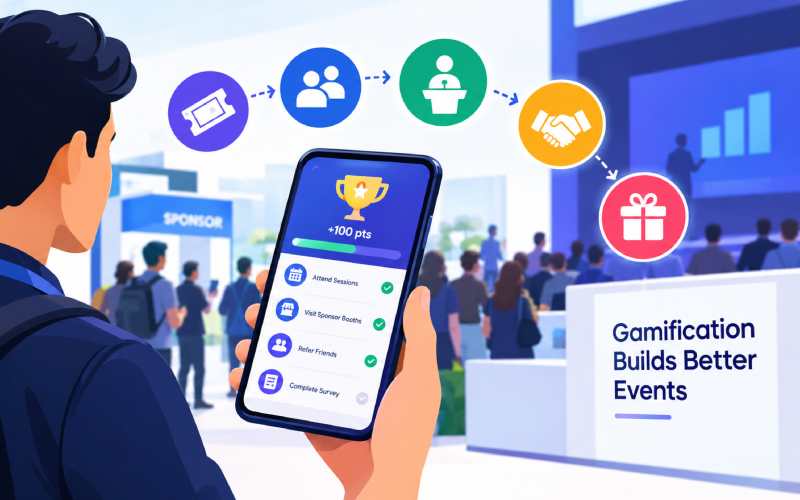
Organizers could introduce a challenge that encourages attendees to visit selected sessions, participate in a discussion, or answer questions related to what they learned. Participants might earn recognition for completing activities that contribute to the event’s objectives.
When these activities are relevant, they can encourage attendees to explore more of the event.
But the design can easily go wrong. If attendees must scan dozens of QR codes without learning anything useful, the challenge becomes another administrative task. If rewards require people to ignore sessions or rush between activities, gamification can interfere with the event experience.
A good event challenge should make participation more valuable, not more complicated.
Organizers should first decide what they want to improve. Are they trying to encourage networking, increase participation in workshops, help attendees discover exhibitors, or reinforce learning? The answer determines which mechanics make sense.
Registration also matters. Before attendees can participate in an event, they need to understand the ticket options, prices, payment process, and registration requirements.
Choosing suitable websites for Gamification Summit tickets can help organizers evaluate ticketing options and consider how the registration process affects the attendee experience.
A smooth ticket-purchasing process will not guarantee engagement, but a confusing one can create unnecessary friction before the event even begins.
How Businesses Can Design Better Gamified Experiences for Gen Z
Businesses do not need to copy popular video games to engage younger audiences. They need to understand what users want to accomplish and decide whether gamification can help.
Start with one clearly defined problem.
Perhaps people abandon an onboarding process before finishing it. Maybe students struggle to complete a course, or conference attendees overlook sessions that would interest them.
Once the problem is clear, choose a mechanic that addresses it. A progress tracker may help users understand how much remains. A short challenge may encourage practice. A cooperative activity may help people connect.
Keep the initial design simple. Adding too many features at once makes it difficult to understand which ones actually help.
Rules should also be easy to understand. Explain how users earn achievements, what information other participants can see, and whether competitive features are optional.
Privacy deserves particular attention. Public rankings and activity tracking should not expose personal information unnecessarily or pressure users into sharing their performance.
Finally, measure outcomes that matter. Depending on the activity, these might include course completion, successful onboarding, attendance at relevant sessions, knowledge retention, or the number of meaningful connections made.
Clicks and time spent on a page can provide useful context, but neither metric proves that an experience has improved.
The goal is to make the activity better for users, not simply to keep them busy.
Does Gen Z Prefer Competition or Collaboration?
There is no single answer because people respond differently to social environments.
Competitive gamification can work well when users understand the rules, believe the competition is fair, and have a realistic opportunity to improve. Friendly quiz competitions or optional scoreboards may make a learning activity more exciting.
However, competition can become discouraging when the same experienced participants dominate every round. New users may feel that their efforts cannot make a difference.
Collaboration offers another approach. Participants work together to solve a problem, reach a shared target, or complete a series of activities.
For example, an event organizer could reward a group for completing a workshop challenge rather than publicly ranking every attendee. This gives participants a shared objective and encourages conversation.
Personal goals can provide a third option. Instead of comparing themselves with others, users track their own progress and celebrate individual milestones.
For businesses and educators, the practical solution is to match the mechanic to the task. Use competition when friendly comparison supports the objective, collaboration when teamwork matters, and personal progress when individual improvement is the priority.
Whenever possible, let users choose between suitable options instead of assuming that one format will motivate everyone.
How to Test Whether Your Gen Z Audience Likes Gamification
General research can provide useful starting points, but it cannot tell you exactly how your own audience will respond.
If you are developing an application, organizing an event, or designing a learning experience, testing a small version with actual users can reveal what works.
For example, you might compare a basic checklist with a version that includes progress tracking and optional challenges. Keep the main task similar so you can better understand whether the additional features make a difference.
Ask participants what they found helpful, what felt unnecessary, and whether they would choose to use the feature again.
Do not rely only on their first reaction. A challenge may feel exciting on the first day but become repetitive after a week. A simple progress tracker may attract less attention initially yet remain useful over time.
Look at several outcomes together:
- Did users complete the intended activity?
- Did they learn something or achieve their goal?
- Did they find the experience fair and easy to understand?
- Did the features encourage useful participation?
- Would they willingly return to the experience?
These questions help distinguish genuine value from temporary excitement.
It is also worth examining differences within your audience. If some participants enjoy competition while others prefer collaboration, the results may suggest that offering more than one participation style would improve the experience.
Testing is more reliable than making assumptions based on age alone.
Personalization, Accessibility, and Privacy Matter
A gamified experience should not require everyone to interact in exactly the same way. Some people prefer visual progress indicators, while others want straightforward instructions. Some enjoy public recognition, while others would rather keep their achievements private. Providing a few relevant choices can make the experience more accessible without creating unnecessary complexity.
Accessibility should be part of the original design. Important information should not depend on colour alone, instructions should be understandable, and interactive features should work for people who use assistive technology. Mobile usability matters too. A complicated interface may discourage participation, particularly when users are trying to complete an activity on a small screen or with an unreliable connection.
Privacy should not be overlooked. Users should understand what information is collected, how their activity is displayed, and whether participation in leaderboards or social challenges is optional. These considerations are not special requirements for Gen Z. They are part of building digital experiences that respect users and make participation easier.
What Does Research Say About Gamification and Motivation?
Research suggests that gamification can improve certain outcomes, but the results depend on how it is designed and where it is used.
A 2024 meta-analysis published in Educational Technology Research and Development examined gamification interventions and their relationship with intrinsic motivation. The findings indicated a small positive overall effect, with results varying across different aspects of motivation. This provides a useful reminder that gamification can help without being universally effective.
Educational research also highlights the importance of considering the activity, the learners, and the design of the intervention. A feature that encourages participation in one setting may have little effect in another. These findings do not prove that every Gen Z user likes gamification. Research on learners in educational settings also cannot automatically establish how all young adults will respond to workplace software, retail applications, or professional events.
For website owners, educators, and event organizers, the responsible approach is to use research to develop ideas and then evaluate those ideas with the actual audience. It is better to make a limited claim supported by evidence than to promise that a particular game mechanic will motivate an entire generation.
Final Verdict: Does Gen Z Like Gamification?
Yes, many Gen Z users can enjoy gamification when it makes an activity more useful, engaging, social, or rewarding. However, there is no single design that works for everyone.
Progress indicators can make achievements easier to understand. Meaningful rewards can recognize effort. Challenges can encourage practice, and collaborative activities can help people connect. But these features are not guarantees of success.
Gamification can lose its appeal when rewards feel meaningless, competition becomes unfair, rules are confusing, or users feel pressured to participate. It can also fail when the game mechanics distract people from the reason they started the activity.
For educators, the priority should be learning. For event organizers, it should be a worthwhile attendee experience. For businesses, it should be helping customers accomplish their goals. The most reliable approach is to identify a real user need, choose mechanics that support it, and measure whether the experience actually improves.
The real question is not simply whether Gen Z likes gamification. It is whether your gamified experience gives people a meaningful reason to participate, make progress, and return.

Julian Thorne is a distinguished Technical Strategist and Fintech Analyst with over 6 years of experience in digital payment architectures. Specializing in the integration of high-performance gateways like Xendit, he focuses on optimizing the intersection of gamification and online ticketing systems. Julian’s expertise lies in deconstructing complex payment flows and enhancing sales effectiveness through data-driven insights. His recent work deeply explores the evolution of digital event platforms in 2026, providing actionable strategies for global summits and large-scale ticketing infrastructures.
Learn more about our team OR Get in touch