Walk into almost any modern classroom or open almost any learning app, and you’ll notice the same design patterns you’d find in a video game: points, streaks, levels, badges, leaderboards, and little celebratory animations for finishing a task. That’s not an accident. It’s the result of a deliberate, research-backed strategy called gamification, and it has quietly become one of the most talked-about trends in education technology.
If you’ve searched for “what is gamification in education” or wanted a clear breakdown of the actual benefits before recommending it to a school, a training team, or your own classroom, this guide covers exactly that — the definition, the psychology behind it, the evidence for and against it, and where it’s headed next.
What Is Gamification in Education?
Gamification in education is the practice of applying game design elements — such as points, badges, levels, challenges, and leaderboards — to non-game learning environments in order to increase student motivation, engagement, and participation.
It’s important to separate this from game-based learning, which is a related but different concept. Game-based learning means using an actual game (a simulation, a puzzle game, a role-playing scenario) as the core teaching tool. Gamification, by contrast, doesn’t turn the lesson itself into a game — it borrows game mechanics and layers them on top of ordinary coursework. A math worksheet is still a math worksheet, but completing it might now earn the student experience points, unlock a badge, or move them up a class leaderboard.
At its core, gamification in education is really about applying motivational psychology. Games are naturally good at keeping people engaged because they’re interactive, voluntary, built around incremental progress with visible rewards, and — critically — they let people fail and retry without real-world consequences. Gamification tries to borrow that same structure and apply it to homework, quizzes, skill practice, and classroom behavior.
How Gamification in Education Actually Works
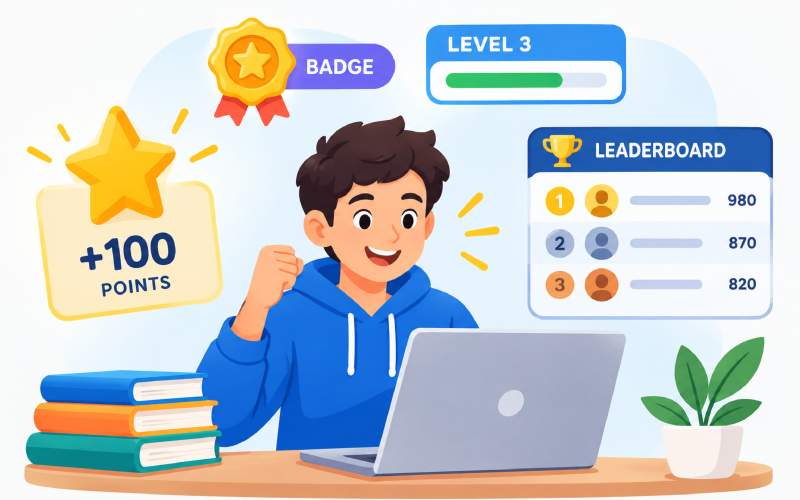
Most gamified learning systems draw from a fairly consistent toolkit of game elements:
- Points and experience (XP): Students earn measurable progress for completing tasks, similar to leveling up in a video game.
- Badges and achievements: Visual recognition for hitting specific milestones (finishing a unit, achieving a streak, mastering a skill).
- Leaderboards: Rankings that let students see how their progress compares with classmates, often used carefully to motivate rather than discourage.
- Levels and progression paths: Structured, step-by-step unlocking of new content as a student demonstrates mastery.
- Streaks and daily challenges: Short-term goals designed to build consistent study habits, popularized heavily by language-learning apps.
- Narrative and quests: Framing an assignment or unit as a “mission” or “quest” with a storyline, rather than a plain list of tasks.
These elements typically fall into two broad categories that education researchers describe as structural gamification — applying game mechanics like points and badges to existing content without changing the content itself — and content gamification, which redesigns the actual learning material to feel more like a game, such as turning a history lesson into a choice-driven narrative.
The Real Benefits of Gamification in Education
The appeal of gamification isn’t just a hunch — it’s backed by a growing body of academic research. Here’s what the evidence actually shows.
1. Stronger motivation to learn. Multiple recent classroom studies have found a majority of students report feeling more motivated in gamified courses than in traditionally taught ones, with several surveys putting that figure between roughly two-thirds and 70% of students.
2. Measurable gains in learning outcomes.A widely cited 2023 meta-analysis reviewed over 40 studies. These studies included more than 5,000 student participants. The analysis found strong benefits from gamified teaching methods. Students achieved better learning outcomes than traditional instruction. Later research reported similar results in university courses. These results also included math-heavy subjects. Students often outperformed peers without game-based learning elements.
3. Better engagement and lower dropout risk. Because gamification introduces short-term, visible goals, it tends to keep students returning to material more consistently rather than disengaging after an initial burst of interest, which researchers link to reduced dropout in both K-12 and online course settings.
4. Improved resilience and a growth mindset. Game-style systems normalize failing and retrying — you lose a level and try again rather than facing a permanent, high-stakes penalty. Over time, this can help students see mistakes as a normal part of learning rather than something to fear.
5. Development of soft skills. Team-based gamified activities, like house systems or group quests, also tend to build collaboration, communication, and teamwork skills alongside the core academic content.
6. Scalability through ed-tech. Digital gamification tools make it realistic to personalize pacing and feedback for large classes or fully online cohorts in a way that would be far harder to do manually, which is a major reason gamified e-learning platforms have grown so quickly in the last few years.
Taken together, this is why “benefits of gamification in education” has become such a common search — the case isn’t just theoretical anymore; it’s supported by a meaningful and growing base of classroom research.
Real-World Examples
Gamification in education isn’t limited to a single subject or age group. A few well-known examples illustrate how differently it can be applied:
- Language learning apps popularized daily streaks, XP points, and leveling systems to keep millions of users practicing consistently, turning vocabulary drills into a habit-forming daily routine rather than a chore.
- Classroom quiz platforms turn ordinary review sessions into live, competitive games with real-time leaderboards, commonly used for quick formative assessment.
- “House” or team-point systems in K-12 schools convert good behavior, participation, and academic performance into points that contribute to an ongoing team competition throughout the school year.
- Corporate and university training platforms use badges and certification “levels” to make compliance training or professional development feel less like an obligation and more like measurable progress.
Educational technology providers have leaned into this trend heavily, and if you want a deeper look at how ed-tech platforms specifically are building gamification into their products, this breakdown of how ed-tech uses gamification is a useful next read.
The Challenges and Limitations Worth Knowing
Gamification isn’t a guaranteed win, and the research is clear that poor implementation can backfire. A few honest limitations to keep in mind:
- Design quality matters more than the tools. Adding badges and points rarely improves unchanged lessons. Thoughtful content design usually creates stronger learning experiences.
- Leaderboards can discourage students. Low-ranked students may lose interest instead of competing. Many educators prefer personal progress tracking or small-group leaderboards.
- Cost and setup time matter. Schools need money to build or license gamified systems. Teachers also need training to use these systems effectively. Schools must maintain these systems over time.
- Equity remains an important concern. Gamified platforms often require reliable devices and internet access. Not every student has equal access outside school. This difference can increase existing learning gaps.
- Novelty eventually wears off. Students may lose interest in new badges or apps. Engagement can decline when novelty drives the experience. Strong educational content must support long-term engagement.
None of this means gamification doesn’t work — it means it works best as a thoughtfully designed layer on top of solid teaching, not as a substitute for it.
Where Gamification in Education Is Headed Next
A few clear trends are shaping the next phase of gamified learning:
- Integration with immersive technology. Virtual and augmented reality are increasingly being combined with gamified mechanics to create fully interactive learning environments rather than flat, screen-based ones.
- Adaptive, personalized gamification. Instead of one-size-fits-all point systems, newer platforms adjust difficulty, pacing, and rewards based on an individual student’s performance and engagement patterns.
- Rapid market growth. Analysts tracking the broader gamification market — spanning education, corporate training, and consumer apps — project it will continue growing sharply through the late 2020s, driven largely by demand from digital and blended learning environments.
- Mobile-first design. With the overwhelming majority of students now carrying smartphones, gamified learning tools are increasingly built mobile-first rather than being adapted from desktop software after the fact.
How to Start Implementing Gamification (Without Overcomplicating It)
For educators or ed-tech teams wondering where to begin, the research consistently points toward starting small and building up rather than trying to gamify an entire curriculum at once.
Start with one unit, not the whole course. Pick a single topic or module and add two or three game elements — say, points for completed practice problems and a badge for mastering the unit — before expanding further. This makes it far easier to see what’s actually working.
Tie rewards to effort and mastery, not just speed. Systems that reward only the fastest or highest-scoring students tend to demotivate everyone else. Progress-based rewards, streaks, and “personal best” tracking generally produce more consistent engagement across a whole class.
Make failure genuinely low-stakes. One of the biggest advantages of a game-like structure is the freedom to retry without real penalty. If a gamified quiz still carries the same weight and anxiety as a normal high-stakes test, most of the motivational benefit disappears.
Use leaderboards carefully. Small-group or self-comparison leaderboards (“your best score” vs. “the whole class”) tend to work better for struggling students than full-class rankings, which can discourage the students who need motivation most.
Get feedback directly from students. What feels rewarding varies a lot by age group and by individual student. A quick survey after a few weeks of a gamified unit — asking what motivated them and what felt pointless — is often more useful than any generic best-practices list.
Track outcomes, not just engagement. Higher enthusiasm doesn’t automatically mean better learning. Comparing quiz scores, completion rates, or skill assessments before and after introducing gamified elements is the only reliable way to know if it’s actually working for a specific group of students.
This approach matches recommendations from existing research. Gamification works best as an ongoing design process. Teachers should test, improve, and adjust gamified learning methods. They should avoid treating gamification as a one-time feature.
Frequently Asked Questions
What is gamification in education? It’s the use of game design elements — points, badges, levels, and leaderboards — inside ordinary, non-game learning environments to boost student motivation and engagement, without turning the lesson itself into a full game.
What are the main benefits of gamification in education? Research points to stronger motivation, measurable improvements in learning outcomes, better long-term engagement, reduced dropout risk, improved resilience toward failure, and stronger collaboration skills when gamification is well designed.
Is gamification the same as game-based learning? No. Gamification adds game mechanics on top of existing content, while game-based learning uses an actual game as the primary teaching method itself.
Does gamification work for all age groups? Yes, though the specific mechanics differ — younger students often respond well to badges, house-point systems, and simple progress bars, while older students and adult learners tend to respond more to structured leveling systems, certifications, and personalized feedback.
What’s the biggest risk of using gamification poorly? Treating it as a surface-level add-on — points and badges layered onto unchanged content — rather than genuinely redesigning the learning experience tends to produce weak or short-lived results.
Final Thoughts
Gamification in education now goes beyond simple novelty. Teachers use game elements to improve learning experiences. Research shows gains in motivation, engagement, and academic performance. However, gamification does not guarantee better results alone. Schools need thoughtful strategies for effective gamified learning. Teachers must choose game elements that support learning goals. Good platforms also make these choices easier. Well-designed gamification can increase student participation. It can also encourage students to return willingly.

Julian Thorne is a distinguished Technical Strategist and Fintech Analyst with over 6 years of experience in digital payment architectures. Specializing in the integration of high-performance gateways like Xendit, he focuses on optimizing the intersection of gamification and online ticketing systems. Julian’s expertise lies in deconstructing complex payment flows and enhancing sales effectiveness through data-driven insights. His recent work deeply explores the evolution of digital event platforms in 2026, providing actionable strategies for global summits and large-scale ticketing infrastructures.
Learn more about our team OR Get in touch