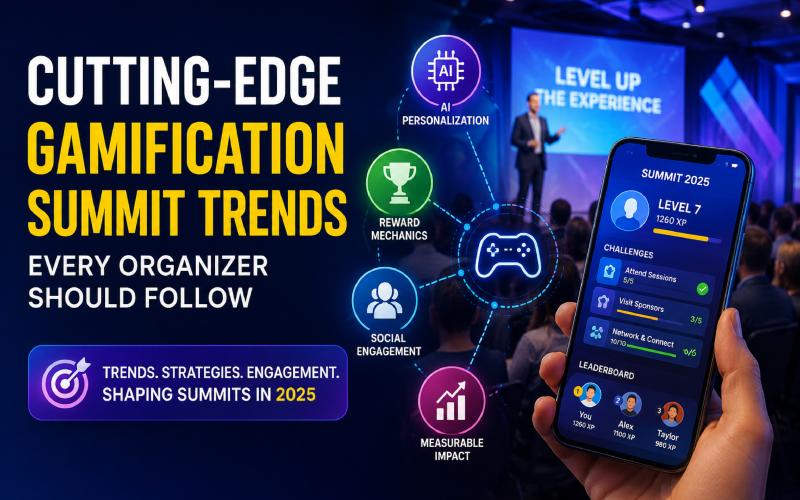
Organizers invest significant budgets into gamification summits, yet many still treat gamification as a novelty layer rather than a core engagement architecture. The result is often a disengaged room, low app adoption, and sponsors who do not return. The fix starts with the trends reshaping how top-tier gamification summits actually operate.
The State of Gamification Summits: What the Numbers Say
The global gamification market was valued at $29.11 billion in 2025, and analysts at Mordor Intelligence project it will reach $112.32 billion by 2031, a compound annual growth rate of 25.24%. That trajectory puts real pressure on summit organizers to keep pace with attendee expectations.
Within the events sector specifically, the shift toward AI is well documented. According to American Express GBT’s Meetings & Events Global Forecast, AI is the top tech focus for 50% of meeting planners, with 42% specifically using or planning to use AI for attendee matchmaking.
These figures set the baseline for what a cutting-edge gamification summit needs to deliver. Attendees increasingly expect personalized journeys, real-time feedback, and mechanics that feel native to the event rather than added on top of it.
Gamification Summit Trends at a Glance
The table below maps seven mechanics currently shaping gamification summit design, along with typical setup time and where each one fits best.
| Trend / Mechanic | Setup Time | Best Fit |
| AI-Driven Personalization | 15–30 min | Events with existing attendee profile data |
| Behavioral Reward Loops | 30–60 min | Any scale, low complexity to start |
| Hybrid Mechanics (Live+App) | 1–2 hr | Events with remote and in-person attendees |
| AR/VR Immersion | 2–4 hr | Larger budgets, novelty-focused activations |
| Blockchain-Backed Rewards | 3–6 hr | Credentialing and professional development events |
| Social-First Leaderboards | 15–20 min | Events prioritizing visible competition |
| Post-Event Gamification | 30–45 min | Organizers building a year-round community |
Trend 1: AI-Personalized Gamification Replaces One-Size-Fits-All Scoring
The clearest shift at high-performing gamification summits is the move from generic point systems to AI-driven personalization. Instead of awarding the same points to every attendee who visits a booth, AI platforms increasingly analyze session history, interests, and behavioral signals to serve challenges matched to each person.
Event AI agents that learn from registration data, app activity, and session choices can meaningfully cut the manual planning time needed for gamification design. The Pedowitz Group, an AI-focused marketing and events consultancy, describes shifting this planning work from 10 to 16 hours down to 60 to 120 minutes using AI guidance and real-time optimization, based on their own client engagements.
What organizers should act on: segment your attendee list into at least three cohorts, such as first-timers, returning delegates, and VIP sponsors, before your next summit. Assign distinct mission tracks to each cohort and use your event app analytics to adjust point thresholds mid-event based on real participation data.
Trend 2: Behavioral Science Drives Reward Architecture
Top gamification summits increasingly embed behavioral science into their reward architecture rather than relying on arbitrary point systems. Four psychological principles consistently show up in what works at live events.
| Principle | Why It Works | Summit Example |
| Variable Reward Schedules | Unpredictable prizes sustain engagement more reliably than fixed rewards | Session check-ins with random bonus points |
| Social Proof Loops | Leaderboards signal desirable behavior to peers | Live attendee rankings on the event app |
| Progress & Completion Bias | People tend to finish what they start (the Zeigarnik effect) | Progress bars for expo hall stamp cards |
| Loss Aversion Triggers | Fear of losing a streak often outweighs the appeal of a reward | Daily streak bonuses that reset at midnight |
Variable reward schedules in particular, where prizes appear at unpredictable intervals, tend to sustain engagement longer than fixed-ratio systems where every fifth action triggers a reward. The unpredictability taps into the same psychological pattern that keeps many mobile games engaging over time.
Trend 3: Hybrid Mechanics Unify Physical and Digital Attendees
Hybrid events have moved past the awkward two-screen divide. Leading gamification summits now design mechanics that deliberately connect physical and digital participants, which requires intentional design rather than just adding a livestream feed.
- QR-gated social challenges: attendees post about the event on social media, then locate a staff member with a hidden badge code to scan for points, turning digital sharing into a physical activity.
- Strategic QR placement: high-value codes placed in quieter exhibit areas pull foot traffic toward booths in lower-traffic zones, which sponsors in those spots benefit from directly.
- Survey-linked rewards: feedback stations award points immediately after a submission, which tends to lift both survey response rates and overall engagement.
- Virtual scavenger hunts: remote attendees complete digital challenges that mirror in-person booth visits, keeping participation roughly comparable across both formats.
The underlying design principle stays constant: every mechanic should offer a similar emotional payoff, recognition, progress, and social status, whether the attendee is in the room or joining from another timezone.
Trend 4: Ticket Sales Strategy Shapes Gamification Expectations
How organizers position gamification mechanics during the ticket-sales phase directly shapes attendee expectations and post-event satisfaction. Summits that communicate specific features, named challenges, prize tiers, and leaderboard structure, during registration tend to see stronger pre-event app adoption. For more on the ticket-buying side of this, see our guide to the GamificationSummit ticket sale website.
This also affects sponsor economics. When attendees know in advance that visiting a sponsor booth unlocks a specific challenge, sponsor traffic becomes more predictable, which makes sponsorship packages easier to price.
Action item: add a gamification preview section to your registration confirmation email. Name a few specific mechanics, show a screenshot of the leaderboard, and describe the top prize.
Trend 5: Post-Event Gamification Extends Engagement Beyond the Venue
Most gamification summit strategies end the moment the closing keynote finishes, which leaves value on the table. The window immediately after a summit closes tends to be a high-intent period for content consumption and referral sharing.
- Content completion challenges: attendees earn badges for watching recorded sessions within a set window after the event closes.
- Referral point systems: sharing the summit recap page earns points redeemable at the next event.
- Community leaderboards: points from in-person activities carry over to a year-round digital community, keeping the summit’s social graph active between editions.
Organizers looking to build on this can review the software powering gamification summits in 2026 to identify platforms that support post-event mechanics natively.
Trend 6: Blockchain-Backed Rewards Add Verifiable Value
A small but growing number of gamification summits issue digital rewards on blockchain infrastructure, making achievements verifiable and portable. The practical benefit for non-crypto-native summits: blockchain-issued badges cannot be forged, do not expire, and can travel with the attendee to a LinkedIn profile or professional portfolio. For credentialing and professional development events, this adds tangible value to participation. Several event-technology platforms now offer this as a feature layer requiring no cryptocurrency knowledge from either the organizer or the attendee.
Two Gaps Most Organizers Should Close
Gap 1: Sponsor-Mechanic Alignment
Most gamification summit strategy focuses on attendee engagement alone. A largely unrealized opportunity sits in sponsor-mechanic alignment. When organizers co-design gamification mechanics with sponsors, rather than selling a standard booth and adding points as an afterthought, sponsor-attendee interactions tend to convert better. A sponsor who owns a specific challenge, for example completing a demo at their booth to unlock a badge, receives motivated traffic rather than passive foot traffic. This shifts the sponsor pitch from logo placement to owned attendee behavior within a measurable journey.
Gap 2: The Data Handoff Problem
Gamification platforms generate rich behavioral data: session dwell time, challenge completion, networking patterns, and content preferences by cohort. Much of this data never reaches the stakeholders who could use it. That data is valuable to four audiences: the organizer for program design, sponsors for lead qualification, speakers for content calibration, and attendees themselves as a personal takeaway. Building a structured handoff process, where each group receives a summary shortly after the event closes, turns a one-time engagement tool into a repeatable value proposition.
What to Prioritize for Your Next Summit
The right starting point depends on your event’s scale, tech stack, and audience profile.
- Under 500 attendees: start with behavioral reward loops and hybrid mechanics. Both deliver strong attendee impact without heavy setup.
- 500 to 2,000 attendees: add AI personalization and social-first leaderboards, since your attendee data is large enough for meaningful segmentation.
- 2,000+ attendees: invest in post-event gamification infrastructure and explore sponsor-mechanic alignment as a revenue stream.
One priority applies at every scale: build your data handoff process before your next summit opens. The behavioral intelligence a gamification platform generates is only worth as much as your ability to act on it.
Julian Thorne is a distinguished Technical Strategist and Fintech Analyst with over 6 years of experience in digital payment architectures. Specializing in the integration of high-performance gateways like Xendit, he focuses on optimizing the intersection of gamification and online ticketing systems. Julian’s expertise lies in deconstructing complex payment flows and enhancing sales effectiveness through data-driven insights. His recent work deeply explores the evolution of digital event platforms in 2026, providing actionable strategies for global summits and large-scale ticketing infrastructures.

Julian Thorne is a distinguished Technical Strategist and Fintech Analyst with over 6 years of experience in digital payment architectures. Specializing in the integration of high-performance gateways like Xendit, he focuses on optimizing the intersection of gamification and online ticketing systems. Julian’s expertise lies in deconstructing complex payment flows and enhancing sales effectiveness through data-driven insights. His recent work deeply explores the evolution of digital event platforms in 2026, providing actionable strategies for global summits and large-scale ticketing infrastructures.
Learn more about our team OR Get in touch