
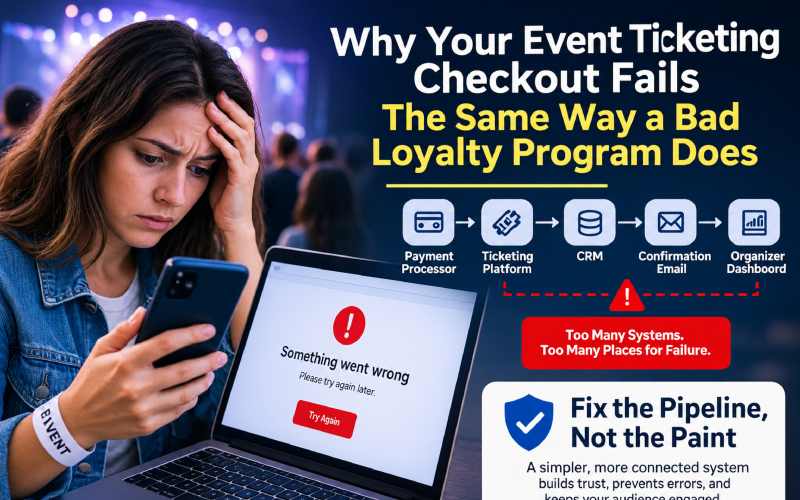
The checkout breaks. Not always, not for everyone, but often enough that every organizer has a story about it. A buyer gets three-quarters through a ticket purchase, the card field throws an error with no explanation, they refresh, and now they’re not sure if they’ve been charged once or twice. Multiply that by a few hundred transactions on a single on-sale night and you get a support inbox that looks like a crime scene.
Here’s the part that gets missed. The checkout itself is rarely the actual problem. It’s usually just the visible symptom of something happening underneath: too many systems passing a transaction between each other before it lands anywhere a human can see it clearly. Payment processor to ticketing platform to CRM to confirmation email service to organizer dashboard. Every handoff is a place where data can get mangled, delayed, or dropped entirely. Baymard Institute’s research on ticketing checkout flows found friction points stacked at nearly every stage of that chain, and most of them trace back to exactly this kind of structural sprawl rather than a single bad design decision.
The Dashboard Problem Is a Trust Problem
Organizers don’t actually want more data. They want numbers that match reality. When a dashboard shows 412 tickets sold but the bank deposit reflects something closer to 390, nobody cares about the technical explanation involving webhook delays or batch reconciliation windows. They care that the number lied to them once, and now every number on that screen carries a small asterisk of doubt.
That doubt is expensive. It’s the reason organizers call support at 11pm the night before doors open. It’s the reason finance teams build their own shadow spreadsheets instead of trusting the platform. Once a system loses credibility on one number, it loses credibility on all of them. Fixing the UI doesn’t fix that. Only fixing the pipeline does.
The Same Failure, at State Scale
This isn’t just a ticketing problem. Any system where money moves between a user and a payout, and multiple intermediaries sit in that gap, tends to break in the same place. Regulated consumer markets run into this constantly. The more licensed operators, the more processors, the more verification layers stacked between a person and their money, the harder it becomes for anyone outside the industry to tell which path is actually reliable.
California’s gambling market is a useful case study here, mostly because of how fragmented it is. Tribal gaming compacts, cardrooms, daily fantasy operators occupying a legal gray zone, and no statewide mobile sports betting framework at all as of this writing. A resident trying to figure out which licensed option actually pays out cleanly and on time is navigating roughly the same mess as an event organizer staring at a dashboard that doesn’t match the bank statement. Too many intermediaries, not enough visibility. A breakdown of what we learned after testing every option in the state found that the gap between what’s advertised and what actually clears at withdrawal time tracks almost exactly with how many separate systems a transaction has to pass through before the player sees a result.
Worth a brief, necessary aside here: regulated betting carries real financial risk, and anyone engaging with it should only ever wager what they can afford to lose, with BeGambleAware.org and GamCare as resources if it stops feeling optional.
Back to engagement systems, because the parallel holds up even tighter once you look at loyalty programs specifically.
Loyalty Programs Fail for the Exact Same Structural Reason
A loyalty program promises a simple exchange. Do this action, get that reward. Nothing about that premise is complicated. What gets complicated is the plumbing behind it: a points engine that runs on a three-day delay, a redemption catalog managed by a separate vendor, a tier system calculated monthly instead of in real time. The user does the thing. The reward shows up late, or wrong, or not at all. From their side, that’s indistinguishable from being lied to.
Engagement and revenue tracking get treated as separate departments inside most companies, which is exactly backwards. They’re the same pipeline wearing two different job titles. When one breaks, the other inherits the damage within days.
What Actually Fixes It
Cutting intermediaries sounds abstract until you watch it work in practice. A platform that handles payment, confirmation, and reporting in one connected system, rather than stitching together four vendors with four different data formats, doesn’t just run faster. It becomes legible. Organizers stop needing a translator to understand their own sales numbers.
The same logic applies to any consumer-facing system built on the promise of “do X, get Y.” The fewer hops between the action and the reward, the fewer places for that promise to quietly fail. Checkout abandonment tends to spike hardest at exactly the points where hidden fees or forced extra steps appear, which is the same lesson showing up again under a different name. Hidden steps kill trust regardless of the industry wrapped around them.
None of this means every system needs to be rebuilt from scratch. It means the next time a checkout fails or a dashboard number looks wrong, the first question shouldn’t be “what broke on screen” but “how many systems did this have to pass through to get here.” Usually that’s where the real answer is sitting.
FAQ
Why do ticketing checkouts fail more often during high-demand on-sales? Traffic spikes expose weak points in the handoff between payment processor, inventory system, and confirmation service. Under normal load those gaps go unnoticed. Under a surge, delayed syncing causes errors, double charges, or tickets showing as sold when they technically aren’t yet.
What’s the single biggest cause of dashboard numbers not matching bank deposits? Timing mismatches between systems. Sales get recorded instantly on the front end but settle with the payment processor on a delay, sometimes days. If the dashboard doesn’t account for that lag clearly, the two numbers look contradictory even when both are technically correct.
Can a loyalty program fix trust issues just by improving the app design? No. A cleaner interface hides the problem temporarily but doesn’t fix delayed point crediting or inconsistent reward tracking underneath. Users eventually notice the gap between promise and delivery again, usually at the worst moment, like during a redemption attempt.
Is reducing the number of vendors in a payment pipeline always the right fix? Usually, though not universally. Consolidation helps most when the vendors involved don’t share data cleanly. If integrations are already tight and well-monitored, the priority shifts to better reconciliation and alerting rather than vendor reduction itself.
Fixing the Pipeline, Not the Paint
A checkout that fails and a loyalty tier that updates three days late are the same complaint wearing different clothes. Somewhere between the user’s action and the system’s response, too many hands touched the data, and one of them dropped it. That’s not a design flaw you patch with a better button color. It’s an architecture decision that either holds up under real load or quietly erodes trust one broken confirmation at a time. The organizers and platforms that get this right aren’t necessarily the ones with the flashiest dashboards. They’re the ones who went looking for the extra hop and removed it before a customer ever noticed it was there.

Julian Thorne is a distinguished Technical Strategist and Fintech Analyst with over 6 years of experience in digital payment architectures. Specializing in the integration of high-performance gateways like Xendit, he focuses on optimizing the intersection of gamification and online ticketing systems. Julian’s expertise lies in deconstructing complex payment flows and enhancing sales effectiveness through data-driven insights. His recent work deeply explores the evolution of digital event platforms in 2026, providing actionable strategies for global summits and large-scale ticketing infrastructures.
Learn more about our team OR Get in touch