
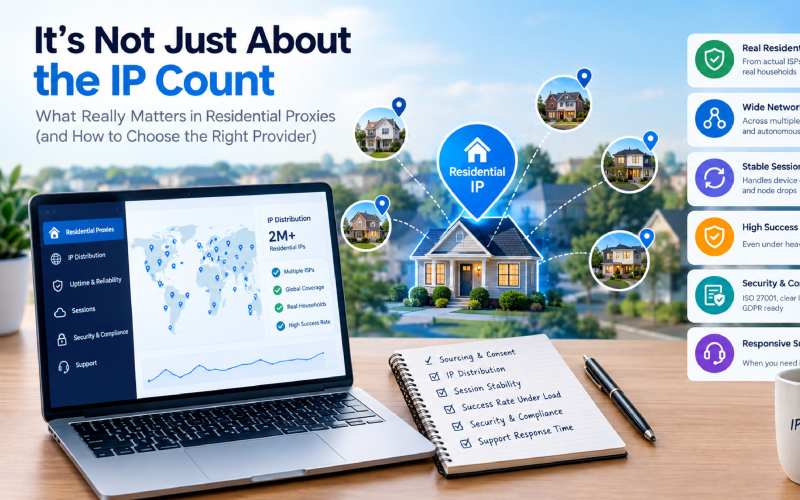
Most buyers compare price per gigabyte, pick the lowest number, and move on. Two weeks later they’re debugging a scraper that dies on every fourth request while waiting three days for a support reply.
Quality in residential networks hides in places the pricing page never mentions: how the addresses were sourced, whether a session survives a node dropping mid-crawl, what the provider does when a target site starts fingerprinting at the TLS layer. The headline IP count tells you almost nothing.
Sourcing Is the Foundation Everything Else Sits On
A residential IP has value for exactly one reason. A real internet service provider assigned it to a real household, and the sites you visit can verify that. Strip out the provenance and you’re paying residential prices for a datacenter IP with worse latency.
Plenty of pools got built by bundling SDKs into free VPN apps and flashlight utilities, with the bandwidth-sharing clause buried on page nine of a EULA nobody read. Those pools work fine until the app gets pulled from an app store and 40% of the addresses vanish over a weekend.
The alternative is a consent-first model, where participants know they’re contributing bandwidth and get compensated for it. IPRoyal offers the best residential proxy pool built on that principle, sourcing addresses through an opt-in program rather than quiet bundling. The distinction isn’t only ethical; it’s operational, because participants who agreed to the arrangement stay online far longer.
Ask any vendor three questions before signing: who consented, what were they told, and can they leave whenever they want?
Distribution Beats Raw Pool Size
Every provider leads with a big number. Ten million IPs, fifty million, a hundred million. Almost none of them publish how those addresses spread across networks, which is the figure that actually predicts block rates.
ISPs announce their address blocks to the rest of the internet using BGP, and anti-bot vendors group incoming traffic the same way. A pool of 20 million addresses concentrated in eight autonomous systems is easier to fingerprint than 2 million spread across 900 of them. Detection engines don’t count IPs, they score reputations, and reputation attaches to the block.
Verifying this takes an afternoon. Regional registries like the RIPE NCC publish which organization holds each range, so pull a sample of 200 IPs from a trial and check the spread yourself.
City-level targeting deserves the same skepticism. Some dashboards offer a city dropdown that resolves to whatever a GeoIP database guessed last quarter. Pull 50 addresses in Hamburg, run them through two independent geolocation providers, and count how many agree.
Sessions, Uptime, and Behavior Under Load
Residential nodes are consumer devices. Laptops close, phones leave WiFi, routers reboot at 3am. Good infrastructure treats that churn as a design constraint instead of an excuse for missed SLAs.
Sticky sessions are where the difference shows. If a provider promises a 30-minute session and the underlying device disconnects at minute four, what happens?
Strong networks hand the session to a neighboring IP in the same subnet and keep the cookie state intact. Weak ones drop the request and return a 502.
Success rate under concurrency is the number to demand, not raw speed. A pool that returns 99% at 50 threads and 71% at 500 threads has a queueing problem the marketing copy won’t mention.
The Boring Layer That Decides Long-Term Reliability
Infrastructure quality includes paperwork. An ISO/IEC 27001 certificate means a provider has documented its access controls, incident response, and retention rules, and that an outside auditor actually checked the documentation against practice.
Logging policy carries similar weight. Vendors that retain full request logs create a liability that eventually becomes the customer’s problem, particularly under GDPR, where responsibility follows the data rather than the invoice.
And support response time decides how bad a bad night gets. When a collection job breaks at 2am before a Monday reporting deadline, an email queue with a 48-hour turnaround is worth roughly nothing.
Where This Is Heading
IPv6 rollout and carrier-grade NAT are already blurring what a residential address signals, while detection vendors shift budget from IP reputation toward behavioral fingerprinting. Pools competing on volume alone will keep getting cheaper and keep working less often.
The providers worth a multi-year commitment are the ones publishing sourcing methods, network spread, and audited success rates before a prospect thinks to ask. That’s a short list today. Expect it to get shorter before it grows.

Julian Thorne is a distinguished Technical Strategist and Fintech Analyst with over 6 years of experience in digital payment architectures. Specializing in the integration of high-performance gateways like Xendit, he focuses on optimizing the intersection of gamification and online ticketing systems. Julian’s expertise lies in deconstructing complex payment flows and enhancing sales effectiveness through data-driven insights. His recent work deeply explores the evolution of digital event platforms in 2026, providing actionable strategies for global summits and large-scale ticketing infrastructures.
Learn more about our team OR Get in touch