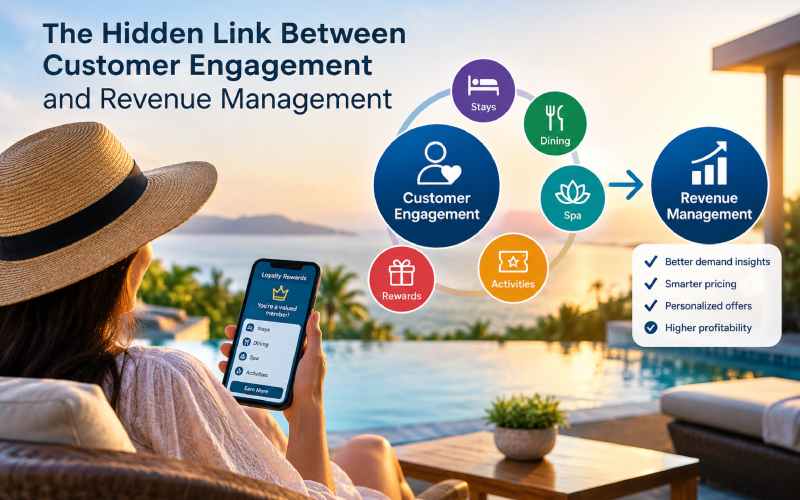
Customer engagement and revenue management often appear to belong to separate areas of a business. Engagement focuses on loyalty, experiences, participation, and relationships. Revenue management, meanwhile, concentrates on demand, pricing, availability, and profitability. Yet, beneath these different objectives lies an important connection: customer behavior can influence better revenue decisions.
Every interaction can reveal something about what a customer values. A booking, reward redemption, dining purchase, activity selection, or repeated offer view can provide useful context. When businesses connect these signals, they gain a clearer understanding of customer intent. That understanding can influence everything from personalized offers to pricing strategies. A hotel loyalty program provides a particularly useful example of how this connection works.
When a Hotel Guest Becomes More Than a Booking
Imagine a coastal resort with a loyalty program that rewards guests for stays, dining, spa treatments, and recreational activities. Members can also complete challenges to unlock additional rewards. The program is designed primarily to make the guest experience more engaging, but it creates another valuable outcome: the resort can observe how guests interact with different experiences.
One guest joins the program after booking a standard room for a weekend. During the stay, the guest spends money at the resort restaurant and books a guided excursion. Several months later, the guest returns and adds a spa treatment to the itinerary. Before the next visit, the guest repeatedly explores premium room options and checks offers connected with longer stays.
Individually, none of these actions proves that the guest wants to spend more. However, the pattern becomes meaningful when viewed together. The guest is returning more frequently, exploring additional services, spending more during visits, and showing interest in premium accommodation. Their engagement is revealing a change in behavior that a simple booking history might not capture.
The resort can therefore view this guest differently from someone who only books the lowest available room and rarely interacts with other services.
Engagement Can Reveal Changing Customer Intent
Traditional revenue management relies on important information such as occupancy, historical demand, booking patterns, seasonality, and room availability. Those factors remain essential, but they do not always explain what an individual customer may want next.
Customer engagement adds another layer of context. In the resort example, the guest’s growing interest in premium rooms and additional experiences suggests that their relationship with the property is changing. The resort could use that information when presenting future options, rather than automatically sending the same promotion to every loyalty member.
For instance, an upgrade opportunity might be more relevant than a percentage discount. A package combining a premium room with a spa experience could also create more value than a generic offer. The objective is not simply to encourage the guest to spend more. Instead, it is to present something that matches demonstrated interests.
This distinction matters because effective revenue management is not only about maximizing price. It is also about understanding demand and matching the right offer with the right customer at an appropriate moment.
Why Gamification Creates Valuable Customer Signals
Gamification can strengthen this connection because it encourages customers to interact with different parts of an experience. A resort might reward guests for trying a new restaurant, attending an event, booking a wellness activity, or exploring a seasonal attraction. These actions create measurable signals about customer preferences.
The value, however, does not come from points or badges alone. The real opportunity comes from understanding what those actions represent. A guest who repeatedly chooses wellness activities may value relaxation. Another guest might consistently participate in family experiences, while someone else may respond strongly to exclusive dining events.
Over time, these patterns can help businesses understand customer preferences more accurately. They can also reveal changes that might otherwise remain hidden until the next purchase. For revenue teams, that information can become especially useful. Instead of seeing customer engagement as a marketing metric, they can view it as another source of commercial intelligence.
Revenue Management Works Better With Customer Context
Consider the resort guest again. The business now knows that the guest books regularly, spends more on experiences, participates actively in the loyalty program, and has started exploring premium accommodation. That combination provides considerably more context than the guest’s previous booking value alone.
Suppose demand begins increasing for an upcoming holiday weekend. The resort could use broader market demand to establish its pricing strategy while also considering customer behavior when communicating with individual guests. A highly engaged guest might respond better to a relevant upgrade or experience package than to a standard discount.
This approach does not mean every engagement signal should trigger a sales message. In fact, excessive personalization can quickly become intrusive. The stronger approach is to identify meaningful patterns and use them selectively.
The result is a more informed relationship between customer experience and revenue strategy. Engagement helps explain the customer, while revenue management helps determine how the business should respond.
The Data Foundation Matters
None of this works effectively if customer information remains scattered across disconnected systems. Imagine that the guest’s room bookings are stored in one system, restaurant purchases in another, and loyalty activity somewhere else. Each system contains useful information, but no team has the complete picture.
That fragmentation can lead to missed opportunities. A revenue manager may see a returning guest without knowing that the same person has recently become highly engaged with premium experiences. Meanwhile, the loyalty team may see increasing participation without understanding its potential commercial significance.
Data quality therefore becomes an important part of revenue strategy. Businesses need consistent customer records, reliable information, and processes that connect relevant data. Without those foundations, even sophisticated analysis can produce an incomplete understanding of demand.
This becomes increasingly important as businesses introduce AI-powered capabilities into customer and revenue workflows. AI can identify patterns quickly, but the quality of those patterns depends heavily on the information available.
Connecting Engagement With Revenue Operations
Modern Salesforce environments can help businesses bring customer information and revenue processes closer together. When customer history, engagement information, sales activity, and revenue processes can work from connected data, teams gain greater context for decision-making.
For businesses exploring Salesforce’s evolving revenue capabilities, an Agentforce Revenue Management partner can help connect revenue processes with broader Salesforce operations. The technology can provide important capabilities, but successful implementation still depends on understanding the business process behind the technology.
Experienced professionals need to determine which signals are genuinely valuable, how customer information should be structured, and where those insights should influence decisions. Otherwise, businesses risk collecting more information without actually improving their decision-making.
One Guest Can Reveal a Much Bigger Pattern
Return to the resort guest. Their journey began with an ordinary weekend booking. Over time, however, their behavior revealed something more significant. They started exploring premium rooms, spending more on resort experiences, returning more frequently, and participating actively in the loyalty program.
The resort could use those signals to understand that the guest’s needs were evolving. More importantly, the same process could reveal broader trends across thousands of customers. If highly engaged guests consistently begin exploring premium rooms, for example, that behavior could indicate emerging demand.
This is where customer engagement becomes particularly valuable to revenue management. Engagement can act as an early indicator of changing customer interests before those interests appear clearly in traditional sales data.
From Engagement to Smarter Revenue Decisions
The connection between customer engagement and revenue management is ultimately about context. A booking tells a business what a customer purchased. Engagement can reveal what the customer is exploring, considering, and valuing.
When those signals are connected, businesses can make more informed decisions about pricing, offers, experiences, and customer relationships. Gamification can encourage meaningful interactions, while revenue management can provide a framework for understanding their commercial significance.
The goal should not be to turn every customer interaction into a sales opportunity. Instead, businesses should use engagement to understand customers more effectively and respond to genuine changes in behavior.
That approach can create better experiences while helping revenue teams recognize opportunities earlier. In the end, the hidden link is straightforward: customer engagement generates valuable signals, while revenue management gives those signals commercial meaning.
For a hotel, that might begin with a guest earning points for a spa visit. Yet, when combined with booking history, spending patterns, and growing interest in premium experiences, that small interaction can become part of a much larger picture of customer demand.

Julian Thorne is a distinguished Technical Strategist and Fintech Analyst with over 6 years of experience in digital payment architectures. Specializing in the integration of high-performance gateways like Xendit, he focuses on optimizing the intersection of gamification and online ticketing systems. Julian’s expertise lies in deconstructing complex payment flows and enhancing sales effectiveness through data-driven insights. His recent work deeply explores the evolution of digital event platforms in 2026, providing actionable strategies for global summits and large-scale ticketing infrastructures.
Learn more about our team OR Get in touch