
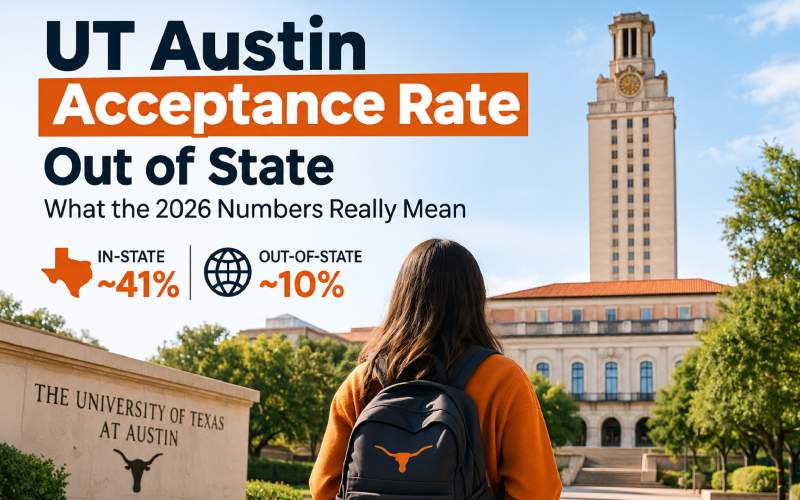
An out-of-state applicant to UT Austin faces long odds hidden behind one misleading headline number. Texas law sets aside roughly 90 percent of seats for state residents, so the university’s overall acceptance rate tells nonresident families almost nothing about their real chances. The UT Austin out of state acceptance rate sits closer to 10 percent, and this guide breaks down the current data, the state rules behind it, and the steps that still move the needle.
UT Austin Acceptance Rate Out of State: The Current Numbers
UT Austin admitted about 20,154 students from a record 90,690 freshman applications for the class entering in fall 2025, an overall acceptance rate of 22.2 percent. That headline figure blends two very different applicant pools: Texas residents, most of whom compete under automatic admission rules, and out-of-state or international applicants, who go through full holistic review.
For the most recent cycle with a published residency breakdown, UT Austin received roughly 23,015 nonresident applications and admitted about 2,332 of them, a rate of approximately 10 percent. The in-state acceptance rate for the same period runs closer to 41 percent, which shows the size of the gap in plain terms.
| Metric | Figure |
| Overall acceptance rate (fall 2025 entering class) | 22.2% |
| Out-of-state acceptance rate | ~10% |
| In-state acceptance rate | ~41% |
| Freshman applications (fall 2025) | 90,690 |
| Students admitted (fall 2025) | ~20,154 |
| Entering class size (fall 2025) | ~9,900 |
| Nonresident share of the entering class | ~10% |
Why the Out-of-State Rate Sits So Far Below the Overall Rate
Texas law, not university preference, creates the gap. State statute requires UT Austin to fill about 75 percent of its Texas resident seats through automatic admission, which guarantees a spot to students who graduate in a set top percentage of their Texas high school class. Starting with the class entering in fall 2026, the university lowered that automatic threshold from the top 6 percent to the top 5 percent, a change driven by application growth and legislative rank rules.
Because the law also caps nonresident enrollment near 10 percent of each entering class, the math works against out-of-state applicants before an admissions officer reads a single essay. A class of roughly 9,900 students leaves about 990 seats for every nonresident and international applicant combined, against tens of thousands of applications from outside Texas. That fixed ceiling, not a drop in applicant quality, explains why the ut austin out of state acceptance rate holds near 10 percent even as the overall rate moves up or down.
Selective majors compress the odds further. Engineering, computer science, and the McCombs School of Business review nearly every out-of-state applicant holistically, and demand for those programs regularly exceeds demand for the university as a whole.
UT Austin Acceptance Rate Trend, 2020 to 2025
Selectivity at UT Austin has tightened every year as applications climbed and the university held admit totals close to flat. The table below tracks five admissions cycles using the university’s own Common Data Set and federal IPEDS filings, plus the most recent fall 2025 figures.
| Cycle | Applications | Admits | Admit rate |
| 2020-21 | 57,241 | 18,290 | 32.0% |
| 2021-22 | 66,077 | 19,162 | 29.0% |
| 2022-23 | 60,055 | 18,830 | 31.4% |
| 2023-24 | 66,109 | 19,253 | 29.1% |
| 2024-25 | 72,885 | 19,417 | 26.6% |
| Fall 2025 (class of 2029) | 90,690 | ~20,154 | 22.2% |
Applications rose 51 percent between 2022 and 2025 while admitted totals grew only modestly, which pushed the overall rate down by roughly ten percentage points in five years. Yield, the share of admitted students who enroll, has stayed unusually high for a large public university, holding near 47 to 49 percent across the same window, a sign that most students who get an offer still choose UT Austin over other options.
UT Austin Ranking Among Public Universities
The UT Austin ranking helps explain why demand keeps rising even as the admit rate falls. In the U.S. News and World Report Best Colleges rankings released for 2026, UT Austin held the following positions.
| Ranking category | Position |
| Public universities in Texas | No. 1 |
| Public universities nationally | No. 7 |
| National universities overall (public and private) | No. 30 |
The same ranking cycle placed 24 UT Austin undergraduate programs in the national top 10, including accounting, finance, and marketing in the McCombs School of Business, and petroleum, chemical, and civil engineering in the Cockrell School of Engineering, according to the university’s official announcement. A rising national profile widens the applicant pool every year, which keeps direct pressure on the ut austin acceptance rate out of state even as the university expands class size.
What Out-of-State Applicants Can Still Control
State law fixes the size of the nonresident pool, but it does not fix who fills it. Three factors move an individual applicant’s odds within that fixed ceiling.
Major choice carries the most weight. A student who applies to a lower-demand college within the university, then transfers internally after building a strong first-year record, often faces better odds than the same student applying directly to engineering or business as a freshman.
Academic rigor matters more for out-of-state files because automatic admission does not apply outside Texas. Every nonresident application goes through full holistic review, so class rank substitutes, such as a strong course load relative to what a high school offers, along with test scores and essays, carry the full weight that Texas rank rules would otherwise carry for a resident.
Application timing also plays a role. UT Austin reviews under a priority deadline, and nonresident seats fill from a pool that is smaller and more competitive than the resident pool, so a complete file submitted early avoids space constraints that build later in the cycle.
UT Austin Mascot and Campus Identity
Away from admissions statistics, the UT Austin mascot is Bevo, a live Texas Longhorn steer who has represented the university at football games and campus events since 1916. Students and alumni pair Bevo’s appearances with the Hook ’em Horns hand sign, a gesture that doubles as unofficial shorthand for university pride at UT Austin sporting events nationwide.
Campus identity and school spirit do not affect admission decisions, but they help explain the surge in applications that has driven the acceptance rate down. National visibility from Longhorn athletics, combined with rising academic rankings, keeps UT Austin near the top of application lists for students who live far outside Texas.
Frequently Asked Questions
Is UT Austin harder to get into as an out-of-state applicant?
Yes. Out-of-state applicants compete for roughly 10 percent of each entering class and receive no benefit from the automatic admission rules that apply to Texas residents, so the effective acceptance rate runs well below the university’s overall published rate.
What GPA do out-of-state students need for UT Austin?
Most admitted students, resident and nonresident alike, present a GPA between 3.7 and 4.0. A strong course load and consistent performance across four years matter as much as the raw number, since holistic reviewers read the full transcript rather than a single figure.
Does UT Austin offer automatic admission to out-of-state students?
No. Automatic admission under Texas’ top percent rule applies only to graduates of accredited Texas high schools. Every out-of-state applicant goes through holistic, individualized review regardless of class rank.
Has the UT Austin acceptance rate out of state changed recently?
The nonresident rate has held close to 10 percent across recent cycles even as the overall rate declined, because Texas law caps the nonresident share of each class at a fairly fixed level regardless of how many students apply.
The Bottom Line for Out-of-State Applicants
The ut austin acceptance rate out of state reflects a fixed legal ceiling far more than it reflects any single applicant’s qualifications. Families who understand the 90-10 residency split, the fully holistic nature of nonresident review, and the pull of a rising UT Austin ranking can build a realistic application strategy instead of relying on the overall admit rate alone.
Sources
UT Ranks As No. 1 Public University in Texas, No. 7 Nationally, UT Austin News, September 2025.
The University of Texas at Austin: Inside the Numbers, College Transitions, using UT Austin Common Data Set and IPEDS filings.
UT Austin Acceptance Rate 2026, fall 2025 application and admit figures, Empowerly, citing UT Austin admissions data.

Julian Thorne is a distinguished Technical Strategist and Fintech Analyst with over 6 years of experience in digital payment architectures. Specializing in the integration of high-performance gateways like Xendit, he focuses on optimizing the intersection of gamification and online ticketing systems. Julian’s expertise lies in deconstructing complex payment flows and enhancing sales effectiveness through data-driven insights. His recent work deeply explores the evolution of digital event platforms in 2026, providing actionable strategies for global summits and large-scale ticketing infrastructures.
Learn more about our team OR Get in touch