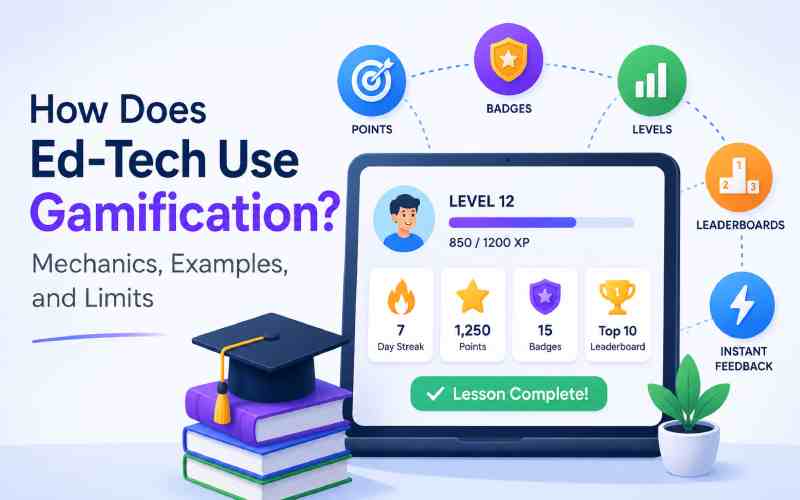
Ed-tech platforms use gamification by borrowing specific mechanics from games, streaks, points, badges, levels, and leaderboards, and applying them to learning tasks to make progress visible and feedback immediate. The goal is not to turn a lesson into entertainment. It is to close the gap between finishing a task and seeing evidence that the effort mattered. This guide breaks down exactly how that works, which platforms do it well, and where the approach runs into real limits.
The Core Mechanics Ed-Tech Borrows From Games
Most gamified ed-tech platforms rely on a small set of repeatable mechanics rather than inventing something new for every course.
- Streaks: a visible count of consecutive days a learner has practiced, which creates a small cost to skipping a day.
- Points and experience: numeric feedback awarded for completing a lesson or answering correctly, giving learners a running score.
- Badges and levels: milestone markers that signal mastery or completion, often unlocking new content once reached.
- Leaderboards: a ranked comparison against peers, which taps into social motivation rather than purely individual progress.
- Instant feedback: a right-or-wrong signal delivered immediately after a response, rather than days later on a graded assignment.
How Real Ed-Tech Platforms Apply These Mechanics
The mechanics above look similar on paper, but different platforms combine them differently depending on the subject and the learner.
| Platform | Primary Mechanic | Subject Area |
| Duolingo | Streaks, XP, leaderboards | Language learning |
| Kahoot! | Live competitive quizzes | K-12 and corporate training |
| Classcraft | Behavioral rewards, team collaboration | K-12 classroom management |
| Brainscape | Spaced repetition with achievement tracking | Test prep and long-term retention |
| Unacademy | Streaks, badges, leaderboards | Exam preparation |
Duolingo pairs streaks with XP and leaderboards to build a daily habit around language practice. Kahoot! leans on live, competitive quizzes that work well in a classroom or training session where everyone participates at the same time. Classcraft ties rewards to collaborative and behavioral goals rather than individual quiz scores, which suits classroom management more than test prep. Brainscape uses spaced repetition, a memory technique, paired with achievement tracking rather than social competition, aiming at long-term retention over short-term engagement.
Why Instant Feedback Matters More Than the Points Themselves
The mechanic doing the most work in gamified ed-tech is not the badge or the leaderboard position. It is the speed of feedback. Traditional homework returns a grade days after the effort was made, by which point the learner has often forgotten the reasoning behind their answer. A gamified platform delivers a right-or-wrong signal within seconds, while the context is still fresh.
This same principle explains why collecting and completion feel rewarding to learners in general: the brain responds to a visible marker of progress more strongly than to an abstract promise that effort will pay off eventually.
Where AI Is Changing Ed-Tech Gamification
The more recent shift in ed-tech gamification is adaptive difficulty. Rather than giving every learner the same fixed quiz, AI-driven platforms adjust question difficulty in near real time based on how a learner is performing, aiming to keep the task challenging without becoming discouraging. This moves gamification from a static reward layer into something closer to a personalized difficulty curve.
Where Gamified Ed-Tech Falls Short
Gamification in education is not a guaranteed improvement, and treating it as one leads to predictable problems.
- Reward dependency: learners can start performing for the badge rather than for understanding, which shows up as effort that drops sharply once the reward system is removed.
- Distraction from the material: when the game layer becomes more complex than the lesson itself, attention shifts to optimizing the game rather than learning the content.
- Uneven access: gamified platforms assume reliable devices and internet access, which is not universal, and can widen gaps between students rather than closing them.
- Design overhead: building a genuinely balanced gamified curriculum takes meaningfully more planning time than a traditional lesson plan, which is easy to underestimate.
These same design tradeoffs, extrinsic reward versus genuine engagement, show up outside the classroom too. Our piece on how simulations reduce student stress in engineering education covers a related case where the mechanic is simulation rather than points, with a similar set of tradeoffs.
Frequently Asked Questions
Does gamification actually improve learning outcomes, or just engagement?
The strongest evidence supports engagement and habit formation, showing up as more consistent practice and lower drop-off rates. Whether that translates into deeper learning depends heavily on how well the game mechanics are tied to genuine understanding rather than surface-level activity.
Is gamification appropriate for adult learners, or just K-12?
Adult-focused platforms use the same mechanics. Streaks and spaced repetition, in particular, work well for adult skill-building and exam preparation, not just classroom settings.
What is the simplest way to start using gamification in a course?
A basic points system or a weekly leaderboard is usually the easiest starting point. Adding one or two mechanics and measuring the effect on completion rates before adding more tends to work better than launching a fully built system at once.

Julian Thorne is a distinguished Technical Strategist and Fintech Analyst with over 6 years of experience in digital payment architectures. Specializing in the integration of high-performance gateways like Xendit, he focuses on optimizing the intersection of gamification and online ticketing systems. Julian’s expertise lies in deconstructing complex payment flows and enhancing sales effectiveness through data-driven insights. His recent work deeply explores the evolution of digital event platforms in 2026, providing actionable strategies for global summits and large-scale ticketing infrastructures.
Learn more about our team OR Get in touch