
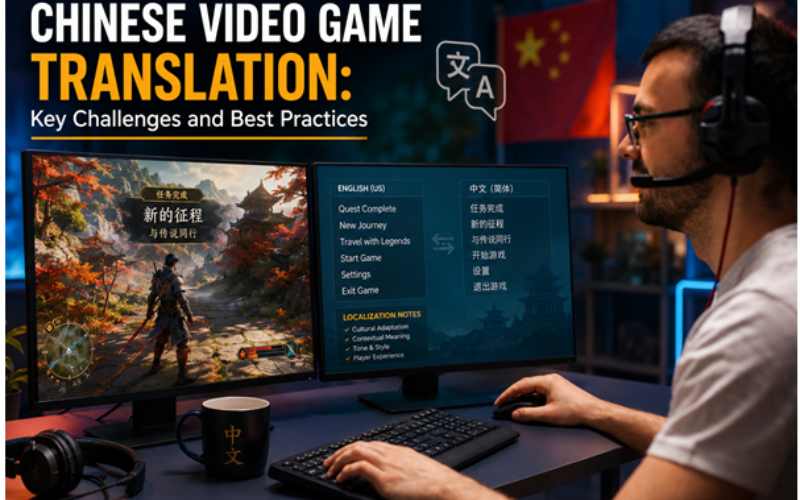
A game takes three years to develop. Then it loses half its audience in one bad afternoon of subtitles. That is the risk behind every Chinese title chasing a global launch. Studios pour money into combat systems and art design. The script becomes a final checklist item. When dialogue feels unnatural, it can become one of the first things players mention in reviews, even when the game itself performs well. video game translation services exist because this gap keeps repeating.
Why The Gap Keeps Showing Up
Chinese games are heavily based on classical literature and history and are rife with four-character idiom-based sayings. The phrase’s meaning often stems from a pun on words or the context in which it is used or the associations that have developed around it over time, while English does not always have an equivalent expression. A translator working line by line, with no picture of what is happening on screen, picks the safest literal phrase. That phrase is usually correct. Flat dialogue breaks immersion faster than a visual bug ever could.
The second problem is more practical. Localization teams rarely receive a game script as one complete, readable story. Much of the content comes through spreadsheets, databases, or localization platforms. Dialogue branches split across dozens of rows with no order attached. Without additional context, a linguist may have to guess who the speaker is, what tone they are using, and how the message relates to other characters or the situation the text is in. This is one of the situations where video game localization can go wrong.
Common Mistakes Studios Make
Timing is usually the first mistake. Localization gets scheduled near the end of production, after the writing team has already spent a year on the script. Translators are then given weeks to match that year of work. Tight deadlines push teams toward safe, literal choices, since there is no time left to test lines with voice actors or run them past testers.
Inconsistent terms come next. Without a shared glossary, one translator names a weapon one way in the tutorial. A different translator renames it two chapters later. Players who read patch notes catch this instantly. It reads as sloppy work, even when the actual translation skill behind it is strong.
Cultural details get erased too often. Some teams cut anything that feels distinctly Chinese, worried it will confuse a Western player. This trade often backfires. Players are drawn to games that feel rooted in a specific place and history. Sanding a story down into something generic tends to weaken it rather than protect it.
A Better Way To Approach It
Localization works better when it begins alongside the writing process rather than after the script is finished. Bringing linguists into early script reviews lets them identify risky lines before voice recording locks those lines in place. A working glossary matters more than most schedules account for. One shared document that defines character names, faction terms, and recurring phrases keeps every translator aligned. Providing this context can reduce unnecessary back-and-forth and give translators a better basis for their decisions.
Teams should handle cultural terms individually rather than follow one fixed rule. Some words translate cleanly into English, while others carry cultural references that direct translations would erase. In those cases, teams can keep the original term and provide enough context for new players to understand its meaning naturally. Teams that understand the game’s setting, genre, and cultural background can make these decisions more effectively. Careful judgment matters more than raw speed.
A Real Case: Black Myth: Wukong
Game Science’s Black Myth: Wukong is a documented example of this exact decision. The studio’s internal style guide told linguists to keep terms like “jingubang” and “yaoguai” in pinyin, instead of swapping them for plain English words like “staff” or “monster.” Sun Wukong kept his Chinese name throughout, rather than becoming “the Monkey King.”
This approach helped preserve some of the game’s Chinese cultural identity, although it also created challenges for players unfamiliar with the source material. It preserved references to the game’s Chinese literary and mythological roots rather than replacing them with more familiar Western fantasy terms. Some reviewers found that certain parts of the story were difficult to follow without knowing the mythology behind them. The game still topped Steam’s concurrent player charts at launch. That result shows a gaming translation does not need to be flawless to succeed. It needs to be deliberate, tested, and backed by a team that weighed the trade-offs before release, not after players pointed them out.
What This Means For The Industry
Overseas sales are no longer a mere source of supplementary income for Chinese studios. According to the China Audio-Video and Digital Publishing Association, Chinese games generated over 20.45 billion dollars in revenues in foreign markets last year, securing the sixth consecutive year of sales of over 14 billion. At this level, a mediocre script will no longer simply prompt a few negative reviews; it will carve out a chunk of the revenue stream in markets comparable to the domestic one in size.
Chinese studios get better results when they treat localization as part of the development process rather than a final polishing stage. In many ways, good localization serves as a second writing pass. It requires cultural judgment, early collaboration, and enough time to test whether the dialogue sounds natural to the target audience. When studios involve localization teams early, they can carry the game’s story, terminology, and cultural identity into new markets without unnecessary changes instead of launching with half the story lost along the way.

Julian Thorne is a distinguished Technical Strategist and Fintech Analyst with over 6 years of experience in digital payment architectures. Specializing in the integration of high-performance gateways like Xendit, he focuses on optimizing the intersection of gamification and online ticketing systems. Julian’s expertise lies in deconstructing complex payment flows and enhancing sales effectiveness through data-driven insights. His recent work deeply explores the evolution of digital event platforms in 2026, providing actionable strategies for global summits and large-scale ticketing infrastructures.
Learn more about our team OR Get in touch