Many B2B companies still treat event sponsorship and booth branding as a “nice-to-have” line item rather than a measurable growth driver. Marketing budgets often prioritize paid lead generation and demand-gen campaigns because those activities are easier to track. But for companies that invest in sponsoring or exhibiting at gamification and event-technology summits specifically, the real question is not “what does a well-branded booth cost?” but “what does an inconsistent, forgettable one cost us in lost pipeline?”
The B2B Buying Journey Now Runs Through Events
Modern B2B buyers complete a significant portion of their vendor research before ever booking a call, and event attendance has become part of that research phase. A buyer walking a summit floor is comparing vendors in real time: which booth looks credible, which sponsor speaks with authority during a session, which brand shows up consistently across the app, the signage, and the swag table.
A sponsor with inconsistent messaging or a generic booth setup signals higher risk to a buyer who is already comparing several vendors in the same room. A sponsor with a clear, consistent brand presence signals stability and expertise before a single sales conversation happens.
Research Shows Event Branding Drives Revenue, Not Just Visibility
Across B2B sectors, companies with stronger, more consistent brand presence at events tend to see a similar pattern: more qualified booth conversations, higher conversion from scanned lead to sales-qualified opportunity, and shorter sales cycles after the event closes. Branding works at events for the same reason it works everywhere else: it reduces the buyer’s perceived risk before the first real sales conversation takes place.
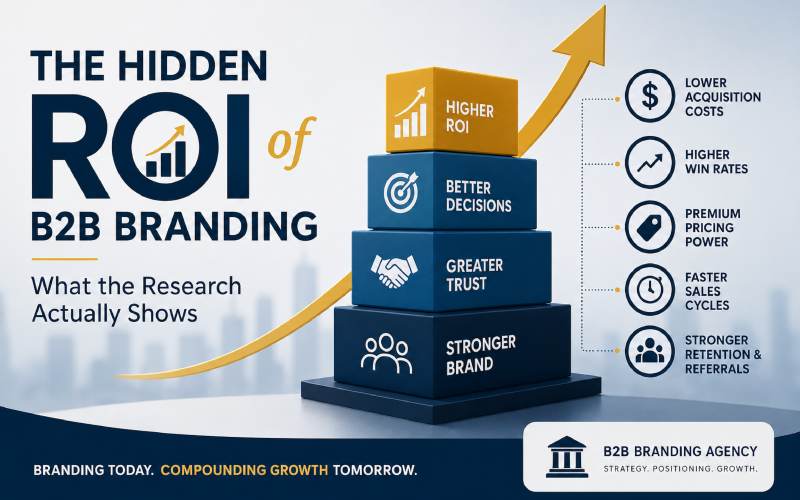
The Hidden ROI Most Sponsors Miss
1. Lower Cost Per Qualified Lead
A recognizable, consistent sponsor brand earns organic booth traffic, attendees who seek the booth out because they already know the name, rather than traffic generated purely by a giveaway or a raffle. Over multiple events, this reduces dependence on expensive lead-generation tactics that produce high scan counts but low actual pipeline.
2. Higher Win Rates From Session and Booth Credibility
Sponsors who deliver a genuinely useful session, rather than a thinly disguised product pitch, spend less time in the sales cycle proving basic credibility. Attendees who already saw the brand present real expertise on stage arrive at the booth further along in their evaluation.
3. Premium Positioning Instead of Booth-to-Booth Price Competition
B2B buyers at a specialized summit rarely choose a vendor purely on price. A sponsor with a differentiated, well-executed brand presence competes on expertise and fit rather than getting pulled into a discount conversation at the booth.
4. Faster Sales Cycles After the Event Ends
Brand familiarity built during the event, through the booth, the session, and any pre-event promotion, creates trust before the first follow-up call. That familiarity is a large part of why some sponsors close deals originated at a summit faster than deals sourced through cold outbound.
Why Brand Consistency Across Every Touchpoint Matters
One of the biggest challenges for growing B2B sponsors is fragmentation. The booth design team, the session slide deck, the swag vendor, and the app-listing copy often get handled by different people with no shared brief, producing a sponsor presence that looks like four different companies instead of one.
A specialized B2B branding agency helps create a unified brand system that aligns positioning, messaging, and visual identity across every one of these touchpoints, rather than treating each event asset as a separate, one-off design task.
Measuring Event and Sponsor Branding ROI
Booth traffic and impressions alone are not the most meaningful indicators. More useful signals for sponsors evaluating event branding ROI include:
- Branded search growth in the weeks following the event
- Sales-qualified lead rate from booth scans, not just raw scan count
- Win rate on opportunities sourced at the event versus other channels
- Average deal size and sales cycle length for event-sourced pipeline
- Renewal rate for sponsorship at the same event year over year
This same measurement discipline, tracking real pipeline outcomes rather than vanity engagement numbers, is the same approach organizers apply to the event itself. Our breakdown of gamification’s impact on modern event planning covers how sponsor engagement data gets captured and reported on the organizer side, which is useful context for any sponsor trying to make the case internally for a bigger event budget.
The Long-Term Advantage
Lead-generation tactics create immediate booth traffic. Consistent event branding creates a compounding advantage: the sponsors who show up recognizable and credible year after year spend less to earn the same attention that a first-time, inconsistent sponsor has to pay full price for every single time.
For sponsors evaluating which summits are worth the investment in the first place, the event and virtual summit platform comparison is a useful starting point for understanding where different audiences show up and which platforms fit which sponsorship goals.
For organizations looking to strengthen their positioning at gamification and event-technology summits specifically, partnering with an experienced B2B branding agency can turn a one-off sponsorship into a compounding, recognizable presence that measurably outperforms a generic booth setup, event after event.
Julian Thorne is a distinguished Technical Strategist and Fintech Analyst with over 6 years of experience in digital payment architectures. Specializing in the integration of high-performance gateways like Xendit, he focuses on optimizing the intersection of gamification and online ticketing systems. Julian’s expertise lies in deconstructing complex payment flows and enhancing sales effectiveness through data-driven insights. His recent work deeply explores the evolution of digital event platforms in 2026, providing actionable strategies for global summits and large-scale ticketing infrastructures.

Julian Thorne is a distinguished Technical Strategist and Fintech Analyst with over 6 years of experience in digital payment architectures. Specializing in the integration of high-performance gateways like Xendit, he focuses on optimizing the intersection of gamification and online ticketing systems. Julian’s expertise lies in deconstructing complex payment flows and enhancing sales effectiveness through data-driven insights. His recent work deeply explores the evolution of digital event platforms in 2026, providing actionable strategies for global summits and large-scale ticketing infrastructures.
Learn more about our team OR Get in touch