
Responsible Gambling Notice: This article discusses engagement design in the online casino industry for informational and professional purposes. It is not intended to encourage gambling. Gambling can be addictive. If you or someone you know is struggling with gambling, contact the National Council on Problem Gambling helpline at 1-800-522-4700, available 24/7.
The traditional online casino model is losing its power to retain users. Welcome bonuses and basic slot options do not keep modern players around. Acquisition costs are rising, and operators face stricter rules on aggressive advertising. Because of this, platforms must shift from transaction-based setups to engagement-focused designs.
By applying an online casino gamification summit strategy, operators convert passive betting into active progression. This approach helps platforms build steady, long-term player value while remaining compliant with current regulations, including built-in player protection tools.
The Retention Gap in Modern iGaming
Many online casinos struggle with a common problem: player drop-off after the first session. According to Xtremepush’s 2026 Gamification Benchmarks, the average iGaming operator sees Day-30 retention rates of roughly 15% to 25%, while operators using structured gamification report 30% to 40% over the same period. This drop occurs partly because standard welcome offers do not build long-term habits.
It is worth noting that retention benchmarks in this industry vary significantly by vendor and methodology; some report ranges as high as 70-80%, others as low as 2-20%, depending on how retention is measured and which player segment is included. Treat any single figure as directional rather than a fixed industry standard.
Best-in-class operators use an advanced gamification framework that embeds progress tracking directly into the game interface rather than treating loyalty as an overnight batch process. Real-time rewards, rather than delayed point updates, tend to keep the behavioral connection intact during a session.
Core Progression Mechanics Shared at Industry Summits
Successful gamification requires structured systems that appeal to different player motivations. An effective structural layer typically combines three mechanics that aim to convert casual players into consistent, engaged users:
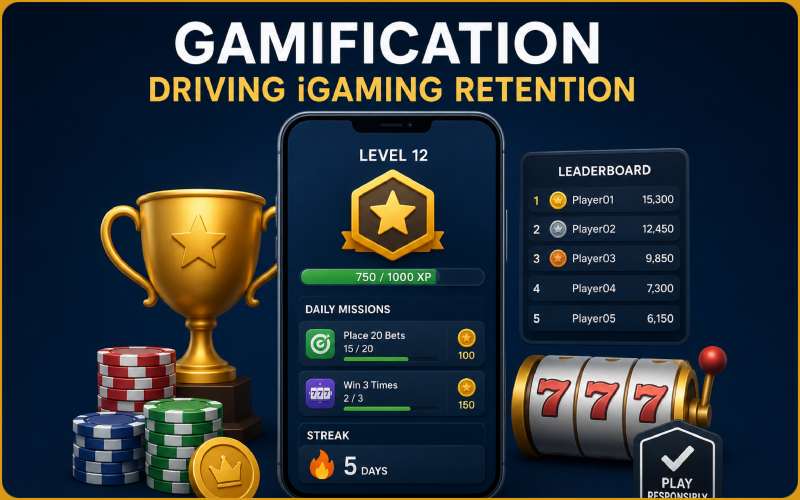
- Real-Time HUD Progression: platforms integrate progress tracking directly into the game display, so players see experience points or tier status update with each spin or wager.
- Clustered Mission Systems: instead of identical tasks for every user, operators segment players by behavioral pattern, such as risk-takers or casual players, and deliver tailored milestones.
- Minute-by-Minute Leaderboards: fast, localized leaderboards within specific live games are increasingly used in place of traditional weekly tournaments.
| Mechanic | Behavioral Focus | Core Operational Lever |
| Progress Bars | Extending mid-tier player sessions | Session duration growth |
| Badges & Tiers | Retaining high-value, aspirational players | Brand loyalty and status |
| Live Leaderboards | Increasing high-frequency wagers | Immediate betting frequency |
| Behavioral Missions | Encouraging cross-vertical exploration | Wallet share and reactivation |
| Streak Rewards | Establishing consistent daily log-in habits | Daily active user expansion |
Designing a Compliant Gamification Framework
Implementing these interactive systems requires careful planning around compliance. Regulators are increasing scrutiny on player protection and marketing limits, and a sustainable framework has to be built around those controls from the start, not added afterward.
Player Engagement Implementation Framework
Phase 1: Behavioral Archetype Mapping → Phase 2: Micro-Moment Triggers & Real-Time Sync → Phase 3: Automated Safeguards & Compliance Controls
Phase 1: Behavioral Archetype Mapping
Operators should avoid generic configurations that apply the same rules to every account. Teams typically segment the user base into distinct behavioral profiles, since a sports bettor requires different milestones than a live-casino player. Analyzing early interaction data helps route relevant tasks to the right audience and reduces early player fatigue.
Phase 2: Micro-Moment Triggers and Real-Time Sync
Engineers connect the core casino engine to the gamification layer through low-latency APIs. When a wager occurs, the system calculates the progression value and updates the HUD close to instantly. Delayed calculations interrupt the core behavioral loop and reduce engagement quality.
Phase 3: Automated Safeguards and Compliance Controls
This is the phase that matters most for player welfare, and it should never be treated as optional. The progression layer must connect directly to the platform’s responsible gambling utilities. If a user triggers a cooling-off period, self-exclusion, or a personalized loss limit, the system needs to freeze all gamification features for that account immediately, not on the next batch cycle. Milestones, badges, and leaderboards must stop tracking entirely once a limit is triggered. A gamification layer that keeps showing progress notifications to a self-excluded account is a compliance failure, not a minor bug.
Some industry sources report that operators with structured gamification programs see materially higher long-term retention than non-gamified platforms, though the specific percentage varies widely by source and could not be independently verified for this update. Treat any single retention-lift figure from a vendor case study as illustrative rather than a guaranteed outcome.
Balancing Feature Value Against Player Fatigue
A common pitfall in system design is overwhelming the user interface with too many active elements. When a player faces multiple competing tasks, flashing progress indicators, and constant tournament alerts, the core entertainment value suffers, and the risk of encouraging compulsive play increases.
In practice, a responsible approach limits visible tracking to one primary tier progression and two simultaneous short-term goals. Platforms should avoid creating artificial milestones that demand unnatural betting spikes; progression tracks should align with normal playing patterns rather than push players toward unsustainable activity. The goal of a well-designed system is to extend genuine engagement naturally, not to manufacture urgency.
Julian Thorne is a distinguished Technical Strategist and Fintech Analyst with over 6 years of experience in digital payment architectures. Specializing in the integration of high-performance gateways like Xendit, he focuses on optimizing the intersection of gamification and online ticketing systems. Julian’s expertise lies in deconstructing complex payment flows and enhancing sales effectiveness through data-driven insights. His recent work deeply explores the evolution of digital event platforms in 2026, providing actionable strategies for global summits and large-scale ticketing infrastructures.

Julian Thorne is a distinguished Technical Strategist and Fintech Analyst with over 6 years of experience in digital payment architectures. Specializing in the integration of high-performance gateways like Xendit, he focuses on optimizing the intersection of gamification and online ticketing systems. Julian’s expertise lies in deconstructing complex payment flows and enhancing sales effectiveness through data-driven insights. His recent work deeply explores the evolution of digital event platforms in 2026, providing actionable strategies for global summits and large-scale ticketing infrastructures.
Learn more about our team OR Get in touch