If you searched for a gamification summit and gaming conference to attend this year, you have probably noticed the results are a mess. Some pages talk about video game trade shows. Others talk about corporate training and loyalty programs. A few read like they were written by nobody in particular, about nothing in particular. You are left unsure whether you should be booking a seat at a game developer conference or a business engagement summit, and whether either one will actually be worth your time.
This guide sorts that out. It explains the real difference between “gaming” events and “gamification” events, gives you the facts on the actual conferences worth knowing about, and hands you a short checklist for choosing the right one before you spend money on a ticket.
Two different worlds share one search term
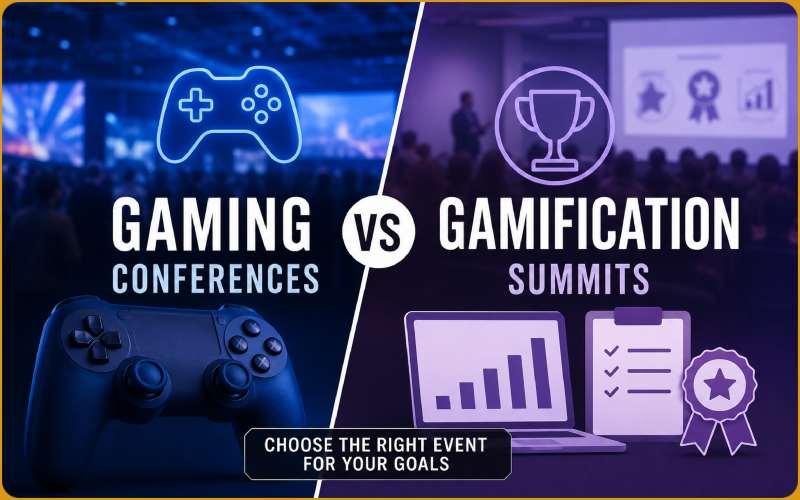
The confusion is not your fault. “Gamification summit gaming” pulls together two industries that use overlapping vocabulary but serve different audiences.
Gaming conferences are built for people who make video games: designers, programmers, artists, producers, and publishers. The flagship example is the GDC Festival of Gaming (formerly the Game Developers Conference), held at San Francisco’s Moscone Center. The 2026 edition ran March 9 to 13 and marked the conference’s 40th iteration since it began in 1988 as a small living-room gathering organized by designer Chris Crawford. Attendance in 2026 dropped to around 20,000, roughly 10,000 fewer than the prior year, a decline organizers linked to the Iran war and the Ukraine conflict, along with immigration policy changes that kept some international developers away.
Gamification summits, by contrast, are built for people who apply game mechanics outside of games: HR leaders, UX designers, marketers, and learning-and-development teams who use points, badges, and leaderboards to drive engagement in apps, classrooms, and workplaces. The category traces back to events like the original Gamification Summit, a two-day conference held in January 2011 at San Francisco’s Mission Bay Conference Center. Speakers included Jane McGonigal and Gabe Zichermann, and the event’s organizer, Margaret Wallace, described how businesses were adding game-like features to boost engagement. A similar tradition continues today through events like the Learning Guild’s Games & Gamification Summit, which focuses specifically on game-based learning and the research behind whether games actually improve performance, not just whether they are fun.
Neither definition is wrong. They are just different conferences that happen to share a name.
A side-by-side comparison
If you are trying to decide which type of event fits your goals, this is the fastest way to tell them apart.
| Gaming (game industry) conferences | Gamification (engagement design) summits | |
|---|---|---|
| Who attends | Game developers, artists, producers, publishers | HR, L&D, UX, marketing, product teams |
| Example event | GDC Festival of Gaming | Learning Guild’s Games & Gamification Summit |
| Core topic | Making and shipping video games | Applying game mechanics to non-game work |
| Typical format | Expo floor, technical talks, awards shows | Workshops, case studies, behavioral design sessions |
| 2026 scale | Roughly 30,000 attendees in a typical year, from over 100 countries | Smaller, often specialized by industry (education, corporate training, retail) |
| What you walk away with | Tools, engines, publishing contacts, hiring leads | Frameworks for engagement, retention, and motivation design |
Who this guide is for
The rest of this article is written for one specific reader: a mid-career UX, HR, or L&D professional who has a training or engagement budget to spend this year and needs to decide, in the next week or two, which single event is worth the travel time and registration fee. If that is not you, the comparison table above should still get you pointed in the right direction.
What the “gamificationsummit gaming” numbers actually tell you
Search around and you will find gamification market size estimates ranging from roughly $16 billion to $36 billion for 2026, depending on the research firm. That spread is wide enough that quoting a single number as fact would be misleading. What the estimates agree on is the direction: multiple independent market research firms project sustained double-digit annual growth for gamification technology through the early 2030s, driven by cloud-based training tools and AI-personalized engagement features. Treat any single “market size” figure you see in a promotional article with some skepticism, and instead pay attention to whether the growth trend and the drivers (cloud adoption, AI personalization, remote-work training needs) show up consistently across sources. If they do, that is a more reliable signal than any one dollar figure.
A decision checklist before you register
Use this before you commit a training budget or a week of PTO to any event:
- Confirm the audience, not just the title. Read the speaker list. If most speakers are game studio staff, it is a gaming conference. If most are HR, learning, or CX practitioners, it is a gamification summit.
- Check the format. Gaming conferences lean toward expo floors and technical sessions. Gamification summits lean toward workshops and case-study discussions. Pick the one that matches how you actually learn.
- Match the outcome to your job. Going to build or ship a game? You want the gaming conference. Going to design an engagement or training program? You want the gamification summit.
- Verify the date and price before budgeting. Passes for major industry events change year to year. For example, GDC 2026’s baseline Festival Pass started at $649, a 45 percent reduction from the prior year’s top-tier All-Access pass, but pricing structures change, so confirm current numbers directly on the event site rather than trusting older articles.
- Look for a session-level agenda, not just a homepage. A legitimate conference publishes a searchable schedule with named speakers and topics well before the event. If a “summit” site only has generic marketing copy and no actual agenda, that is a warning sign, not a scheduling delay.
A common mistake worth avoiding
In practice, a common mistake is picking a conference based on its name alone rather than its published agenda. Because “gamification” and “gaming” get used almost interchangeably in event marketing, it is easy to register for something that turns out to be aimed at the wrong audience entirely. The fix is simple: before you buy a ticket, pull up the actual speaker list and session titles. Five minutes of checking will tell you more than the event’s tagline ever will.
The bottom line
“Gaming” and “gamification” summits solve different problems for different people. If you build games, the game industry’s flagship events, led by GDC, are where the real technical and business conversations happen. If you design engagement, motivation, or training systems for a non-game product or workplace, a dedicated gamificationsummit gaming will give you frameworks and case studies you cannot get at a game developer conference. Check the speaker list, check the agenda, and check the current price before you book, and you will end up at the right event instead of just the one that ranked first in your search results.
This article was compiled and fact-checked by the editorial team using publicly available event listings, market research reports, and industry reporting cited throughout. Figures on market size and conference attendance vary by source and are noted where estimates differ.

Julian Thorne is a distinguished Technical Strategist and Fintech Analyst with over 6 years of experience in digital payment architectures. Specializing in the integration of high-performance gateways like Xendit, he focuses on optimizing the intersection of gamification and online ticketing systems. Julian’s expertise lies in deconstructing complex payment flows and enhancing sales effectiveness through data-driven insights. His recent work deeply explores the evolution of digital event platforms in 2026, providing actionable strategies for global summits and large-scale ticketing infrastructures.
Learn more about our team OR Get in touch