
A small creator can now publish a simple, instantly playable game and start earning without spending years developing a premium PC or console release. This change has created surprising cases in which casual creators generate more income than technically skilled indie developers working through traditional storefronts.
That does not mean every casual creator earns more than every independent studio. Earnings remain highly unequal across both models. For example, Roblox reported that creators earned more than $1 billion through its Developer Exchange program over a 12-month period, but it also reported a median payout of $1,440 among participating creators. A small group can earn exceptionally well while many others earn relatively little.
The important difference is structural.
Traditional indie development often depends on one large release, an upfront purchase, and a short launch window. Casual creators can publish faster, test more ideas, reduce access barriers, update continuously, and earn through several smaller interactions over time.
This article examines why that model can outperform traditional independent publishing, where the advantage comes from, and what new creators should understand before choosing either path.
The Traditional Indie Model Carries More Risk Upfront
Traditional independent development usually begins with a long production period.
A creator or small team may spend months or years working on:
- Programming
- Art and animation
- Level design
- Music and audio
- Testing
- Store preparation
- Marketing
- Localization
- Platform requirements
During this period, the project may generate no income.
The team is making a large bet that enough people will notice and purchase the finished release. When the launch receives little visibility, recovering the time and money invested becomes difficult.
Traditional platforms can provide enormous audiences and strong commercial opportunities, but they also contain thousands of competing products.
Publishing on Steam, for example, requires a Steam Direct fee for each product. The fee becomes recoverable only after the product reaches at least $1,000 in adjusted gross revenue.
The financial fee itself is not usually the largest barrier. The greater risk is spending a long development period on an idea before enough real players have tested it.
Casual creation reduces that risk by making validation happen earlier.
Casual Creators Can Reach Players Before Building Everything
A casual creator does not always need to finish a large product before publishing.
They may begin with:
- One central mechanic
- A short playable loop
- Basic progression
- Simple visual feedback
- A score or challenge
- A fast restart system
This smaller first release allows the creator to observe whether people understand the idea, replay it, share it, or leave immediately.
The creator can then decide whether to:
- Improve the existing version
- Add more content
- Change the central mechanic
- Test a different audience
- End the experiment
- Apply the lesson to another project
Traditional development often places validation after production. Casual creation places validation inside production.
That distinction can save months of work.
Development Speed Creates More Opportunities
A traditional independent developer may place most of their resources into one major release.
A casual creator can test several smaller concepts during the same period.
Suppose one developer spends 18 months producing one project. Another creator launches six focused experiments during those 18 months.
The second creator gains six opportunities to discover:
- Which idea attracts attention
- Which mechanic produces repeat play
- Which audience responds
- Which promotional message works
- Which monetization method feels natural
- Which project deserves expansion
Not every experiment will succeed. That is not necessarily a problem.
The business advantage comes from keeping the cost of failure small.
A game builder can help reduce the setup required for these experiments by providing reusable systems, templates, controls, and publishing options.
Faster production does not guarantee income. It increases the number of informed decisions a creator can make before committing to a large project.
Casual Games Have a Lower Commitment Barrier
A premium independent release may ask the player to:
- Pay before playing
- Download a large file
- Install the product
- Learn several systems
- Commit to a longer session
- Decide whether the purchase is worthwhile
A casual experience may ask only for one click.
The player can start immediately, understand the main action quickly, and decide whether to continue after experiencing the mechanic directly.
This lower commitment barrier can increase the number of people willing to try an unknown creator’s work.
It is especially valuable for creators without:
- An established brand
- A large social following
- Publisher support
- Professional reviews
- A major advertising budget
The creator does not need to convince someone that the project is worth purchasing before the person understands it. The experience can demonstrate its own value first.
Free Access Creates More Monetization Options
Traditional premium games normally depend on sales. Casual games can use several revenue sources.
Common models include:
- Rewarded advertising
- Display advertising
- Optional purchases
- Cosmetic items
- Progression upgrades
- Subscriptions
- Sponsorships
- Creator-platform payouts
- Brand partnerships
- Paid content extensions
Mobile platform fees still affect paid transactions. Apple’s Small Business Program offers eligible developers a 15% commission rate on paid apps and in-app purchases, while Google Play offers a 15% service-fee tier on the first $1 million in annual digital-goods earnings for enrolled developers.
The advantage of casual monetization is not that fees disappear. It is that payment does not always need to occur before the first session.
Players can discover the value first and contribute later through an appropriate model.
Small Earnings Can Accumulate Across Many Players
Premium developers often focus on the number of copies sold.
Casual creators may focus on smaller amounts generated across repeated sessions.
One player may produce only a small amount of advertising or purchase revenue. However, a large number of short sessions can create meaningful total income.
This changes the design priorities.
A casual creator may optimize for:
- Fast onboarding
- Frequent replay
- Short loading
- Clear rewards
- Daily challenges
- Return visits
- Shareable results
- Accessible controls
The goal is not necessarily to convince every player to make a large purchase. It may be to create enough value that players return repeatedly and a small percentage choose optional paid features.
This model can outperform an upfront sale when the experience is easy to distribute and retains a sufficiently large audience.
Mini Tanks 2
Mini Tanks 2 is a casual tank battle game where players control a small tank and fight enemy tanks through fast-paced action. Its commercial potential would depend on delivering immediate controls, short battles, fast restarts, escalating challenge, and visible rewards before adding a large campaign or complicated progression structure.
Simple Games Are Easier to Market Visually
Casual experiences often contain one mechanic that can be understood in a few seconds.
This is useful on discovery platforms where people make decisions quickly.
A short clip can show:
- A dramatic failure
- A difficult success
- A score challenge
- A satisfying reaction
- A visible upgrade
- A rapid transformation
- An unexpected outcome
The viewer does not need to understand a long story, complex character history, or advanced control system before becoming interested.
Traditional indie projects can also produce excellent promotional clips, but deeper games are sometimes harder to explain in a short format.
Casual creators can design the mechanic and the marketing hook together.
The same moment that entertains the player can become the moment that attracts the next player.
Distribution Is Becoming Part of the Product
Traditional storefronts usually separate development from discovery.
The developer finishes the project, creates a store page, attracts wishlists, and attempts to generate enough attention around launch.
Creator-focused platforms can integrate:
- Publishing
- Player accounts
- Discovery feeds
- Social features
- Recommendations
- Virtual economies
- Analytics
- Monetization
Roblox’s creator economy demonstrates the scale that an integrated platform can reach. The company reported that creators earned more than $1 billion globally over the 12 months leading up to early 2025.
This does not make success easy. Competition remains intense, and earnings are concentrated. However, it shows how distribution, social interaction, and monetization can operate inside one environment.
A traditional developer may need to build or manage these systems separately.
Creators Can Improve the Game While It Is Earning
A premium release is often treated as a major finishing point.
The developer may publish updates afterward, but the first public version is expected to feel complete.
Casual games can operate more like evolving services.
The creator may publish a focused version, collect behaviour data, and then improve:
- Tutorial completion
- Difficulty balance
- Session length
- Reward timing
- Feature discovery
- Retention
- Monetization placement
Revenue and development can overlap.
Instead of finishing the entire project before learning what players want, the creator can allow player behaviour to guide future investment.
This reduces the chance of spending heavily on systems that receive little use.
Analytics Gives Casual Creators Faster Feedback
A casual creator can measure the complete player journey:
- The person sees the project.
- The person opens it.
- The first session begins.
- The tutorial is completed or abandoned.
- The main challenge is attempted.
- The player restarts or leaves.
- The player returns later.
- The player watches an ad or makes a purchase.
Each step reveals where growth is being lost.
Useful metrics include:
- Click-to-play conversion
- First-minute retention
- Tutorial completion
- Session length
- Restart rate
- Day 1 retention
- Day 7 retention
- Revenue per active player
- Player-acquisition cost
Analytics should not be used to manipulate players. It should identify where the experience is confusing, frustrating, or failing to provide enough value.
The creator who learns faster can often improve faster.
Casual Creators Build Portfolios Instead of Betting Everything on One Release
A traditional indie studio may become known for one major project.
Casual creators can build a collection of experiences.
One project may attract players through search. Another may produce strong social clips. A third may earn through repeat sessions. A fourth may lead players toward the creator’s other work.
The portfolio creates several advantages:
- Multiple discovery points
- Shared audiences
- Cross-promotion
- Reusable assets
- Reusable mechanics
- More reliable traffic
- More opportunities to learn
A creator can use one successful experiment to support several related projects.
This reduces dependence on one launch day.
Someone using a game maker online can also keep projects accessible through direct links, allowing old experiments to continue bringing new visitors.
Lower Production Costs Improve the Break-Even Point
A project does not need massive revenue to become profitable when its production cost is low.
Traditional independent projects may involve:
- Full-time development
- Contractors
- Custom artwork
- Original audio
- Software licences
- Localization
- Testing
- Marketing
- Store assets
Casual creators may begin with simpler visuals, smaller teams, reusable systems, and shorter production cycles.
An AI game maker can assist with early concepts, placeholder content, scripting help, or rapid variations. A no-code game maker can reduce the need to implement every mechanic through traditional programming.
These tools do not eliminate expenses or guarantee quality. Their financial advantage comes from reducing the time and specialist labour needed to test whether an idea has potential.
A project that costs $500 to validate needs far less revenue to break even than one that costs $50,000 before receiving its first player.
Casual Design Supports Frequent Experimentation
A short loop makes it easier to test individual changes.
The creator can compare:
- Two tutorial versions
- Different reward timings
- Alternative control systems
- Shorter or longer rounds
- Different difficulty curves
- Multiple visual presentations
- Different calls to action
These focused experiments help the creator discover what improves player behaviour.
Traditional projects can also use testing, but larger interconnected systems make changes more expensive. Adjusting one mechanic may affect story progression, balancing, level design, animation, and technical performance.
Casual projects can be easier to measure because the player journey is shorter and more focused.
The Casual Model Matches Modern Attention Patterns
Many players want experiences that can fit into short breaks.
They may prefer something that starts quickly and does not require a long commitment.
Casual games can serve these situations through:
- Short rounds
- Simple controls
- Immediate objectives
- Mobile or browser access
- Quick rewards
- Easy restarting
This does not mean players no longer value deep experiences. Traditional games continue to serve large and dedicated audiences.
The difference is that casual creators compete for a different type of time.
They do not always need to persuade someone to spend an entire evening. They may need only a few minutes—and then provide a reason to return tomorrow.
Casual Creators Can Respond to Trends Faster
A traditional production cycle may be too slow to respond to an emerging format, cultural moment, or new player behaviour.
Casual creators can test a related mechanic while interest remains active.
The process may be:
- Identify the underlying appeal.
- Create an original playable interpretation.
- Release a small version.
- Measure audience response.
- Expand only when the idea proves itself.
Speed matters because discovery opportunities are temporary.
The creator who needs two weeks to validate an idea has an advantage over the team that needs a year to complete its first public version.
However, speed should never become an excuse for copying protected identities, publishing unsafe content, or misleading players.
Traditional Indie Developers Still Have Important Advantages
Casual creation is not automatically superior.
Traditional indie games can offer:
- Deeper storytelling
- More complex systems
- Stronger artistic identity
- Premium positioning
- Larger individual transactions
- Longer player relationships
- Greater ownership outside a platform
- More control over distribution
A successful premium release may generate substantial income without depending on advertisements, constant updates, or repeated small purchases.
Traditional developers may also build valuable intellectual property that can expand into sequels, licensing, merchandise, or other media.
The correct model depends on the creator’s skills, audience, resources, and goals.
The Casual Model Also Has Serious Weaknesses
Casual creators face their own risks.
Platform Dependence
A change to discovery, monetization, moderation, or payout rules can affect earnings quickly.
Low Revenue Per Player
A large audience may be necessary to produce meaningful income.
Retention Pressure
Players may leave quickly when the experience becomes repetitive.
Content Demands
Some models require frequent updates to maintain attention.
Monetization Ethics
Poorly designed ads or purchases can damage trust.
Intense Competition
Low development barriers allow many other creators to publish similar experiences.
Unequal Earnings
Large platform-wide creator payouts do not mean the average creator earns a full-time income. Roblox’s reported median DevEx payout of $1,440 over a 12-month period illustrates how different typical results can be from the earnings of top creators.
The casual path lowers certain barriers, but it does not remove the need for skill, persistence, distribution, and good business judgment.
Why Hybrid-Casual Design Has Become Important
Purely hyper-casual games traditionally relied on extremely simple mechanics and advertising scale.
Hybrid-casual design adds deeper systems such as:
- Progression
- Collections
- Upgrades
- Events
- Customization
- Optional purchases
- Longer-term goals
Unity’s mobile-industry outlook identified hybrid-casual design and monetization as an important direction, combining accessible core gameplay with stronger engagement layers.
This model attempts to preserve the easy entry of casual games while improving retention and revenue depth.
For new creators, the lesson is not to add dozens of systems immediately.
Start with a mechanic that is easy to understand. Add depth only after players demonstrate that they enjoy the core interaction.
How Astrocade Fits Into the Casual-Creator Model
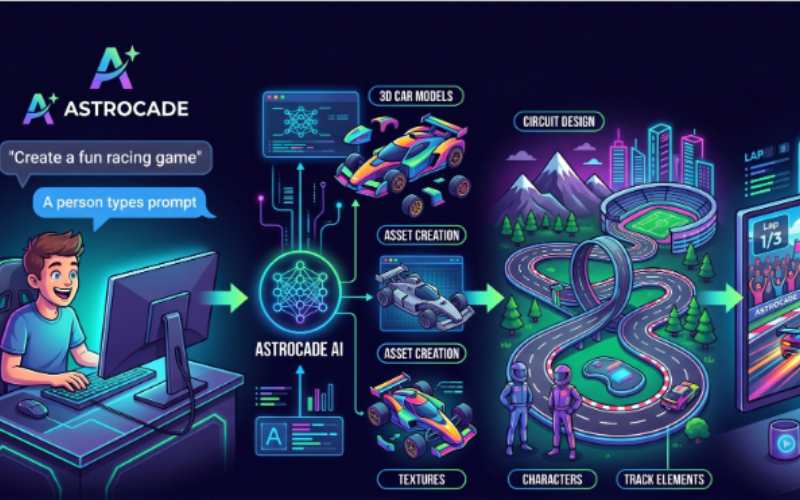
Astrocade helps reduce the distance between an idea and a playable public experiment.
A creator who wants to create a game can focus first on the main interaction, publish a small version, and use player feedback to decide what deserves further development.
People searching for game solutions often expect instant commercial success. Faster production is helpful, but revenue still depends on player value, retention, distribution, and responsible monetization.
Astrocade can make games more accessible by reducing technical setup and supporting rapid experimentation.
That accessibility allows a creator to build a game, test its potential, and avoid investing heavily before the main idea has been validated.
A Smarter Casual-Creator Revenue Strategy
A practical approach includes five stages.
Stage 1: Validate the Mechanic
Publish a basic playable version with no complicated economy.
Measure whether people understand it and choose to replay.
Stage 2: Improve Retention
Fix onboarding, difficulty, controls, feedback, and loading.
Do not monetize aggressively while the experience is still losing most players immediately.
Stage 3: Identify Natural Value
Determine what players want more of.
It may be:
- More challenges
- Customization
- Faster progression
- Additional modes
- Competitive features
- Convenience
- Cosmetic identity
Stage 4: Add Responsible Monetization
Choose a model that matches the experience.
Avoid making the free version intentionally unpleasant merely to force payment.
Stage 5: Build a Portfolio
Use lessons, audiences, and reusable systems from one project to improve the next.
Someone learning how to make your own game should think beyond a single release. A portfolio can create more stable discovery and revenue than one isolated experiment.
Questions to Ask Before Choosing a Platform
Before committing to any casual-creation ecosystem, investigate:
- Who owns the published project?
- How are creators paid?
- What percentage does the platform retain?
- Can the project be exported?
- Can you access player analytics?
- Which monetization methods are supported?
- What happens if the platform changes its rules?
- Can you communicate directly with your audience?
- Are there age or regional restrictions?
- How are disputes and refunds handled?
Low development friction should not prevent you from examining the business terms.
The platform becomes part of your revenue model.
Final Thoughts
Casual game creators are not universally out-earning traditional indie developers. However, some are gaining a structural advantage through faster production, lower costs, easier access, integrated discovery, multiple monetization methods, and continuous player feedback.
Traditional development often places a large financial and creative bet on one release.
Casual creation allows smaller bets, faster experiments, and earlier evidence.
That can make the model more efficient, especially for creators who do not have a major budget, established audience, or large team.
The strongest approach is not necessarily choosing simplicity forever. It is using simplicity to discover what players value before investing in complexity.
Build a clear core loop. Publish it quickly. Observe real behaviour. Improve retention. Add monetization only when it fits the experience. Then expand the ideas that prove they deserve more time.
The casual creator’s greatest advantage is not that simple games automatically earn more.
It is that the creator can learn what deserves to become a business before spending years building it.

Julian Thorne is a distinguished Technical Strategist and Fintech Analyst with over 6 years of experience in digital payment architectures. Specializing in the integration of high-performance gateways like Xendit, he focuses on optimizing the intersection of gamification and online ticketing systems. Julian’s expertise lies in deconstructing complex payment flows and enhancing sales effectiveness through data-driven insights. His recent work deeply explores the evolution of digital event platforms in 2026, providing actionable strategies for global summits and large-scale ticketing infrastructures.
Learn more about our team OR Get in touch