
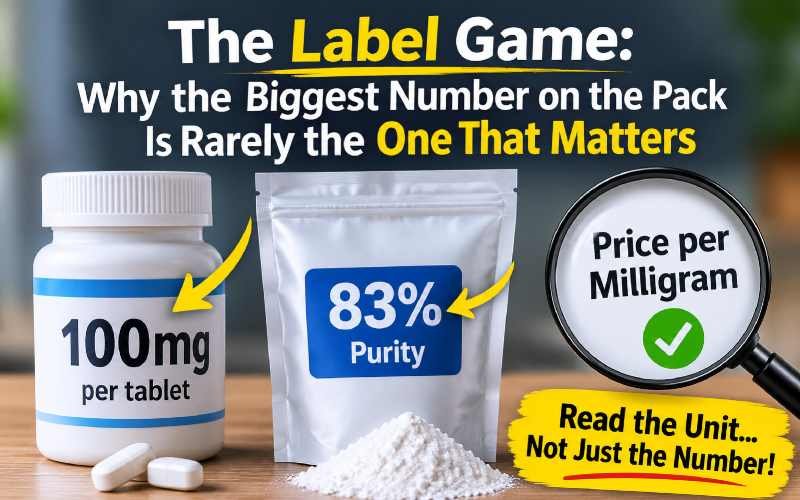
Every package is designed to win a small game against you. It has about two seconds of your attention, and it spends them on one number: the biggest, boldest figure it can print. “100mg.” “83%.” “10g.” The designer’s job is to make that number feel like the score.
Anyone who has studied game design knows the trick. Show players a big, simple metric and they will chase it, even when it isn’t the one that decides who wins. Points instead of progress. Badges instead of skill. Labels work the same way.
Research compounds are a good place to see this in action, because they come in two formats that keep score in completely different units. Once you see how the game is set up, it becomes very easy to win.
Two scoreboards, two units
Tablets keep score in milligrams. The label tells you how much of the named compound sits in each tablet: 10mg, 50mg, 100mg. Everything else in the tablet is binder and filler that holds it together. The upside is simplicity. You count tablets rather than weigh them, so tracking stock is easy. The downside is that a tablet is never the pure compound; the binders always come along.
Powder keeps score in percent. The label states purity, the share of the total weight that is the compound. “83%” means 83% of every gram is the compound and 17% is other material. Powder is flexible, since you can weigh out any amount, but it asks more of you: a lab balance that reads to at least 1mg, and a quick multiplication every time. One gram at 83% holds about 830mg of the compound.
Put a tablet pack and a powder pouch side by side and the two scoreboards don’t talk to each other. That is exactly where people lose.
The only score that counts
In most games there is one hidden stat that actually decides the outcome. Here it is price per milligram of the compound itself.
- Tablets: pack price ÷ (number of tablets × mg per tablet)
- Powder: price ÷ (grams × 1,000 × purity)
Run one round. A 1g pouch of 83% powder holds about 830mg. To match it with 10mg tablets you would need 83 of them. Only now can you compare the two prices honestly. Before that step, “price per pack” against “price per gram” is like comparing a high score from one game with the high score from another.
Across most product ranges, powder wins on price per milligram. Tablets cost more because pressing, mixing and checking each batch is real work. You pay for the convenience of counting instead of weighing, and that can be a perfectly reasonable trade.
Four ways players lose
These come up again and again. Reading the percentage as the content. Someone looks at a 5g pouch marked 83% and assumes it contains 83mg. It actually holds about 4,150mg (5,000mg × 0.83). The percentage is a ratio, not a total.
Playing the pack price. A cheaper pack is not a better deal if it holds fewer tablets, or weaker ones. Convert first, then compare.
Missing the salt form. Some compounds are sold as a salt, such as a hydrochloride, and the label may give the weight of the salt rather than the free compound. Check which one the number refers to before you run the maths.
Mistaking strength for size. A bigger mg figure on a tablet describes the compound inside, not the size of the tablet or how much binder it carries.
The fix for all four is the same move: read the unit before you read the number.
Protect your progress
Many alkaloids break down with heat, light, air and moisture, which quietly lowers the real number over time. Keep tablets in their sealed pack and powder in an airtight, opaque container in a cool, dry place, out of reach of children and pets. Write the product name, batch number and opening date on each container so nothing gets mixed up later.
A real scoreboard
Canadian retailer Get7 sells 7-hydroxymitragynine in both formats: tablets from 10mg to 100mg, and 7-OH powder at 83% purity, sold by weight from 0.5g to 10g. Each powder size shows its price, so the price-per-milligram round takes a few seconds on a phone calculator.
That is the whole game. Ignore the biggest number, find the unit, and convert everything to milligrams of the compound before you compare.
This article is for general information only. It is not medical advice and does not recommend the use of any product.

Julian Thorne is a distinguished Technical Strategist and Fintech Analyst with over 6 years of experience in digital payment architectures. Specializing in the integration of high-performance gateways like Xendit, he focuses on optimizing the intersection of gamification and online ticketing systems. Julian’s expertise lies in deconstructing complex payment flows and enhancing sales effectiveness through data-driven insights. His recent work deeply explores the evolution of digital event platforms in 2026, providing actionable strategies for global summits and large-scale ticketing infrastructures.
Learn more about our team OR Get in touch