
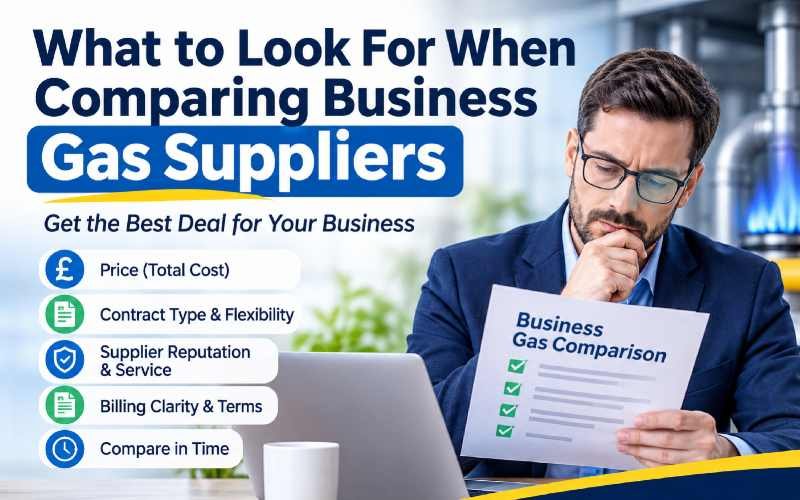
When businesses compare gas suppliers, most focus on a single thing: the price. Price obviously matters, but choosing a supplier on headline rate alone can lead to a deal that disappoints in other ways. A good comparison weighs several factors together, so you end up with a supplier that is not just cheap today but a sound fit for your business. Here is what to look for.
Price, judged the right way
Price is the starting point, but it needs to be judged properly. A business gas price is made up of a unit rate, what you pay per unit of gas, and a standing charge, a fixed daily cost regardless of usage. A low unit rate can be undermined by a high standing charge, so the figure that matters is the total estimated cost for your actual usage. When you run a business gas suppliers comparison, compare that total cost across suppliers rather than being drawn in by whichever unit rate looks lowest.
Contract type and flexibility
Beyond price, consider the type of contract on offer. A fixed contract locks your rate for the term, giving you certainty and protecting you against price rises, while a variable contract moves with the market. Think about which suits your business. If predictable budgeting matters most, a fixed rate is usually preferable. Also look at the contract length and how much flexibility it offers, since being locked into a long term that does not suit you can be costly.
Accuracy of the quote
A supplier comparison is only as good as the information behind it. Quotes are calculated from your gas usage, so before comparing, gather accurate consumption figures from your recent bills. A quote based on a rough estimate can mislead you, making a supplier look cheaper or more expensive than they really are for your actual usage. Accurate data ensures you are comparing suppliers on a fair, realistic basis.
Reputation and service
Price and contract terms are not the whole story. The quality of a supplier’s customer service matters, particularly if something goes wrong with billing or you need to query a charge. A supplier that is cheap but difficult to deal with can cost you time and frustration that outweigh the saving. It is worth considering a supplier’s reputation for service and reliability alongside the numbers, so you are not trading a few pounds for a lot of hassle.
Billing clarity and terms
Look at how a supplier bills and what their terms involve. Clear, accurate billing saves you time and prevents disputes. Check for any additional fees, the renewal arrangements, and what happens at the end of the contract. Understanding these details upfront helps you avoid being caught out later, for example by an automatic rollover onto an expensive rate if you do not act in time.
Using a comparison service to weigh it all
A comparison service simplifies the process of weighing prices, contract types, and supplier terms. Instead of contacting suppliers individually, you can compare quotes from leading UK suppliers together. This approach saves time and helps you make informed decisions. Moreover, you can compare important factors side by side before choosing your supplier. As a result, you can avoid automatically accepting your current supplier’s renewal offer.
Timing your comparison
As with any energy decision, timing matters. Most business gas contracts have a window before renewal when you can agree a new deal. Comparing suppliers within that window lets you switch smoothly and avoid dropping onto out-of-contract or deemed rates, which are among the most expensive available. Set a reminder for your contract end date so you always compare in good time.
Switching is straightforward
Once you have chosen a supplier, switching is simple and carries no disruption. Your gas supply is not changed or interrupted when you switch. Only the billing arrangement and the company you pay change, and the paperwork is usually handled for you. This means you can act on a better supplier choice confidently, without worrying about your operations.
The bottom line
Comparing business gas suppliers well means looking past the headline rate. Judge price on total cost for your usage, consider the contract type and flexibility, base everything on accurate usage data, and weigh service and billing clarity alongside the numbers. Use a comparison service to see your options together, time your comparison before renewal, and switch without fear of disruption. Do that, and you will choose a supplier that serves your business well, not just one that looked cheap at first glance.
Frequently asked questions
What should I look for when comparing business gas suppliers?
Judge price on total cost for your usage, consider the contract type and flexibility, check service reputation and billing clarity, and base everything on accurate usage data.
Why not just choose the lowest unit rate?
Because a low unit rate paired with a high standing charge can cost more overall. The total estimated cost for your usage is the figure that matters.
Does customer service really matter when choosing a supplier?
Yes. A cheap supplier that is difficult to deal with can cost you time and frustration over billing issues, which can outweigh a small saving.
How does a comparison service help?
It gathers quotes from leading suppliers and presents them together, letting you compare price, contract type, and terms side by side without contacting suppliers individually.
When should I compare suppliers?
Before your contract renews, within the window that lets you switch smoothly and avoid dropping onto expensive out-of-contract rates.

Julian Thorne is a distinguished Technical Strategist and Fintech Analyst with over 6 years of experience in digital payment architectures. Specializing in the integration of high-performance gateways like Xendit, he focuses on optimizing the intersection of gamification and online ticketing systems. Julian’s expertise lies in deconstructing complex payment flows and enhancing sales effectiveness through data-driven insights. His recent work deeply explores the evolution of digital event platforms in 2026, providing actionable strategies for global summits and large-scale ticketing infrastructures.
Learn more about our team OR Get in touch