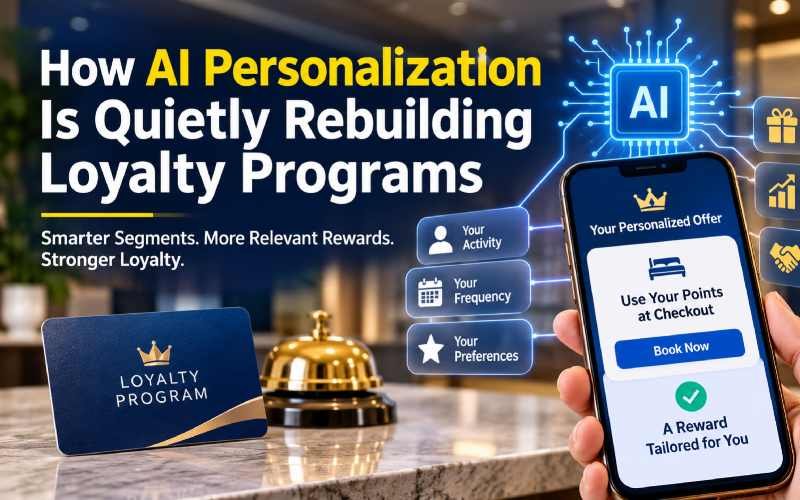
Hilton just did something that sounds small but isn’t. Members can now apply loyalty points directly at digital checkout, no separate redemption flow, no point-to-dollar math in your head. The Wise Marketer’s loyalty roundup flagged it as the first move of its kind among major hotel brands, and Atmos Rewards expanding its tiered perks in the same week wasn’t a coincidence either. Loyalty programs are in the middle of a quiet architecture change. The points haven’t changed. The way the system decides what to show you, and when, has.
For years, loyalty tech meant tiers, a points ledger, and a birthday email. That model is getting replaced by something closer to a recommendation engine wearing a loyalty program’s clothes. And the industries moving fastest on this aren’t always the obvious ones.
Segmentation Used to Be a Blunt Instrument
Most loyalty programs built before 2022 ran on three or four tiers. Bronze, Silver, Gold, maybe a Platinum tier nobody reached. Everyone inside a tier got the same offer, the same email, the same cadence. It worked because it was cheap to run and nobody expected better.
That bar has moved. A member who redeems points weekly behaves nothing like one who logs in twice a year to check a balance. Treating them identically wastes the frequent user’s engagement and annoys the infrequent one with offers that don’t match their habits. Harvard Business Review’s analysis of loyalty program economics makes a blunt case: programs that fail to track granular behavior often lose money on the very members they’re trying to retain, because the reward cost doesn’t match the incremental spend it’s buying.
The fix isn’t more tiers. It’s behavioral segmentation that updates in real time instead of being recalculated once a quarter.
What AI-Driven Segmentation Actually Looks Like in Practice
This is where things get interesting, and where the gaming industry has been running ahead of most retail and hospitality brands for a while.
An AI-driven engine doesn’t sort players or members into four static buckets. It tracks session length, deposit or spend frequency, time-of-day activity, churn risk signals, and reward redemption patterns, then recalculates the segment continuously. A player who usually logs in Friday nights but skips two weekends in a row gets flagged differently than one whose activity is steady. The offer that follows isn’t generic. It’s built for that specific behavioral pattern.
A feature published by SBC News walked through exactly this approach from BetConstruct’s Chief AI Officer, describing how the operator’s personalization layer segments players by in-play behavior rather than static demographic data, then adjusts bonus structures and messaging per segment automatically. That’s not a gambling-specific trick. It’s the same logic Netflix uses for recommendations, just pointed at retention offers instead of content.
Nebraska is a useful place to watch this play out at speed, mostly by accident. The state has no regulated online casino framework yet, but offshore platforms serving Nebraska residents have scaled fast anyway. Local reporting on the state’s casino revenue put the 2025 haul at a record $261 million, and a petition drive is pushing mobile sports betting onto this November’s ballot, which only accelerates the pace operators are moving at. Welcome offers in that market already show early personalization fingerprints: deposit-matched bonuses that scale with a new player’s first transaction size rather than a flat number for everyone. Anyone curious what that looks like in a live, fast-growing market can see it laid out in this guide to casino gaming from Nebraska, which tracks how operators structure those offers today.
The mechanism matters more than the market it’s running in. Segment by behavior, not by a label assigned at signup. Adjust the offer per segment, not per tier.
Why Hospitality and Retail Are Catching Up Late
Hotel loyalty programs spent two decades optimizing for simplicity. Earn a point per dollar, redeem for a free night, done. That design philosophy made sense when the alternative was a punch card.
It’s a weak design now. A business traveler who stays four nights a month and a leisure traveler who stays twice a year shouldn’t see the same upgrade offer. Hilton’s checkout change is a surface-level fix. The real work is underneath it, in whether the system knows enough about the member to make that checkout moment worth anything.
Retail loyalty has the same problem, just slower to admit it. The HBR’s earlier piece on loyalty program design argued that most retail programs still reward based on total spend rather than marginal behavior change, meaning brands pay out points to customers who would have bought anyway. That’s money spent for zero incremental loyalty. An engine that can tell the difference between a habitual buyer and one on the edge of churning is worth more than another percentage point of cashback.
The Technical Shape of a Segmentation Engine
Three components show up in every serious implementation, regardless of industry:
A behavioral data layer that ingests session activity, not just transaction history. Frequency and recency matter more than lifetime spend when predicting what a member does next.
A scoring model that recalculates segment membership on a rolling basis, often daily, sometimes closer to real time for high-engagement products like gaming apps or trading platforms.
An offer engine that maps segments to specific incentive types, not a single discount percentage applied uniformly. A frequent, low-spend user might get a frequency-based reward. A high-spend, infrequent user might get a reactivation-specific bonus instead.
None of this is exotic machine learning. Most of it is logistic regression and clustering that’s existed for over a decade. What changed is the willingness to actually wire it into the offer delivery system instead of treating segmentation as a quarterly slide deck nobody acts on.
Where This Breaks
It’s worth being honest about the failure mode here, because there is one. Over-personalization creates a program that feels surveilled rather than rewarded. A member who gets an oddly specific offer two hours after browsing a product can feel targeted instead of valued. The line between helpful and unsettling is thinner than most engagement teams want to admit, and crossing it quietly kills trust in the whole program.
The operators getting this right keep the personalization invisible in its mechanics but obvious in its value. The offer feels relevant. The reasoning behind it stays backstage.
Building Toward Real-Time Loyalty, Not Quarterly Loyalty
Static tiers aren’t going away overnight. They’re simple, they’re easy to communicate to members, and rebuilding an entire loyalty stack around continuous scoring is expensive. But the direction is set. Hilton’s checkout update, Atmos Rewards’ tiered expansion, and the AI segmentation work showing up in fast-moving gaming markets are all pointing at the same end state: a loyalty program that reacts to behavior this week, not behavior last quarter.
Teams building loyalty or gamification systems right now should treat segmentation granularity as the metric that matters, not the number of tiers on a marketing page. A three-tier program with real-time behavioral scoring will outperform a six-tier program running on a quarterly batch job every time.

Julian Thorne is a distinguished Technical Strategist and Fintech Analyst with over 6 years of experience in digital payment architectures. Specializing in the integration of high-performance gateways like Xendit, he focuses on optimizing the intersection of gamification and online ticketing systems. Julian’s expertise lies in deconstructing complex payment flows and enhancing sales effectiveness through data-driven insights. His recent work deeply explores the evolution of digital event platforms in 2026, providing actionable strategies for global summits and large-scale ticketing infrastructures.
Learn more about our team OR Get in touch