
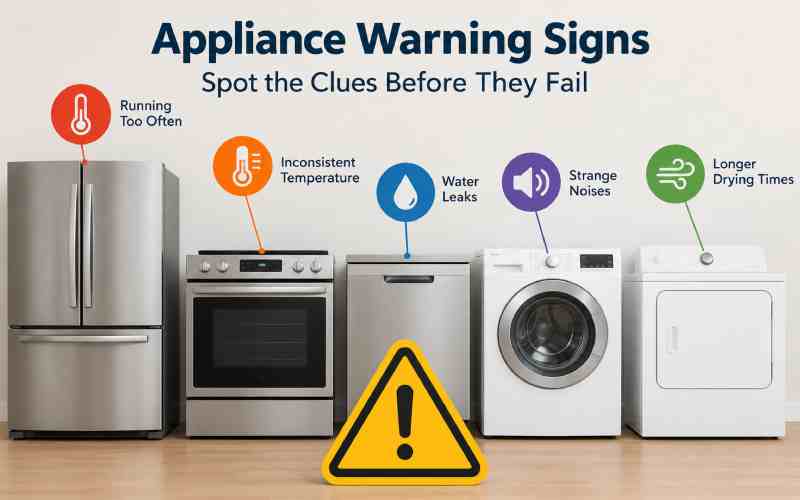
Most appliances don’t quit without warning. A refrigerator rarely goes from working perfectly to completely warm in an instant. A washer usually starts making a new sound, a dishwasher leaves a little more water behind, or an oven takes longer than usual to reach the temperature you set.
The problem is that these early symptoms are easy to ignore. If the appliance still technically works, you might decide to deal with it later.
Sometimes that’s fine. Other times, waiting turns a relatively small repair into an expensive failure. Knowing which symptoms deserve attention can help you make that call before the appliance makes it for you.
Your Refrigerator Is Running Almost Constantly
Refrigerators cycle on and off throughout the day. How often they run depends on room temperature, how frequently the doors are opened, and how much food is inside.
What isn’t normal is a refrigerator that suddenly seems to run all the time.
There are several possible reasons. Dirty condenser coils can make it harder for the refrigerator to release heat. A worn door gasket may allow cold air to escape. Fans, sensors, or other cooling components can also develop problems that force the system to work harder.
Start with the simple things. Make sure the doors close properly and check whether anything is blocking airflow inside.
If temperatures are beginning to rise or the refrigerator continues running excessively, don’t wait until the food is warm to investigate.
Your Oven Isn’t Holding a Consistent Temperature
An oven doesn’t maintain exactly the same temperature every second. It naturally cycles above and below its target temperature while cooking.
Large or unpredictable swings are different.
Maybe a meal that normally takes 40 minutes suddenly needs an hour. Perhaps one side of a tray cooks much faster than the other. You might even notice the oven reaching the displayed temperature unusually quickly while the food inside remains undercooked.
Problems with heating elements, igniters, temperature sensors, or controls can all produce inconsistent heating.
You can test the pattern with a separate oven thermometer. If there’s a repeated, substantial difference between the selected temperature and the actual temperature, having the appliance checked makes more sense than simply adjusting every recipe.
Strange Noises Usually Deserve an Explanation
Appliances make noise. That’s hardly news.
The important question is whether the noise has changed.
A refrigerator may hum and click during normal operation. A dishwasher moves water around. A washer spins at high speed. Those sounds become familiar after you’ve owned an appliance for a while.
A new grinding, scraping, squealing, banging, or unusually loud buzzing sound deserves attention.
Mechanical noises can come from worn bearings, motors, fans, pumps, belts, or objects trapped where they shouldn’t be. Continuing to operate the machine may put more strain on the damaged component.
If you need appliance repair Beverly Hills after an unfamiliar sound appears, describing exactly when the noise occurs can also help the technician narrow down the problem. Does it happen when the washer spins? When does the refrigerator compressor start? Only while the dishwasher drains?
Those details matter.
Water Around an Appliance Is Never Something to Ignore
A tiny puddle might look harmless, especially if the appliance continues working.
Water has an annoying habit of turning small problems into bigger ones.
For refrigerators, leaks may involve water lines, drains, ice makers, or condensation issues. Dishwashers can leak because of hoses, pumps, door seals, or connections. Washing machines have their own collection of hoses and components that can fail.
The appliance isn’t the only concern. Repeated moisture can damage flooring, cabinetry, drywall, and nearby materials.
If you find water, identify the source if you safely can. Don’t assume a puddle is simply from something spilled nearby, particularly if it returns after the appliance runs.
Your Dryer Is Taking Longer to Dry Clothes
If one normal load suddenly requires two cycles, pay attention.
Before assuming the dryer itself has failed, check the lint filter and airflow. Restricted ventilation can dramatically increase drying times.
A clogged dryer vent isn’t simply inconvenient. Poor airflow causes the machine to run hotter and longer than intended.
If the filter is clean and drying performance continues getting worse, the appliance may have a heating, airflow, sensor, or mechanical problem that needs diagnosis.
Running another cycle every time might get the clothes dry, but it doesn’t solve whatever has changed.
Your Washer Has Started Moving Across the Floor
Some vibration during a spin cycle is normal. A washer repeatedly banging against a wall or shifting across the floor isn’t.
First, stop the cycle and check the load. One heavy item can throw the drum badly out of balance. Make sure the machine is also sitting level and stable.
If severe vibration happens with ordinary balanced loads, something else may be wrong.
Suspension components and other internal parts help control the drum during high-speed spinning. When they wear, the movement can become increasingly violent.
Ignoring it can place additional stress on hoses, bearings, and surrounding components.
Your Dishwasher Is Leaving Water Behind
A small amount of water in certain areas of a dishwasher can be normal, depending on its design. A noticeable pool of dirty water at the bottom after the cycle is another matter.
Start by checking the filter for food debris and obvious obstructions. Also look at the drain area if it’s accessible according to the appliance’s instructions.
Recurring drainage problems may involve the pump, hose, valves, or another part of the drainage system.
The key word is recurring. If you clear the filter and standing water keeps returning, the dishwasher is telling you something.
Burning Smells Change the Situation
Many appliance symptoms allow time for basic troubleshooting.
A burning smell deserves more caution.
If you smell burning plastic, electrical insulation, or something that clearly isn’t normal cooking residue, stop using the appliance. Disconnecting power may be appropriate when it can be done safely.
Don’t repeatedly restart the appliance just to see whether the smell comes back.
Electrical faults, overheating motors, damaged wiring, and other failures aren’t problems you want to diagnose through trial and error.
The same caution applies if an appliance repeatedly trips a circuit breaker. A single trip can have several explanations, but repeated trips associated with one appliance warrant investigation.
Error Codes Shouldn’t Be Cleared Forever
Modern appliances can be surprisingly good at telling you that something is wrong. Unfortunately, it’s tempting to respond by turning the machine off and back on until the message disappears.
A reset can sometimes clear a temporary fault.
If the same code keeps returning, write it down.
The code can provide useful diagnostic information about the system detecting the problem. Even if the appliance starts working again after a reset, the underlying issue may still be present.
Repeatedly clearing the warning without finding the cause is a bit like removing the battery from a smoke detector because you don’t like the noise.
Pay Attention to Changes, Not Just Complete Failures
You don’t need to call for service every time an appliance makes a click or takes five minutes longer to finish a cycle. Basic troubleshooting and routine maintenance solve plenty of minor problems.
What matters is a change that persists.
A refrigerator that suddenly runs much longer, a dryer that consistently needs another cycle, a washer that has become unusually violent during spinning, or an oven that no longer cooks predictably is giving you information.
Catching those changes early gives you options. You can check the simple causes, arrange a diagnosis if necessary, and decide whether repairing the appliance makes financial sense.
Waiting until it completely stops working usually removes one option from the equation: choosing when to deal with it.

Julian Thorne is a distinguished Technical Strategist and Fintech Analyst with over 6 years of experience in digital payment architectures. Specializing in the integration of high-performance gateways like Xendit, he focuses on optimizing the intersection of gamification and online ticketing systems. Julian’s expertise lies in deconstructing complex payment flows and enhancing sales effectiveness through data-driven insights. His recent work deeply explores the evolution of digital event platforms in 2026, providing actionable strategies for global summits and large-scale ticketing infrastructures.
Learn more about our team OR Get in touch