
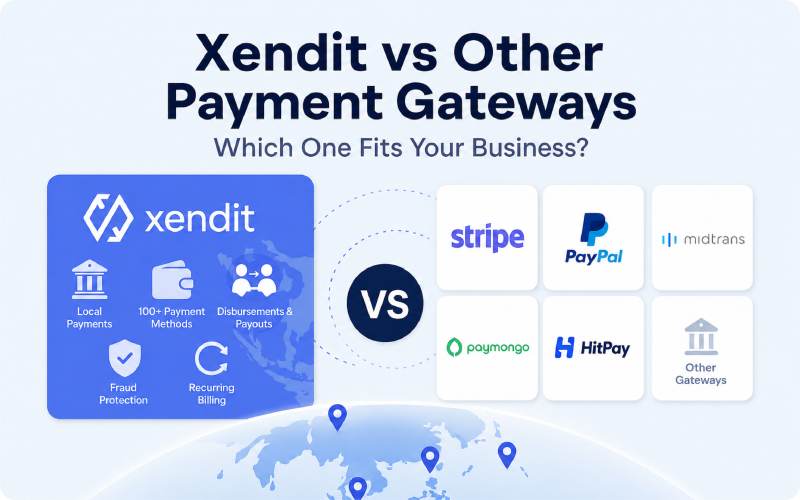
Choosing a payment gateway feels harder than it should when every provider claims the lowest fees and the widest reach. Founders in Indonesia, the Philippines, and the rest of Southeast Asia often pick a gateway based on a sales pitch, then discover local coverage gaps months later. This guide compares Xendit against Stripe, PayPal, Midtrans, PayMongo, and HitPay on fees, coverage, and features so you can match the right tool to your market.
What Sets Xendit Apart
Xendit builds its infrastructure around Southeast Asia first. The platform connects directly to local banks and payment partners across Indonesia, the Philippines, Malaysia, Thailand, Vietnam, and Hong Kong, which speeds up settlement times compared to gateways that route local transactions through international networks. Xendit also covers more than 100 payment methods, including bank transfers, e-wallets, and card payments, plus disbursement tools that let marketplaces pay out to multiple sellers at once. Its fraud detection system relies on machine learning to catch suspicious activity while keeping false declines low, and the platform adds recurring billing for subscription businesses.
Xendit vs Stripe
Stripe remains the strongest choice for companies that need global reach. It supports more than 135 currencies and a mature set of developer tools, which makes it a natural fit for SaaS companies selling worldwide. Stripe struggles, though, with local payment habits in Indonesia and the Philippines, since bank transfers and regional e-wallets are not its core strength. On pricing, the gap is measurable: in the Philippines, Xendit charges 2.9% plus fifteen pesos on card payments, while Stripe charges 3.4% plus fifteen pesos, with an extra 1% on international cards. Businesses that sell mainly within Southeast Asia typically save money and gain payment method coverage with Xendit, while businesses expanding into the United States or Europe still benefit from Stripe’s global tooling.
Xendit vs PayPal
PayPal carries enormous brand trust, with more than 392 million active accounts worldwide, and many international shoppers already have an account ready to use. That recognition matters for cross-border sales, but PayPal does not match Xendit on local Southeast Asian payment methods such as direct bank transfers and region-specific e-wallets. Businesses that sell mostly to local customers in Indonesia or the Philippines generally see higher checkout conversion with Xendit, while businesses that depend on international buyers benefit from keeping PayPal as a secondary option.
Xendit vs Regional Competitors
Midtrans, PayMongo, and HitPay each compete with Xendit on their home turf. Midtrans often costs slightly less for small Indonesian merchants, charging around 2.9% plus Rp 2,000 on local cards compared to Xendit’s 3% plus Rp 2,000, though the difference shrinks once transaction volume grows. PayMongo focuses only on the Philippines and appeals to developer-first teams, since Stripe and Y Combinator back the company. HitPay stands out in Singapore with PayNow fees starting at 0.65%, the lowest among major providers, and it pairs online payments with in-person point-of-sale hardware for retail and food businesses. HitPay’s tradeoff is limited infrastructure for expanding across multiple Southeast Asian markets and no built-in support for complex marketplace payout splitting, both areas where Xendit performs strongly.
Where Xendit Wins and Where It Falls Short
Xendit wins on regional depth. Few providers match its combination of local bank integrations, disbursement tools, recurring billing, and fraud controls across six or more Southeast Asian countries in a single API. That combination matters most for marketplaces, platforms that pay multiple sellers, and subscription businesses operating regionally. Xendit falls short once a business needs to sell heavily outside Southeast Asia and Latin America, since its network does not run as deep in the United States, Europe, or other global markets. Companies scaling globally often pair Xendit for regional collections with Stripe or PayPal for international sales.
Which Payment Gateway Should You Choose
The right choice depends on where your customers are and how your business collects revenue.
- Choose Xendit if you sell primarily to customers in Indonesia, the Philippines, Malaysia, Thailand, Vietnam, or Hong Kong, or if you run a marketplace that needs to pay out to multiple sellers.
- Choose Stripe if your customers are mostly in the United States or Europe and you need broad currency and payment method support.
- Choose PayPal if international buyer trust and instant checkout recognition matter more than local payment method depth.
- Choose Midtrans if you run a small Indonesian business focused only on card payments and want the lowest possible per-transaction rate.
- Choose PayMongo if you operate only in the Philippines and want a developer-first integration.
- Choose HitPay if you run a Singapore retail or food business that needs both online PayNow payments and in-person point-of-sale hardware.
Frequently Asked Questions
Is Xendit cheaper than Stripe?
In markets like the Philippines, Xendit charges lower card fees than Stripe, and it adds more local payment methods at no extra integration cost. Stripe can still work out cheaper for businesses that process mostly international cards outside Southeast Asia.
Does Xendit work outside Southeast Asia?
Xendit supports cross-border and global setups for businesses that need them, but its core strength stays within Indonesia, the Philippines, Malaysia, Thailand, Vietnam, Hong Kong, and parts of Latin America.
What is the best alternative to Xendit?
PayPal Payments ranks as a commonly cited top alternative to Xendit on review platforms, followed by GoCardless and Stripe Connect, depending on whether a business needs global reach or automated recurring payments.
Can I use Xendit and another gateway together?
Yes. Many businesses run Xendit for Southeast Asian collections and pair it with Stripe or PayPal to cover the United States, Europe, or other markets outside Xendit’s core region.
The Bottom Line
No single payment gateway wins every category. Xendit earns its place for businesses built around Southeast Asia, thanks to local bank integrations, disbursement tools, and fraud controls that competitors struggle to match in the region. Stripe and PayPal still make sense for businesses chasing global reach, and smaller regional players like Midtrans, PayMongo, and HitPay fit specific niches where their focus beats a broader platform. Match the gateway to where your customers actually are, and the fees will matter far less than the payment methods your checkout page can actually offer.

Julian Thorne is a distinguished Technical Strategist and Fintech Analyst with over 6 years of experience in digital payment architectures. Specializing in the integration of high-performance gateways like Xendit, he focuses on optimizing the intersection of gamification and online ticketing systems. Julian’s expertise lies in deconstructing complex payment flows and enhancing sales effectiveness through data-driven insights. His recent work deeply explores the evolution of digital event platforms in 2026, providing actionable strategies for global summits and large-scale ticketing infrastructures.
Learn more about our team OR Get in touch