A gamification summit built around one-hour keynotes leaves attendees with notes they will not reopen and zero new contacts. Registration fees, travel costs, and a full day away from the office return little more than a slide deck. A today’s tech gamification summit changes that equation. AI-built agendas, live engagement scoring, and immersive demo zones turn the event itself into an example of the engagement design the speakers describe onstage.
What Is a Today’s Tech Gamification Summit
A today’s tech gamification summit is an industry event that applies current technology, including artificial intelligence, augmented reality, and real-time analytics, to the format of the summit itself. The event does not just discuss gamification theory. It runs on gamification mechanics, from personalized session paths to live leaderboards tracking attendee participation.
Why the Old Summit Format Falls Short
A fixed agenda forces every attendee down the same path regardless of role or goal. A retail marketer and a corporate trainer sit through the same sessions, even though only half the content applies to either one. Networking is left to chance encounters at the coffee station, and engagement data stops at a headcount.
Six Ways Technology Is Changing Gamification Summits
1. AI Builds a Personal Agenda for Every Attendee
Event platforms now use AI to build an individual session path for each attendee, based on stated goals, past sessions attended, and real-time activity on the show floor. A game designer sees a different recommended path than an HR platform buyer. Neither has to search a printed program to find it.
2. Live Engagement Data Turns the Summit Into a Game
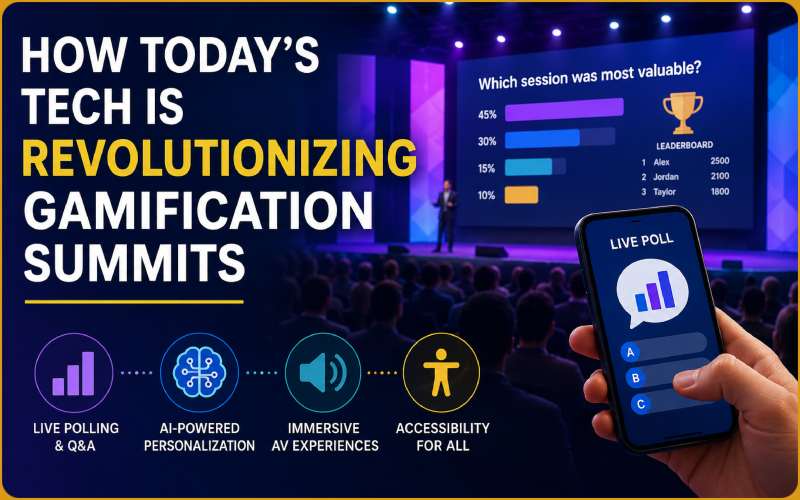
Points, badges, and leaderboards now track session attendance, booth visits, and networking activity in real time. Attendees can see their own standing on an app dashboard, and sponsors get concrete engagement numbers instead of a vague sense of foot traffic. The summit demonstrates the exact mechanics its speakers are teaching.
3. AR and VR Demo Zones Replace the Static Booth
Augmented reality lets attendees test a gamified training module or loyalty app on their own phone before they speak with a vendor representative. Dedicated VR zones let exhibitors run full simulations, which matters most for sectors like healthcare and corporate training, where the gamification use case is hard to explain on a slide.
4. Hybrid Formats Let Remote Attendees Fully Participate
Remote attendees no longer just watch a livestream. Current platforms let them vote in live polls, submit questions that get algorithmically surfaced to the speaker, and earn the same engagement badges as attendees on-site. Session recordings are increasingly cut into short, on-demand modules rather than posted as raw video.
5. AI Matchmaking Replaces Guesswork Networking
AI matchmaking tools scan attendee profiles and stated interests, then suggest specific people to meet rather than leaving networking to chance. In a specialized field like gamification, where a startup founder, an HR buyer, and an academic researcher can all be in the same room with different goals, this cuts a significant amount of wasted small talk.
6. Digital Materials Cut Waste and Cost
Digital badges, QR-code session check-ins, and app-based swag redemption have replaced printed programs and giveaways at many summits. The change lowers production cost and supports the sustainability positioning that resonates with a technology-focused audience.
The Market Numbers Behind the Shift
The investment in event technology tracks a broader trend. The global gamification market reached $34.43 billion in 2026 and is projected to grow to $92.37 billion by 2030, according to a 2026 market report from Research and Markets. Separate industry data compiled by Review42’s gamification statistics roundup puts employee productivity gains in gamified environments at up to 90 percent, and customer retention gains from AI-driven gamified loyalty programs at 47 percent.
| Year | Projected Global Market Size |
| 2025 | $26.91 billion |
| 2026 | $34.43 billion |
| 2027 (estimate) | $44.06 billion |
| 2030 (projected) | $92.37 billion |
Source: Research and Markets, Gamification Market Report 2026.
Enterprise technology events outside the gamification niche show the same pattern. Forrester’s 2026 Technology & Innovation Forum agenda centers on operationalizing AI for technology leaders, which signals that AI-driven event design is now standard across the broader conference industry, not a gamification-specific novelty.
What This Means for Attendees and Exhibitors
For Attendees
A personalized agenda and AI matchmaking save time across a multi-track event. Attendees spend less time guessing which session fits their role and more time in sessions and conversations that match their actual goals.
For Exhibitors
Immersive demo technology lets a product show its value instead of only describing it, which tends to convert better in a category built on behavioral design. Exhibitors planning a booth can register for the next gamification summit to reserve a demo zone slot ahead of the AR and VR build-out.
Frequently Asked Questions
What makes a summit tech-forward today?
A tech-forward summit applies AI personalization, real-time engagement data, and immersive demo technology to the event format itself, rather than only discussing these tools from the main stage.
Do virtual attendees get the same experience as in-person attendees?
Virtual attendees at a modern hybrid summit can vote in live polls, submit questions, and earn the same engagement badges as in-person attendees, though immersive AR and VR demo zones still favor on-site participation.
How much does AI personalization actually help attendees?
AI personalization reduces the time attendees spend searching a program for relevant sessions and increases the odds that networking suggestions match their actual professional goals, based on stated interests and real-time activity.
Where Gamification Summits Go From Here
None of this technology is gamification for its own sake. It is these summits applying the same behavioral design principles their speakers present, to the event experience itself. That consistency is one of the strongest signals that the underlying methods work: the organizations running gamification summits are the first ones putting the approach to use.

Julian Thorne is a distinguished Technical Strategist and Fintech Analyst with over 6 years of experience in digital payment architectures. Specializing in the integration of high-performance gateways like Xendit, he focuses on optimizing the intersection of gamification and online ticketing systems. Julian’s expertise lies in deconstructing complex payment flows and enhancing sales effectiveness through data-driven insights. His recent work deeply explores the evolution of digital event platforms in 2026, providing actionable strategies for global summits and large-scale ticketing infrastructures.
Learn more about our team OR Get in touch