The best gamified experiences do not always need complicated technology or elaborate rewards. Sometimes, a small visual moment is enough to make an interaction feel more alive. A character celebrating a completed challenge, a quick animation explaining what to do next, or a visual reaction after earning points can completely change how an audience experiences digital content.
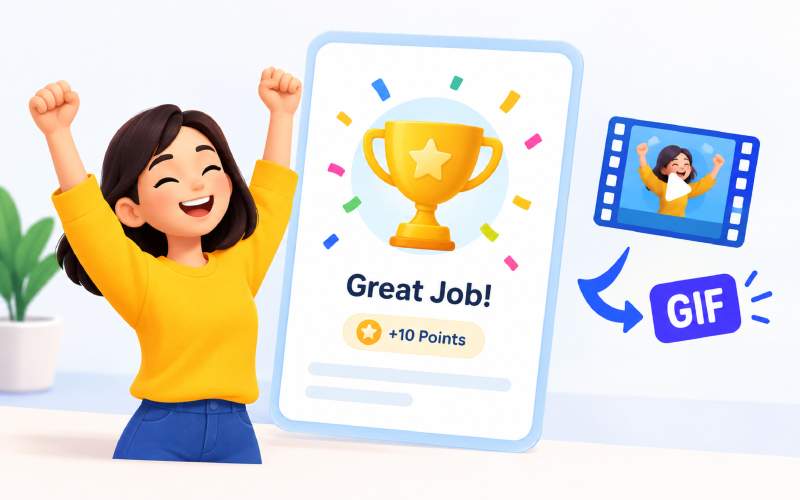
In gamification, movement can be especially effective because it gives users immediate visual feedback. A video to GIF converter can help turn short video moments into lightweight animated visuals that are easy to use across websites, presentations, social media, learning platforms, and digital campaigns. Instead of asking users to watch a full video, brands can use a short looping animation to communicate an idea almost instantly.
Why Visual Feedback Matters in Gamification
Gamification is built around interaction. Whether users are completing a quiz, collecting points, unlocking achievements, participating in a challenge, or moving through an educational course, they need to understand what is happening.
Visual feedback makes that process clearer.
Imagine completing a difficult quiz and seeing nothing more than a small text message saying, “Correct.” It works, but it does not create much excitement. Now imagine the same interaction followed by a short animation of a trophy appearing, confetti falling, or a character celebrating.
The action feels more rewarding.
This is one reason animated visuals can be useful in gamified environments. They provide an immediate response to user behavior without requiring a long explanation.
Using GIFs to Celebrate Small Wins
One of the easiest ways to introduce animation into gamification is through small moments of recognition.
Not every achievement needs a large reward. Users can stay engaged simply by receiving consistent feedback as they make progress.
For example, an online learning platform could use different animations when students:
- Complete a lesson
- Reach a new level
- Answer a difficult question correctly
- Finish a weekly challenge
- Maintain a learning streak
- Unlock a new badge
These animations can be short and simple. A two-second celebration can sometimes be more effective than a large graphic that takes up valuable screen space.
The key is to make the animation match the action. If someone completes a major milestone, the visual response should feel meaningful. For a smaller action, a subtle animation may be enough.
Making Educational Content More Interactive
Gamification is increasingly common in education and professional training because it can make learning feel less passive.
Consider a corporate training course. Employees might be asked to complete several modules before receiving a certificate. If each section consists of long blocks of text and static slides, attention can quickly disappear.
Small animated elements can break up that experience.
A short GIF could demonstrate how a software feature works, highlight the correct answer in a quiz, or visually explain a process before the learner tries it themselves. This gives learners a quick visual reference without forcing them to pause the course and watch a longer video.
For educators and training teams, the advantage is practical. The same short animation can often be reused in presentations, course materials, knowledge bases, and promotional content.
Creating More Engaging Quizzes and Challenges
Quizzes are one of the most familiar forms of gamification, but the basic question-and-answer format can become repetitive.
Animation gives designers another way to make these interactions feel dynamic.
For example, a travel website could create a destination quiz where users identify landmarks. After a correct answer, a short animation could reveal the destination. A fitness platform could use animations to acknowledge completed exercises. A marketing campaign could turn a product-related quiz into a small game where users unlock visual rewards as they progress.
These details may seem minor, but they contribute to the overall experience.
The important thing is not to add animation simply because it looks attractive. Every visual should have a purpose. It should provide feedback, explain something, guide the user, or reinforce the reward system.
GIFs Can Also Support Storytelling
Gamification and storytelling work particularly well together.
A campaign can introduce a character, create a challenge, and gradually reveal progress through small animated moments. Instead of explaining every stage with text, the story can unfold visually.
For example, a sustainability campaign might allow users to complete environmental challenges. Every completed task could contribute to the growth of a virtual garden. Short animations could show plants appearing, water being added, or the environment becoming healthier.
This approach gives users a visible representation of their progress.
Seeing the result of an action can make the experience feel more personal and encourage users to continue.
Keep Animations Short and Purposeful
There is a temptation to animate everything once animation becomes part of a design strategy. That usually creates the opposite effect.
Too much movement can distract users, slow down an interface, and make important information harder to find.
A better approach is selective animation.
Before adding a GIF, ask:
What does this animation accomplish?
If it celebrates an achievement, explains a process, or provides useful feedback, it probably has a place in the experience. If it exists only because the page feels “too static,” another design solution may be more appropriate.
Short animations are particularly useful because they communicate quickly. They can attract attention without requiring users to commit to watching a full video.
Think About Where the Animation Will Appear
The same GIF may work differently depending on its environment.
On a website, it might appear after a user completes an action. In an online course, it could sit beside an explanation. In a social media campaign, it might become the main visual element. In a presentation, it could demonstrate a concept that would otherwise require several static slides.
Before creating an animation, consider its size, placement, speed, and purpose.
It is also worth testing the experience on mobile devices. Gamified campaigns often reach users across different screen sizes, and an animation that looks excellent on a desktop may become distracting on a smaller screen.
A More Human Approach to Gamification
The strongest gamification strategies are not really about adding points, badges, or animated effects. They are about understanding what motivates people to continue.
A visual reward works because it supports that larger goal.
When someone finishes a challenge, they want to know that their effort mattered. When they answer a difficult question, they want confirmation. When they make progress, they want to see it.
A thoughtful animation can communicate all of that in a moment.
The best digital experiences use these details naturally. They do not overwhelm users with effects. Instead, they use movement at exactly the right time to make an interaction feel clearer, more rewarding, and more memorable.
Conclusion
Gamification succeeds when users feel involved rather than simply being asked to consume content. Small visual interactions can play an important role in creating that feeling. From celebrating achievements to explaining processes and showing progress, well-designed animations can turn ordinary digital interactions into experiences people are more likely to remember.
The goal is not to animate everything. It is to use visual movement where it adds genuine value. When every animation has a clear purpose, even a few seconds of motion can make a digital experience feel significantly more engaging.

Julian Thorne is a distinguished Technical Strategist and Fintech Analyst with over 6 years of experience in digital payment architectures. Specializing in the integration of high-performance gateways like Xendit, he focuses on optimizing the intersection of gamification and online ticketing systems. Julian’s expertise lies in deconstructing complex payment flows and enhancing sales effectiveness through data-driven insights. His recent work deeply explores the evolution of digital event platforms in 2026, providing actionable strategies for global summits and large-scale ticketing infrastructures.
Learn more about our team OR Get in touch