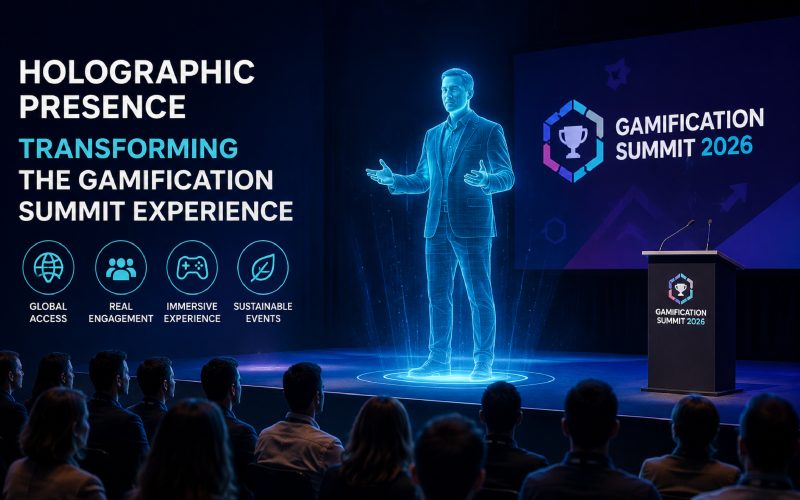
Remote attendance at a gamification summit used to mean a muted Zoom grid and a shaky slide deck. You missed the energy, the stage moments, and the spontaneous conversations that drive real learning. That gap is now closing fast. Holographic presence brings speakers and remote attendees into the same space as life-sized, three-dimensional figures, turning what was once a flat screen experience into something that feels genuinely live.
What Is Holographic Presence and Why Does It Matter at Summits?
Holographic presence uses an array of high-definition cameras and depth sensors to capture a speaker in three dimensions. That data is compressed and transmitted over high-speed networks to a remote venue, where a specialized display system reconstructs the speaker as a life-sized hologram on the stage.
The result is fundamentally different from a video stream. Attendees can see the speaker move, gesture, and make eye contact. Body language reads clearly. The experience triggers the same social instincts as in-person attendance because the human brain processes a three-dimensional figure very differently from a face on a flat screen.
For a gamification summit, this matters more than it does at a standard corporate conference. Gamification is a discipline built on engagement mechanics, reward loops, and participant psychology. A format that actually demonstrates immersive engagement while discussing it carries immediate credibility that no slide deck can match.
Understanding the latest updates on gamification summit formats and tools shows how quickly the field is shifting toward experience-first delivery models.
Market Data: How Fast Is Holographic Technology Growing?
The numbers behind holographic telepresence confirm that this is not a niche experiment. Adoption across events, corporate settings, and education is accelerating sharply.
| Metric | 2024 / 2025 Value | Projected Value | Source |
| Holographic Display Market Size | USD 2.85B (2023) | USD 17.71B by 2032 (22.55% CAGR) | SNS Insider |
| Holographic Telepresence Market | USD 3.22B (2025) | USD 12.09B by 2030 (30.3% CAGR) | Research and Markets |
| Attendee Engagement Lift (Immersive Tech) | +47% | Measured at live events | EventMB Study |
| Digital Holography Market | USD 4.87B (2025) | USD 9.74B by 2030 (14.87% CAGR) | Mordor Intelligence |
| Hologram Keynote Setup Cost (2026) | USD 50K+ per event | Declining as adoption scales | Ticket Fairy Industry Report |
Research and Markets data confirms that the holographic telepresence market will grow from $3.22 billion in 2025 to $4.2 billion in 2026 alone, driven largely by rising demand in events and entertainment applications.
How Holographic Presence Works at a Live Gamification Summit
The technical setup involves three core stages: capture, transmission, and display.
Stage 1: Volumetric Capture
A speaker records from a green screen studio or a portable camera ring that films them from multiple angles simultaneously. Depth sensors map the speaker’s exact spatial dimensions in real time, creating a 3D data model that updates continuously throughout the presentation.
Stage 2: Compression and Transmission
The 3D data is compressed using advanced algorithms and sent over low-latency networks. According to Telefonica’s research on holographic meetings, 5G connectivity and edge computing now make it possible to transmit high-resolution volumetric data with near-zero perceptible delay, a technical barrier that previously made live holographic events impractical.
Stage 3: Display at the Summit Venue
At the venue, projection systems reconstruct the speaker as a life-sized hologram on stage. Systems range from Pepper’s Ghost projection setups to dedicated hologram pods from companies such as PORTL, Proto, and ARHT Media. The hologram moves naturally within the physical space, allowing the speaker to walk the virtual stage, point at screens, and respond to audience questions in real time.
What Specific Benefits Does Holographic Presence Deliver at a Gamification Summit?
Global Speaker Access Without Travel Barriers
A gamification expert based in Tokyo can appear as a life-sized hologram on a stage in Chicago within seconds. This removes the cost and logistics of international travel, which for a niche academic and practitioner discipline like gamification means organizers can book speakers who would never have agreed to a three-day international trip for a one-hour session.
By 2025, several global tech summits featured keynote addresses delivered holographically, with speakers able to appear at multiple conferences on the same day. The same capability is now available to gamification events at every scale.
Live Audience Engagement That Flat Screens Cannot Match
A study by EventMB found that events incorporating immersive technologies such as augmented reality and holography produced a 47% rise in attendee engagement compared to standard formats. At a gamification summit, where audience participation mechanics are the core subject matter, this engagement differential becomes a live product demonstration.
Attendees who submit questions via Q&A apps get answers from a speaker who appears physically present in the room. Moderators on stage interact with the hologram naturally. The dynamic shifts from a lecture format to a shared experience, which is precisely the engagement shift that gamification research advocates.
Smaller Carbon Footprint for a Growing Global Community
Holographic presence reduces the need for international air travel, lowering the carbon cost of a summit without reducing its global reach. For a field that overlaps significantly with corporate sustainability programs and behavioral change initiatives, this alignment between practice and principle adds credibility.
An Angle Competitors Miss: Holographic Presence as a Gamification Case Study in Itself
Most articles treat holographic presence as a delivery mechanism, a way to transport a speaker. At a gamification summit, the technology itself functions as a live demonstration of the field’s core principles.
Gamification research focuses on what makes experiences feel meaningful, rewarding, and memorable. Presence is one of the most documented drivers of these outcomes. When attendees interact with a three-dimensional speaker who responds to their questions and maintains eye contact, the psychological experience mirrors in-person attendance far more closely than video conferencing does.
Summit organizers who deploy holographic presence are not just solving a logistics problem. They are actively demonstrating, in real time, that technology can shape human perception and emotional engagement. Every gamification practitioner in the audience can observe exactly how the technology creates behavioral responses, and that observation directly informs their own work.
Stay updated on how these trends are shaping the latest developments in gamification summits worldwide, where format innovation and engagement mechanics continue to evolve together.
Holographic Presence vs. Standard Delivery Formats: A Direct Comparison
How does holographic presence stack up against the other formats gamification summits currently use? The differences are significant across every dimension that matters to organizers and attendees.
| Feature | In-Person | Video Stream | Holographic Presence |
| Speaker Travel Required | Yes | No | No |
| 3D Spatial Presence | Yes | No | Yes |
| Real-Time Q&A | Yes | Limited | Yes |
| Audience Engagement Level | High | Low to Medium | High |
| Global Speaker Access | Limited by travel | Full | Full |
| Production Cost | Moderate | Low | High (50K+ for one-off) |
| Carbon Footprint | High (travel) | Low | Low |
| Body Language Visible | Yes | Partial | Yes |
| Scalability | Venue-limited | Unlimited | Venue-limited |
| Wow Factor for Attendees | Standard expectation | Low | High |
What Do Gamification Summit Organizers Need to Know Before Deploying This Technology?
Choose Vendors With Proven Event Experience
Holographic event production is not a standard AV task. Organizers need vendors with specific experience in live event installations, not just studio setups. Ask for documented case studies from similar events and begin vetting vendors early, as reputable providers book out quickly for major events in 2026.
Network Infrastructure Is the Single Biggest Variable
Transmitting real-time holographic data requires bandwidth that can be thousands of times greater than a standard HD video stream. Venue connectivity must be confirmed and tested well in advance. Venues with dedicated fiber connections or 5G infrastructure handle the demands far more reliably than standard broadband setups.
Rehearse the Full Technical Chain Before the Event
A holographic presentation involves a capture studio at the speaker’s location, a transmission network, and a display system at the venue. Each link must work under live conditions. Thorough rehearsals that test every component simultaneously under realistic load conditions are the standard practice that separates successful holographic keynotes from expensive technical failures.
Design the Stage Around the Hologram, Not the Other Way Around
Stage lighting, backdrop design, and audience seating all affect how a hologram reads to the room. Controlled lighting that does not wash out the projection, and a moderator trained to interact naturally with the holographic figure, significantly improve the perceived quality of the experience without adding hardware cost.
For gamification professionals planning to attend or organize events, reviewing top platforms for gamification summit ticket sales provides context on how event access and pre-event engagement are evolving alongside the in-room experience.
The Second Gap Competitors Miss: How Holographic Presence Extends Gamification Mechanics Beyond the Session
Holographic presence does not stop at the keynote stage. Forward-thinking summit organizers are now integrating it into the broader event gamification loop.
Consider a summit where attendees earn points by engaging with holographic speaker sessions, submitting verified questions, and sharing session highlights. The holographic format creates shareable, visually striking moments that traditional sessions do not. An attendee who photographs or records a brief clip of a life-sized hologram on stage and shares it on professional networks generates organic reach that organizers could not produce with standard content.
This creates a reward loop: attendance earns points, engagement with holographic content produces shareable moments, sharing drives new registrations, and new registrants experience the technology firsthand. The gamification summit becomes its own best advertisement, and the holographic presence element is the catalyst.
Explore how gamification mechanics apply across the broader gaming and summit landscape on gamificationsummit to understand the full ecosystem these technologies are entering.
Where Is Holographic Presence Heading for Gamification Events?
The trajectory is clear. The holographic telepresence market is forecast to reach $12.09 billion by 2030 at a 30.3% compound annual growth rate, driven by rising demand in events and entertainment, corporate adoption, and the continued expansion of 5G infrastructure globally.
Bandwidth barriers that once made real-time 3D transmission impractical are now receding. As Mordor Intelligence’s digital holography market data confirms, the adoption of the Versatile Video Coding standard (H.266/VVC) has cut data loads by 40%, enabling nationwide 5G holographic telepresence pilots that were not feasible three years ago.
For gamification summits specifically, the next development to watch is multi-location simultaneous holographic delivery. A single keynote speaker could appear as a life-sized hologram at five regional summit venues at the same time, giving every location the experience of in-person attendance while the speaker delivers one presentation from a single studio.
The cost curve for setup will follow the same path that video conferencing followed: expensive and specialized in the early years, then accessible and expected. Summit organizers who build experience with holographic production now will hold a significant operational advantage as the technology becomes standard across the events industry.
Holographic presence is not a novelty feature for a gamification summit. It is an alignment between the technology and the discipline it serves. A field that studies how immersive design shapes human behavior is at its strongest when it demonstrates that principle live, on stage, in a format that attendees have never experienced before.

Julian Thorne is a distinguished Technical Strategist and Fintech Analyst with over 6 years of experience in digital payment architectures. Specializing in the integration of high-performance gateways like Xendit, he focuses on optimizing the intersection of gamification and online ticketing systems. Julian’s expertise lies in deconstructing complex payment flows and enhancing sales effectiveness through data-driven insights. His recent work deeply explores the evolution of digital event platforms in 2026, providing actionable strategies for global summits and large-scale ticketing infrastructures.
Learn more about our team OR Get in touch