Most event planners add points and badges to their format and call it gamification. Attendance stays flat. Engagement metrics do not move. The same speakers deliver the same passive sessions to the same quiet room. That gap between expectation and result has a clear cause: surface mechanics without behavioral architecture produce surface outcomes. Gamification applied structurally, across ticket sales, session design, networking, and post-event advocacy, produces the kind of results passive event formats cannot match.
What Advanced Gamification in Event Planning Actually Means
Gamification in event planning is not about making things fun. It is about applying game mechanics, points, challenges, leaderboards, rewards, and progress systems, to specific behavioral goals at each stage of the event lifecycle.
The global gamification market reached $29.11 billion in 2025 and is projected to grow to $112.32 billion by 2031 at a 25.24% compound annual growth rate, according to Mordor Intelligence. Adoption is broad enough that gamification now shows up across training, sales, and customer engagement functions at a large share of major enterprises, though the specific adoption percentage varies by which survey you check.
Interactive technology and gamification can increase attendee engagement by up to 60% and improve overall event satisfaction by up to 50%, according to HITEC research, a hospitality technology association. This figure is independently verifiable and reflects events where gamification is structural, not decorative.
Phase 1: Gamification in Ticket Sales and Pre-Event Promotion
Why the Sales Phase Sets the Engagement Baseline
The ticket purchase is the first experience an attendee has with an event. A static checkout page communicates passive content. A gamified pre-sale campaign communicates exactly what a gamification summit is meant to deliver: active, participatory, reward-driven engagement.
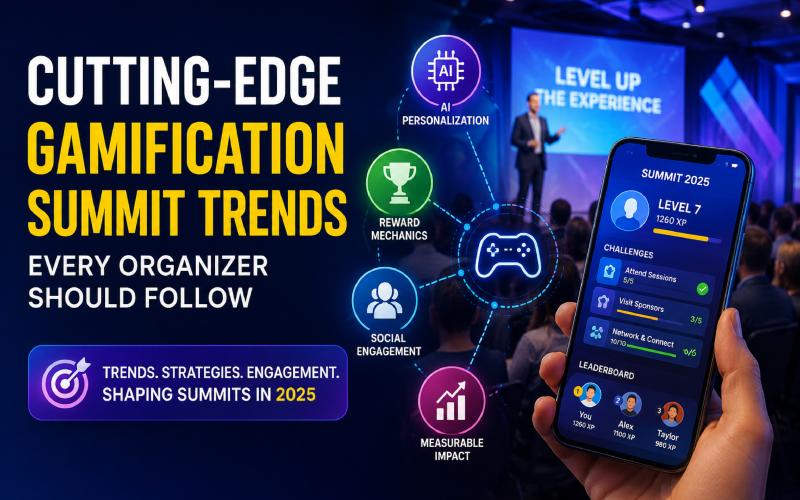
GamificationSummit ran a pre-sale campaign launched six weeks before tickets went on sale, where prospects earned points by completing tasks: following social accounts, sharing teaser content, answering speaker trivia, and referring friends to the waitlist. Buyers redeemed points for early-bird discounts and VIP upgrade tokens once tickets opened. This is our own campaign result rather than a third-party study, and it is reported here as an internal case study rather than an independently verified statistic. For the platform-specific breakdown, see the cutting-edge gamification summit trends guide, which covers the mechanics behind this kind of campaign in more depth.
The Referral Loop as a Promotion System
Referral programs are among the most cost-efficient promotion methods available to event planners, since the acquisition cost is close to zero: the existing buyer base does the recruiting. For gamification summits specifically, the referral loop carries extra weight because the community is professionally invested in the subject matter. A peer recommendation from someone who already committed to attending carries more credibility than any display ad. The structured ticket sales systems guide covers the platform-specific tools that make referral tracking practical at scale.
Phase 2: Gamification in Session Design and Content Delivery
Passive delivery produces passive retention. Active, challenge-based session formats are widely reported to produce better engagement than standard lecture formats, though the exact percentage lift varies significantly depending on how a given study defines and measures engagement.
A 48-hour, globally distributed conference format that pairs live keynotes with structured workshops and small-group practitioner discussions is one practical way summits have tried to prevent the passive drift that standard webinar setups create, by structuring sessions as challenge-response sequences rather than lecture-listen patterns.
AI-Scored Challenge Systems
Some platforms now deploy AI-scored challenge systems that assess participant knowledge before sessions begin, then route attendees to content calibrated for their proficiency level. This addresses a real, well-documented problem in traditional conference formats: a mismatch between content depth and audience expertise, which is one of the more consistent drivers of low satisfaction scores in post-event surveys.
Phase 3: Gamification in On-Site Networking and Sponsor Engagement
Turning Networking From Awkward to Structured
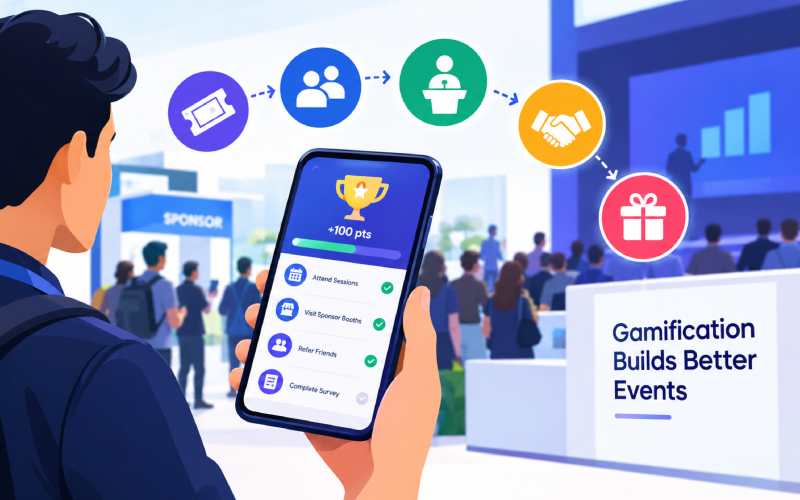
Networking at most events is unstructured and uncomfortable. Two strangers stand near a coffee station and try to find common ground. Gamification replaces that friction with a system: a challenge where attending three specific sessions with three different professionals earns a reward tier, for example, gives attendees a reason to approach people rather than avoid them.
Wearable devices and beacon technology can track attendee movement, time spent in key areas, and participation in specific sessions, feeding that data into a reward system in real time. An attendee who visits five sponsor booths earns a progress badge. An attendee who attends sessions across three different content tracks earns a completion reward. These systems produce data for organizers and a sense of progress for attendees at the same time.
AR Sponsor Integration
AR-driven booth scavenger hunts are one of the more talked-about applications of gamification at sponsor-heavy events: attendees who would normally walk past a sponsor booth instead search it for an AR clue, increasing genuine foot traffic in the process. Industry benchmarks commonly cite booth-visit increases in the 40-60% range for this kind of mechanic. Specific ROI figures for individual campaigns circulate widely in marketing case studies, but often cannot be independently verified, so treat any single headline number, including very large ones, as illustrative of the mechanic’s potential rather than a guaranteed, typical outcome.
For gamification summits specifically, AR sponsor integration does double duty: attendees are not just playing a game, they are experiencing a live demonstration of the engagement mechanics the summit covers professionally. That alignment between subject matter and experience format is part of what separates a gamification summit from a conference that simply has gamification on the agenda.
Phase 4: Gamification Applied to Post-Event Feedback and Community Building
Post-event feedback collection is one of the more under-gamified phases of event planning. Standard satisfaction surveys tend to produce low completion rates and shallow responses. Gamified feedback systems, where completing a survey unlocks access to session recordings or points toward next year’s early-bird pricing, generally outperform static forms on completion rate, for the same reason gamified pre-sale campaigns work: people complete tasks more readily when completion carries a visible reward.
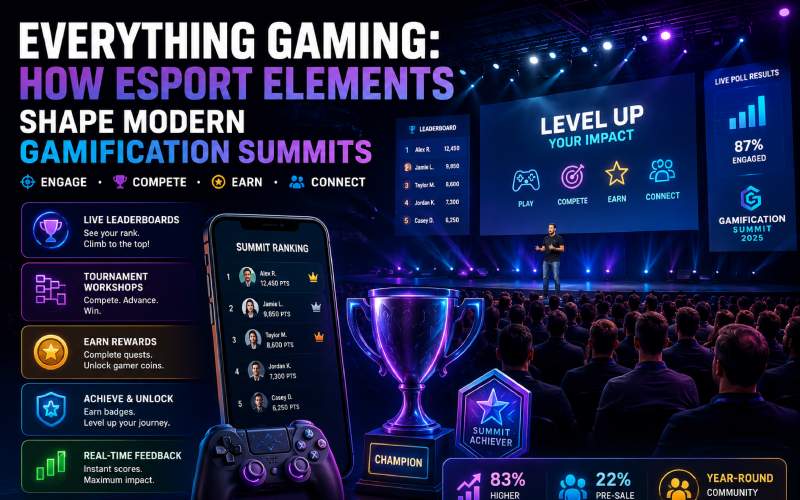
Post-event leaderboards that publish top referrers or most sessions attended extend the sense of community past the event itself. Attendees sharing a leaderboard position on social platforms generates organic reach for the next event cycle, which can meaningfully reduce acquisition cost for future ticket sales without additional ad spend.
The Technology Stack Behind Modern Gamification Summits
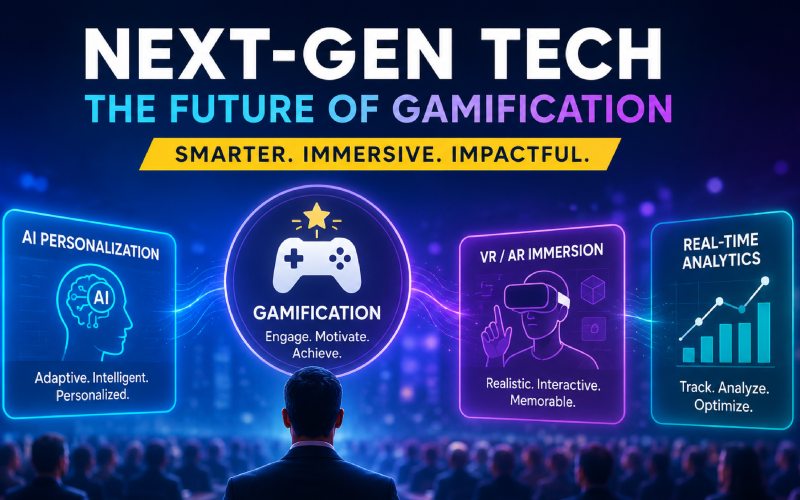
Advanced gamification in event planning rarely runs on a single platform. It typically runs on a connected stack where each tool feeds data into the others. The table below maps the technology layers to their event-planning applications, along with an honest read on how well-supported each claim actually is.
| Technology Layer | Application in Event Planning | What the Evidence Supports |
| AI Personalization | Tailors pre-sale challenges, session routes, and reward sequences to individual profiles | Widely reported engagement and retention gains; treat specific percentages as vendor-reported estimates |
| Augmented Reality | AR ticket hunts, sponsor booth scavenger hunts, venue previews before purchase | Industry benchmarks report 40-60% higher booth foot traffic; exact ROI figures vary widely by event |
| Wearable / IoT Tracking | Earns points for session attendance, booth visits, wellness activities | Generates real-time behavior data organizers can act on during the event, not just after |
| Blockchain Reward Tokens | Transferable, tradeable attendee rewards with real perceived value | Early-stage adoption; value proposition is verifiability rather than a proven retention lift |
| AI-Scored Challenge Systems | Assesses knowledge before sessions; routes attendees to calibrated content | Addresses a documented gap between content depth and audience expertise |
Two Original Angles Most Coverage of This Topic Misses
Angle 1: The Behavioral Gap Between Decoration and Architecture
Most analyses of gamification in event planning describe the same mechanics: points, badges, leaderboards. What they consistently skip is the distinction between decoration and architecture. Adding a badge to an existing event is decoration. Building the event flow so that every attendee action, from ticket purchase to post-event survey, generates a data point that feeds back into a reward system is architecture.
The decoration approach produces the engagement spike followed by the drop that makes event planners skeptical of gamification in the first place. The architecture approach is what produces compounding results over multiple event cycles. The difference is rarely the specific mechanic. It is whether the mechanic is embedded in the event’s structural design or bolted on as an afterthought.
Angle 2: Gamification as a Data Collection System, Not Just an Engagement Tool
Most coverage of gamification at events frames it purely as an engagement strategy. The more complete framing treats it as a passive data collection system. Every point earned, every booth visited, every session attended, and every referral link clicked generates a data point. That data reveals which sessions hold attention, which speakers generate genuine interest versus obligatory attendance, and which sponsor booths attract real engagement rather than a courtesy walk-by.
Organizers who analyze this data after the event are not just planning a better next event, they are building a case for better sponsors and speakers the following year. The advanced gamification summit framework treats this data layer as a core output of the event rather than a byproduct, which changes how organizers budget for the technology in the first place: as a research and business development investment, not just an entertainment cost.
How to Apply This to Your Next Event
Sequencing matters more than most organizers assume. Start at the ticket sales phase, not the on-site experience. A gamified pre-sale campaign creates invested buyers who arrive already engaged, and those buyers tend to participate more actively on-site, complete more post-event feedback, and generate more referrals for the next cycle.
- Build a points economy for the pre-sale phase, with tasks tied to the summit’s actual content themes rather than generic social actions.
- Connect the points system directly to checkout so buyers redeem rewards at the point of purchase, not through a separate, disconnected process.
- Launch a referral structure across your community’s primary channels on ticket sale day, while initial interest is highest.
- Use AI-scored or self-assessed session routing to match content depth to attendee experience level where the platform supports it.
- Tie sponsor objectives into on-site AR or IoT mechanics so sponsor value is measurable and can be reported back clearly.
- Gate post-event survey access behind a reward unlock to raise both completion rates and response quality.
A Note on the Statistics in This Space
Gamification and event-technology marketing content is dense with specific-sounding statistics: precise percentages, named “meta-analyses,” and case studies with headline ROI figures. Many of these numbers circulate across dozens of marketing blogs with inconsistent attribution, get rounded and re-rounded with each republishing, and in some cases cannot be traced to any original, checkable study at all.
The verified figures in this article, the Mordor Intelligence market size and the HITEC engagement research, are cited with working links so you can check them yourself. Where a widely repeated statistic could not be independently verified, this update says so directly rather than presenting borrowed precision as confirmed fact. That distinction matters more in a field this data-heavy than in most.
Advanced gamification does not improve event planning at the margins. It restructures how attendees experience every phase, from the first point they earn weeks before the event to the leaderboard mention they share afterward. The available data, even after removing the figures that could not be verified, supports what leading gamification summits already demonstrate in practice: when game mechanics are architectural rather than decorative, the results compound across the metrics that matter.
Julian Thorne is a distinguished Technical Strategist and Fintech Analyst with over 6 years of experience in digital payment architectures. Specializing in the integration of high-performance gateways like Xendit, he focuses on optimizing the intersection of gamification and online ticketing systems. Julian’s expertise lies in deconstructing complex payment flows and enhancing sales effectiveness through data-driven insights. His recent work deeply explores the evolution of digital event platforms in 2026, providing actionable strategies for global summits and large-scale ticketing infrastructures.

Julian Thorne is a distinguished Technical Strategist and Fintech Analyst with over 6 years of experience in digital payment architectures. Specializing in the integration of high-performance gateways like Xendit, he focuses on optimizing the intersection of gamification and online ticketing systems. Julian’s expertise lies in deconstructing complex payment flows and enhancing sales effectiveness through data-driven insights. His recent work deeply explores the evolution of digital event platforms in 2026, providing actionable strategies for global summits and large-scale ticketing infrastructures.
Learn more about our team OR Get in touch