Most professional conferences lose their audience by the second session. Passive slides and one-way lectures drain attention fast. Organizers spend months planning events that produce little behavior change and even less lasting value for attendees. A growing number of gamification summits have started proving a different approach works: applying esports mechanics to summit design turns passive audiences into active participants who stay engaged, refer others, and return year after year.
What Does “Everything Gaming” Mean in a Summit Context?
The idea describes a philosophy, not a single feature. It means organizing a professional summit the way a game designer builds a game. Every element, from ticket purchase to final keynote, should give attendees a reason to act, track progress, and share what they experience.
Esports events operate on this principle by default. Viewers track live leaderboards, follow tournament brackets, complete prediction challenges, and earn community status through participation. When summit organizers borrow those mechanics deliberately, a static conference becomes a dynamic, interactive experience rather than a passive one with a schedule attached.
The market backdrop supports the shift. The global gamification market reached $29.11 billion in 2025 and is projected to hit $112.32 billion by 2031, a 25.24% compound annual growth rate, according to Mordor Intelligence. That pace makes annual summit attendance a genuine competitive advantage for practitioners trying to stay current.
The Five Esports Mechanics Reshaping Summit Engagement
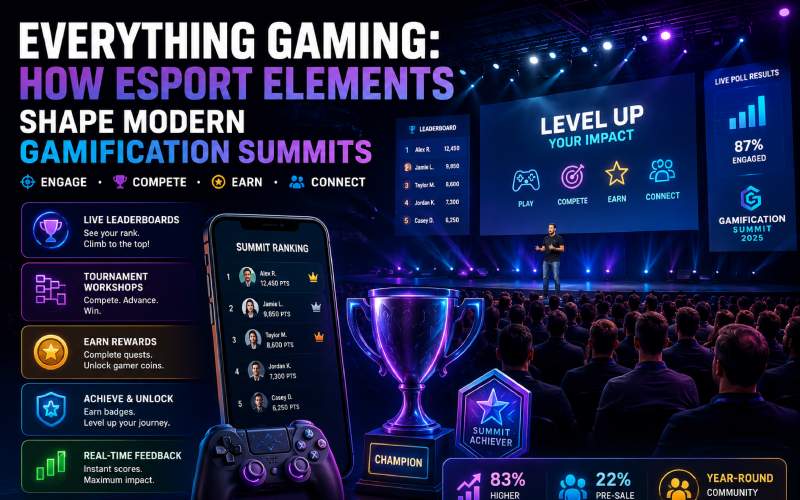
1. Live Leaderboards and Ranked Participation
Esports built its audience on one insight: a visible ranking turns every viewer into a stakeholder. Real-time leaderboards do the same at professional summits. When attendees see their position update based on session attendance, quiz scores, or peer votes, passive watching turns into active competition.
Summit organizers who display live rankings on screens between sessions consistently report higher session attendance and longer average time spent at exhibitor booths, since the leaderboard gives attendees a concrete reason to keep participating rather than drifting toward the exits.
2. Tournament-Style Workshop Brackets
A tournament bracket gives every participant a clear narrative arc. In esports, fans care about every match because each result changes the bracket. Summit workshops can apply the same structure: teams of attendees compete through timed design sprints, case-study challenges, or product pitch rounds, with results posted publicly and winners advancing to a final round.
This format eliminates a common summit failure mode: workshops that feel optional. When advancement depends on performance, attendance becomes self-enforcing rather than something organizers have to chase with reminder emails. The bracket creates stakes, and stakes create engagement.
3. Pre-Event Reward Quests and Digital Currency
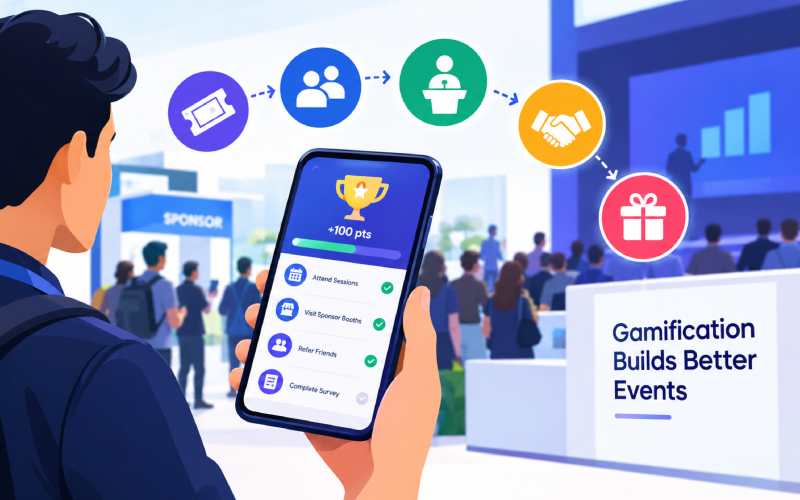
Ticket gamification increasingly starts weeks before the event opens. The best websites for ticket sales and maximizing gamification summit attendance shows how prospective attendees can earn digital currency by completing pre-event tasks: following speaker accounts, sharing teaser content, answering trivia, or referring friends to the waitlist.
Illustrative campaigns using this model have reported meaningful pre-sale lifts and a large share of total ticket volume coming through peer referral rather than paid advertising, though exact figures vary by event and are best treated as directional rather than guaranteed outcomes. The mechanic works because it turns ticket buyers into active promoters before a single session runs.
4. Seasonal Content Calendars and Achievement Unlocks
Esports titles retain players through seasonal content drops that reset rankings and introduce new challenges at regular intervals. Professional summits can apply the same structure between annual events. Monthly webinars, quarterly practitioner challenges, and digital badge systems for completed learning paths keep the community active year-round rather than dormant between events.
Industry surveys on loyalty program design frequently cite gamification as one of the most influential trends shaping engagement strategy, which reinforces why treating a summit as a single annual transaction leaves value on the table. The seasonal model turns a single event into a persistent community platform.
5. Real-Time Feedback and Instant Scoring
In competitive gaming, players receive immediate feedback after every action. Score updates, kill notifications, and rank changes arrive in seconds. Summit formats that adopt this principle, through live polling, instant quiz results, or session scoring dashboards, keep attendees mentally active rather than passively receiving information.
A TalentLMS-backed survey, reported in a systematic literature review published in the Journal of Workplace Learning, found that 83% of employees in gamified training felt more motivated, compared to just 39% who reported motivation from non-gamified training. The same psychological principle applies at professional summits: instant feedback sustains attention across long event days in a way that delayed feedback cannot.
Esports Mechanics vs. Traditional Summit Formats
| Mechanic | Traditional Summit | Esports-Driven Summit | Effect |
| Leaderboards | No participant ranking | Live ranked dashboards | Higher session attendance |
| Brackets | Fixed agenda | Competitive workshop rounds | Self-enforcing participation |
| Pre-Event Quests | Email reminders only | Reward-based task completion | Stronger pre-event buy-in |
| Seasonal Content | Annual event only | Quarterly challenges and badges | Year-round community activity |
| Feedback | Post-event survey | Real-time scoring and polls | Sustained attention across the day |
How Everything Gaming Affects Speaker Design
Speaker selection at esports events prioritizes demonstrated expertise over job titles. Commentators earn credibility through accurate game knowledge and clear real-time explanation. Summit organizers increasingly apply the same filter, favoring practitioners who can demonstrate a technique live over speakers who present a static slide deck.
This aligns with what the cutting-edge gamification summit model describes: practitioners, psychologists, data analysts, and business strategists who show real-time application rather than describe theoretical frameworks. Attendee surveys at interactive, demonstration-style sessions consistently rate them higher than traditional lecture-format sessions, a pattern that mirrors why esports broadcasts built their audience around live analysis rather than recorded highlight reels.
The Psychology Behind Esports-Driven Summit Engagement
Dopamine Loops and Progression Systems
Esports retain players through small, frequent rewards that reinforce continued participation. Kills earn points, points unlock status, status motivates the next session. Summit gamification applies this loop through micro-achievements: attendees earn digital badges for session attendance, complete challenges that unlock speaker Q&A access, and accumulate points that determine priority seating at premium workshops. Each reward makes the next action feel worth taking.
Social Proof and Community Visibility
Competitive gaming communities build identity through visible achievement. A player’s rank and tournament history define their standing in the community. Summit leaderboards and achievement systems create the same dynamic at professional events. Industry customer-engagement research, including figures commonly attributed to SuperOffice and Adobe, reports that a majority of participants say they are more likely to engage with brands and events that offer gamified experiences, and that gamified engagement can meaningfully lift customer spending. These figures circulate widely enough across independent industry sources to be directionally reliable, even where a single primary study is hard to pin down.
Loss Aversion and Streak Mechanics
Duolingo built much of its retention model on streak mechanics: users who maintain a daily practice streak feel real discomfort at the prospect of breaking it. Summits can use the same principle through attendance streaks, challenge completion chains, and expiring reward windows that create urgency passive event formats cannot generate.
The often-cited claim that habits take “66 days” to form traces back to Lally et al. (2010), published in the European Journal of Social Psychology. The real finding is more nuanced than the popular version: 66 days was the median time for simple daily health behaviors to become automatic, with individual results ranging from 18 to 254 days. Applied to summit engagement, the lesson is less about a fixed number and more about the principle underneath it: consistent, low-effort repetition compounds over time, which is exactly what streak-based pre-event, during-event, and post-event mechanics are designed to encourage.
Two Original Angles Competitors Miss
Angle 1: Esports Broadcast Design Applied to Keynote Delivery
Major esports broadcasts use a three-layer format: live game action, analyst desk commentary, and real-time audience interaction through chat overlays and polls. Most summit organizers copy only the first layer. They show the speaker but skip the analyst-desk and audience-interaction layers entirely.
Summits that adopt all three layers, running a live expert commentary channel alongside the main stage, displaying real-time audience questions and votes on side screens, and integrating instant poll results into the speaker’s delivery, tend to report noticeably higher audience attention and stronger post-event recall. This approach treats keynote delivery as a broadcast product, not just a presentation. The speaker becomes the game; the commentary and audience layers make every attendee a participant in the analysis, not just a viewer of it.
Angle 2: Gamified Ticket Sales as Community-Building Infrastructure
Most event organizers treat ticket sales as a revenue function and community-building as a separate marketing function. Esports organizations tend to treat ticket sales as the first community activation. Registration begins a journey, not a transaction.
The gamified ticket purchase model detailed in our guide to websites for ticket sales at gamification summits shows how pre-event quest systems convert ticket buyers into active community members before the event begins. Peer referrals, social sharing tasks, and trivia completion build investment in the event’s success, not just attendance at it. Attendees who complete pre-event quests tend to arrive with established community connections and a stronger sense of shared stake in how the event goes, which shows up later in deeper networking and higher session engagement compared to attendees who receive only a confirmation email.
Measuring the ROI of Everything Gaming Approaches
Attendance Quality vs. Attendance Volume
Traditional summit metrics focus on headcount. The everything-gaming framework shifts measurement toward engagement depth. Active participants who complete challenges, maintain streaks, and refer peers generate more value per attendee than passive ticket holders who attend and leave. Engagement-depth metrics, including session completion rates, challenge participation percentages, and post-event community retention, tend to predict sponsor ROI and speaker return rates better than raw attendance figures alone.
Data Collection and Personalization Loops
Gamified summit systems naturally generate participant behavior data. Every quiz answer, poll vote, leaderboard check-in, and challenge completion tells organizers what topics, formats, and speakers drive the deepest engagement. This data feeds the next event’s design in a way that a post-event survey, filled out by a fraction of attendees days after the fact, cannot replicate.
| Measurement Area | Traditional Metric | Gamified Metric | Why It Matters |
| Attendance | Headcount | Active engagement rate | Depth predicts sponsor ROI |
| Speaker quality | Post-event survey | Real-time session scores | Immediate format feedback |
| Community growth | Email list size | Streak and challenge retention | Predicts year-round activity |
| Ticket revenue | Total sales | Referral-driven ticket share | Measures community activation |
| Knowledge transfer | Attendee satisfaction | Pre/post quiz score delta | Tests actual learning |
What Real Esports Communities Get Right That Summits Still Miss
Esports organizations rarely think of their audience as attendees at a single event. A League of Legends or Valorant tournament exists inside a year-round ecosystem: Discord servers stay active between tournaments, content creators produce ongoing commentary, and fan-run statistics sites track player performance long after a match ends. The tournament is a peak moment inside a continuous community, not an isolated transaction.
Most gamification summits still operate as isolated transactions. The event happens, a recap email goes out, and the community effectively goes dormant until registration opens for next year. Building a lightweight, always-on space, even something as simple as a dedicated community channel where past attendees can keep discussing sessions, share follow-up wins, and preview next year’s speaker lineup, closes a large part of this gap without requiring esports-scale production budgets.
How to Start Applying Everything Gaming Principles
Start With One Mechanic, Not Five
Organizers who attempt every esports mechanic simultaneously tend to produce disjointed experiences. Brackets, leaderboards, quest engines, seasonal calendars, and broadcast-style commentary each require their own infrastructure and attendee education. Introducing one mechanic per event cycle, then measuring its specific impact, produces more reliable results than a full simultaneous rollout.
A pre-event quest system typically requires the least infrastructure and produces the fastest visible results. Launching this mechanic first, measuring referral rates and pre-sale lift, then building a leaderboard layer in the next cycle using the community that pre-event quests already activated, is a sequencing that tends to compound rather than overwhelm.
Use Platform Infrastructure That Supports Gamified Events
Not all event platforms support gamification natively. Organizers generally need platforms that handle point accumulation, leaderboard display, badge issuance, and referral tracking without requiring custom development for every single event. Choosing infrastructure with built-in gamification support reduces implementation cost and speeds the transition from a passive to an active summit format.
Train Speakers for Interactive Delivery
Speakers presenting to a gamified audience need different preparation than those presenting to a passive conference room. They need to know how to respond to live poll results, weave real-time audience scores into their narrative, and adjust content depth based on engagement signals in the moment. This is a trainable skill, and pre-event speaker briefings that cover these mechanics consistently improve live delivery quality.
The Future of Everything Gaming at Gamification Summits
Esports audiences grew because competitive gaming solved a problem passive entertainment could not: it gave viewers agency. Every leaderboard check, every prediction, every community vote made the viewer a participant in the outcome. That is the everything-gaming principle at full scale, applied to a professional summit instead of a tournament arena.
The gamification market’s continued growth toward $112.32 billion by 2031 suggests the summits attracting the field’s leading practitioners will be the ones already operating on esports principles, where every session, ticket purchase, and networking interaction earns the attendee a measurable return. Organizers who apply these principles now build community infrastructure that compounds: each gamified event activates peer referrals, generates engagement data, and retains participants who arrive at the next event already invested. That compounding advantage is what separates events that define a field from events that merely document it.
Julian Thorne is a distinguished Technical Strategist and Fintech Analyst with over 6 years of experience in digital payment architectures. Specializing in the integration of high-performance gateways like Xendit, he focuses on optimizing the intersection of gamification and online ticketing systems. Julian’s expertise lies in deconstructing complex payment flows and enhancing sales effectiveness through data-driven insights. His recent work deeply explores the evolution of digital event platforms in 2026, providing actionable strategies for global summits and large-scale ticketing infrastructures.

Julian Thorne is a distinguished Technical Strategist and Fintech Analyst with over 6 years of experience in digital payment architectures. Specializing in the integration of high-performance gateways like Xendit, he focuses on optimizing the intersection of gamification and online ticketing systems. Julian’s expertise lies in deconstructing complex payment flows and enhancing sales effectiveness through data-driven insights. His recent work deeply explores the evolution of digital event platforms in 2026, providing actionable strategies for global summits and large-scale ticketing infrastructures.
Learn more about our team OR Get in touch