Most gamification professionals watch their programs plateau. Points and badges generate a short burst of engagement, then fade. The problem is not the concept, it is the technology underneath it. Next-generation tools like AI personalization, immersive VR training, and real-time behavioral analytics change what gamification can actually do. This article explains why professionals at gamification summits are eager to adopt these technologies and what the available data actually supports.
The Market Behind the Eagerness
Gamification is no longer a nice-to-have feature. The global gamification market reached $29.11 billion in 2025 and is on track to hit $112.32 billion by 2031, growing at a 25.24% compound annual growth rate, according to Mordor Intelligence. That pace of growth signals organizations are spending real budget on solutions with a track record, not one-off experiments.
A word of caution on the statistics that follow this section: figures like “X% increase in engagement” circulate widely across marketing blogs and statistics roundups in this industry, often repeated from source to source without a traceable original study. Where a specific number could not be verified against a named, checkable source, it is presented here as a commonly cited industry figure rather than a confirmed research result.
Professionals who attend a gamification summit are not there to learn about leaderboards. They are there because the next-generation approaches showcased at these summits directly affect workforce performance, product retention, and revenue at scale.
Why Traditional Gamification Has Hit a Ceiling
First-generation gamification borrowed three mechanics from consumer games: points, badges, and leaderboards. These worked for short-term campaigns and simple habit formation. They work less well for complex skills, sustained behavior change, or personalized learning journeys.
The core problem is that generic reward systems treat every user the same. A sales manager and a new hire receive the same badge for completing the same module. That sameness undercuts motivation, since rewards tend to drive engagement most when they feel earned and relevant to the individual.
Professionals at gamification summits identify this ceiling quickly. They arrive looking for the specific technologies that break through it.
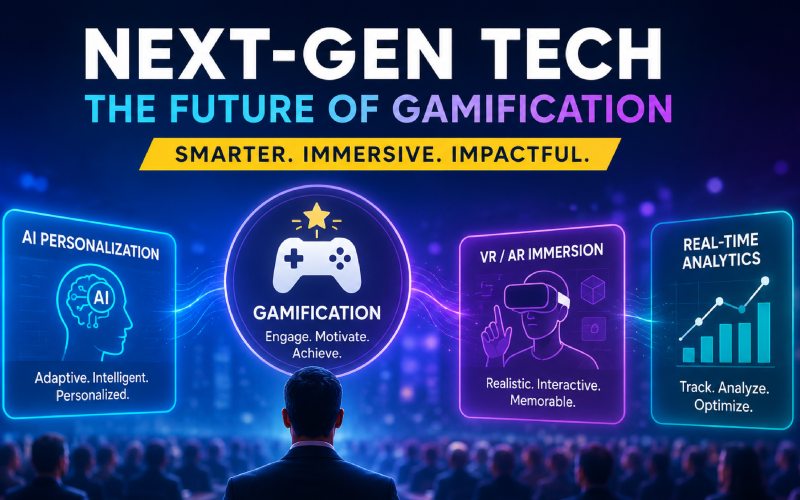
Technology 1: AI-Powered Personalization
Artificial intelligence is the most discussed shift in gamification technology right now. AI moves gamification from a fixed rule system into an adaptive experience that responds to each user in something closer to real time.
Industry sources, including AmplifAI’s gamification statistics roundup, commonly cite figures in the range of a 40-50% increase in interaction frequency and a 35-40% rise in retention for AI-enabled gamification compared to standard, non-adaptive systems. These figures appear consistently enough across industry sources to be directionally credible, though they should be treated as industry-reported estimates rather than a single peer-reviewed result.
AI engines increasingly adjust tasks, incentives, and feedback based on a user’s engagement history, skill gaps, and progress rate, aiming for a system that challenges each person near the right difficulty level.
What AI Personalization Does in Practice
- Adaptive challenge scaling: the system raises or lowers task difficulty based on real-time performance data.
- Predictive churn detection: AI flags disengaging users before they drop off and triggers targeted re-engagement mechanics.
- Micro-personalized rewards: incentives matched to individual motivators, such as status, progress, social recognition, or autonomy, rather than one badge for everyone.
- Real-time coaching prompts: in workforce applications, AI surfaces relevant tips at the moment a user struggles.
Technology 2: Immersive VR and AR Training Environments
Virtual and augmented reality have moved from consumer entertainment into enterprise training at scale. The AR and VR training market was valued at $22.56 billion in 2025 and is projected to reach $95.83 billion by 2035 at a 15.56% compound annual growth rate, according to Market Research Future. Note that other research firms publish substantially different figures for this same market, a common issue in emerging-technology forecasting, so treat any single number as directional rather than definitive.
The reason professionals are eager for VR-based gamification is the learning outcome pattern reported across industry studies: gamified and immersive training is widely reported to improve information retention compared to passive instruction, though the exact percentage varies by source. VR extends this by placing learners inside the scenario rather than in front of a screen.
How VR Gamification Works in Enterprise Settings
A VR-gamified training module puts an employee inside a simulated workplace scenario, a difficult customer conversation, a manufacturing safety drill, or a medical procedure. They earn points for correct decisions and receive instant feedback without real-world consequences.
This approach narrows the gap between training and performance. Employees do not just learn what to do; they practice doing it under simulated pressure until the skill becomes closer to automatic.
Next-Gen Technology Comparison: What Gamification Professionals Prioritize
| Technology | Primary Use Case | Adoption Stage | Summit Priority |
| AI Personalization | Adaptive learning and retention | Widely adopted across platforms | Very High |
| VR/AR Immersive Training | Skill development and simulation | Scaling rapidly | High |
| Behavioral Analytics | Real-time engagement tracking | Mature | High |
| Gamified Checkout and Onboarding | User acquisition and activation | Growing | Medium-High |
| Spatial Computing (XR) | Immersive collaboration and design | Early enterprise stage | Medium |
| NFT and Blockchain Rewards | Ownership-based loyalty systems | Pilot stage | Emerging |
Technology 3: Behavioral Analytics and Real-Time Feedback Loops
Behavioral analytics gives gamification designers the data to know what is working, in something close to real time. Without this layer, organizations can run gamified programs for months before discovering that most users stopped engaging weeks earlier.
Modern analytics platforms track which mechanics drive meaningful behavior change versus which ones only generate superficial activity. A user who collects badges without completing any real task looks engaged on a surface metric but produces no business outcome. Analytics helps separate real engagement from vanity metrics.
For summit professionals, this technology addresses a long-standing criticism of gamification: that it creates hollow incentive loops. When you can see where users drop off and which challenges they repeat voluntarily, you can build systems aimed at lasting change rather than short-term spikes.
Why the Summit Format Accelerates Technology Adoption
Gamification professionals do not just read about these technologies. Many experience them directly at summits where the sessions themselves are gamified, earning points for workshop participation and competing on leaderboards for engagement.
This experiential format matters because it turns attendees into informed buyers. Understanding how the best ticket sales platforms for gamification summits are structured reveals the same behavioral design principles that professionals then apply inside their own products and training programs.
The Meaningful Gamification Standard
A consensus has emerged among leading gamification professionals: superficial reward systems can damage long-term engagement. When users sense that a gamified system manipulates rather than empowers them, trust and participation tend to drop.
Transparency and purpose have become widely regarded as non-negotiable design requirements. Participants should understand why they earn rewards and how their data is used. This shift toward what practitioners call meaningful gamification explains why next-gen technologies matter: AI personalization makes rewards feel earned, VR simulations create real skill transfer rather than just completion credits, and behavioral analytics lets designers remove mechanics that produce anxiety rather than mastery.
The Skills Transfer Gap That Immersive Tech Helps Close
There is a real gap between knowing how to do something and being able to do it under real conditions. Traditional training, and even standard gamified e-learning, tends to fill the knowledge gap but rarely closes the performance gap on its own.
VR helps close that gap because it forces procedural practice rather than passive information recall. A safety engineer who completes a VR fire-drill module does not just know the steps; they have executed them under simulated pressure, with mechanics like time limits and scoring that raise the stakes.
Summit professionals in HR technology, corporate training, and product design are eager for this capability because it offers a more credible answer to a question every executive asks: does this training actually change behavior on the job?
Where Gamification Professionals Are Deploying Next-Gen Tech
| Industry | Primary Technology | Key Outcome Measured | Adoption Status |
| Corporate L&D / HR Tech | AI personalization + VR simulation | Skills transfer and retention rate | Mainstream |
| Healthcare | VR scenario training + analytics | Procedure accuracy and safety scores | Scaling |
| Retail and Customer Loyalty | AI-adaptive reward systems | Repeat purchase and churn reduction | Mainstream |
| Education | Gamified LMS with adaptive AI | Course completion and test scores | Mainstream |
| Manufacturing | AR-guided task completion | Error rate reduction and output speed | Scaling |
| Fintech and Financial Services | Behavioral nudge mechanics + analytics | Savings behavior and app engagement | Growing |
| Sales Enablement | Leaderboards + AI coaching prompts | Pipeline activity and quota attainment | Mainstream |
What Professionals Actually Do With These Technologies After the Summit
The eagerness that characterizes gamification summit attendees is not passive interest. Most professionals arrive with a specific business problem: a training completion rate that is too low, an onboarding process that loses new hires early, or a loyalty program that only reaches a small share of buyers.
They typically leave with a prioritized technology roadmap:
- Phase 1: Deploy behavioral analytics on the existing system to identify where and why engagement drops off.
- Phase 2: Layer AI personalization to serve different content, rewards, and challenges to different user segments based on behavior data.
- Phase 3: Introduce VR or immersive scenarios for the highest-stakes skill areas where standard training has struggled to change behavior.
- Phase 4: Iterate using real-time data, removing mechanics that produce hollow activity and expanding those that produce measurable change.
Understanding the full event experience, including how the ticket-sale process at a gamification summit uses the same behavioral design principles discussed above, gives professionals a complete picture of gamification applied end-to-end.
The Drive to Build Better Systems
Gamification summit professionals are eager for next-generation technology because they have already seen what first-generation systems can and cannot do. They understand that AI personalization, immersive VR environments, and real-time behavioral analytics are the tools that close the gap between a gamified experience and a genuinely useful one.
The market data supports the urgency directionally: the gamification market is growing at over 25% annually as organizations across industries invest in solutions aimed at measurable outcomes. Summit professionals help set the standard for what those solutions should look like, and push toward systems designed to support users rather than just extract engagement from them.

Julian Thorne is a distinguished Technical Strategist and Fintech Analyst with over 6 years of experience in digital payment architectures. Specializing in the integration of high-performance gateways like Xendit, he focuses on optimizing the intersection of gamification and online ticketing systems. Julian’s expertise lies in deconstructing complex payment flows and enhancing sales effectiveness through data-driven insights. His recent work deeply explores the evolution of digital event platforms in 2026, providing actionable strategies for global summits and large-scale ticketing infrastructures.
Learn more about our team OR Get in touch