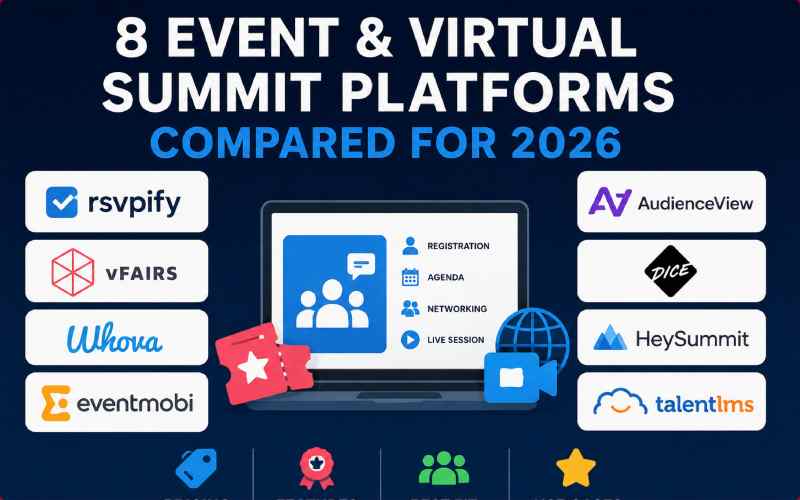
Choosing an event platform without a clear comparison wastes budget on features an organizer will never use. A wrong pick also creates friction for attendees during registration and check-in, which lowers turnout and repeat attendance. This guide compares eight platforms across pricing, core strengths, and the event types each one fits best, so an organizer can match the tool to the actual event instead of the marketing page.
How We Compared These Eight Platforms
We reviewed public pricing pages, verified vendor documentation, and cross-checked user reports from independent review sites for each platform. We prioritized real pricing signals over marketing claims and flagged platforms that require a custom quote. We also separated platforms built for ticketed live events from platforms built for virtual summits and learning, since organizers often confuse the two categories.
Event and Virtual Summit Platforms at a Glance
| Platform | Best For | Starting Price | Pricing Model |
| RSVPify | Corporate and nonprofit RSVP events | Free plan; paid tiers from $39/month | Monthly subscription or per-ticket fee |
| vFairs | Immersive 3D trade shows and job fairs | Custom quote only | Per-event, quote-based |
| Whova | Conferences and academic events | Custom quote only | Per-event, quote-based |
| EventMobi | Brand-controlled event apps | From $1,500 per event | One-time, transparent |
| AudienceView | Theaters, venues, and performing arts | From $7,000/month (enterprise) | Subscription or per-ticket |
| DICE | Independent music and comedy shows | No published US rate table | Invite-gated, quote-based |
| HeySummit | Virtual summits and creator events | From $33/month | Monthly subscription |
| TalentLMS | Gamified training and learning summits | Free tier; paid from active-user pricing | Per active user |
RSVPify: Best for Corporate and Nonprofit RSVP Events
RSVPify serves corporate teams, nonprofits, and private hosts who need flexible RSVP and guest-list tools. The platform reports use by 30 percent of Fortune 500 companies, which signals strong enterprise trust.
Pricing starts with a free plan capped at 100 registrations per month. Paid tiers range from a Starter plan near $39 per month to a Professional plan near $299 per month, and ticketed events can run on a per-ticket fee instead of a flat rate. Organizers who run occasional ticketed events often prefer this fee-based option, since it removes the fixed monthly cost.
vFairs: Best for Immersive 3D Trade Shows
vFairs builds branded 3D virtual environments that mirror a physical trade show floor, including booths, lobbies, and networking lounges. The platform supports GDPR, CCPA, and PCI DSS compliance, which matters for organizers handling attendee payment data across regions.
vFairs does not publish standard pricing. Every quote depends on event format, attendee volume, and the level of custom design an organizer requests. Teams should request a detailed quote early, since custom 3D environments can add both cost and lead time.
Whova: Best for Conferences and Academic Events
Whova centers its platform around a mobile event app that attendees actually open, which is not true of every competitor on this list. The app bundles registration, agenda management, speaker profiles, and a networking suite with attendee profiles and community boards.
Pricing runs on a custom per-event quote plus a per-ticket fee, and costs can reach several thousand dollars for large conferences. Reviewers on independent software directories note that core features work well, but optional add-ons raise the total price quickly.
EventMobi: Best for Brand-Controlled Event Apps
EventMobi positions itself against bundled competitors by charging a transparent, one-time fee instead of ongoing processing fees. Organizers keep more ticket revenue when they use their own payment gateway rather than a platform-locked one.
Starting price sits near $1,500 per event according to independent software directories, which makes EventMobi easier to budget against upfront compared with quote-only competitors. The tradeoff is less bundled functionality out of the box, so teams with simple needs may pay for capability they will not use.
AudienceView: Best for Theaters, Venues, and Performing Arts
AudienceView targets performing arts organizations, museums, and multi-venue operators that need reserved seating, subscriptions, and donor management in one system. The platform embeds a full CRM, which keeps ticket buyers, donors, and members inside a single data record instead of scattered across separate tools.
Enterprise pricing starts near $7,000 per month according to public listings, positioned for large venues rather than single-event organizers. Smaller teams evaluating AudienceView should confirm whether the per-ticket pricing model fits better than the subscription tier before committing.
DICE: Best for Independent Music and Comedy Events
DICE built its reputation on upfront, all-in pricing for concertgoers, with no resale markups and a waiting list for sold-out shows. A Forbes profile on ticketing transparency credits DICE with pushing the wider industry toward clearer, fee-inclusive pricing for fans.
Organizers cannot self-serve onto DICE. The platform onboards venues and promoters through an invite-gated application process, and it does not publish a standard United States fee table. This makes DICE a fit mainly for established music and comedy venues rather than first-time event organizers.
HeySummit: Best for Virtual Summits and Creator Events
HeySummit builds specifically for the format this site covers most directly: multi-speaker virtual summits. The platform automates speaker coordination, ticketing, and event pages in one workflow instead of requiring organizers to combine separate tools.
Entry pricing starts near $33 per month for a Growth-level plan, with higher tiers unlocking affiliate promotion and white-label branding. This makes HeySummit one of the more accessible options on this list for a first-time summit host, though reviewers note transaction fees at the lowest tier reduce net revenue.
TalentLMS: Best for Gamified Training and Learning Summits
TalentLMS fits organizers running a learning-focused summit or certification track rather than a live ticketed show. The platform builds gamification directly into its core rather than bolting it on, with points, badges, levels, and leaderboards tied to course completion.
A free tier supports up to five users and ten courses permanently, which lets teams test the gamification model before paying. Paid pricing scales by active users rather than total registered accounts, so an organizer only pays for people who actually log in during a given month. This matches the reasoning behind why collecting and completion feel rewarding to learners in the first place, since visible progress drives the same repeat engagement in a training summit that it does in a live one.
Which Platform Fits Which Type of Event
Most comparison articles rank these platforms by feature count, which does not answer the real question an organizer has. The better filter is event format first, then budget.
A ticketed live show or concert points toward DICE or RSVPify, depending on whether the event needs open registration or curated access. A trade show or job fair points toward vFairs for its 3D environment strength.
A professional conference with a strong networking need points toward Whova. A venue running a season of shows points toward AudienceView for its seating and CRM depth.
A multi-speaker virtual summit, the format most readers of this site plan, points toward HeySummit first. EventMobi becomes the better fit once branding control matters more than bundled speed. A learning-focused summit or certification event points toward TalentLMS.
Payment processing sits underneath every one of these platforms. Teams comparing options should also confirm how each platform handles payment gateways, since our guide to how Xendit payment processing works covers the technical side of that decision for organizers who need a closer look.
Common Mistakes When Comparing Event Platforms
Organizers frequently compare sticker price without comparing pricing model. A per-ticket fee looks cheap for a small event and expensive for a large one, while a flat monthly fee works in reverse. Matching the pricing model to expected attendance matters more than the headline number.
A second common mistake is skipping the quote-request step for platforms like vFairs and Whova. Public pricing pages do not exist for every platform on this list, and treating no listed price as too expensive can eliminate a strong option before a real quote is even requested.
Frequently Asked Questions
Which platform is cheapest for a small event?
RSVPify and HeySummit publish the lowest entry pricing on this list, with the RSVPify free plan and the HeySummit Growth tier both suited to small, budget-limited events.
Do these platforms charge attendees or organizers?
Most charge organizers directly through a subscription or per-ticket fee, though DICE and RSVPify can pass ticketing fees to attendees depending on the plan selected.
Is a quote-only platform automatically more expensive?
Not necessarily. Quote-only platforms like vFairs and Whova price around event size and feature selection, so a small, simple event can sometimes cost less than the published starting price of a bundled competitor.
Pricing details in this article reflect publicly available information at the time of writing and change without notice. Organizers should confirm current pricing directly with each vendor before making a purchase decision

Julian Thorne is a distinguished Technical Strategist and Fintech Analyst with over 6 years of experience in digital payment architectures. Specializing in the integration of high-performance gateways like Xendit, he focuses on optimizing the intersection of gamification and online ticketing systems. Julian’s expertise lies in deconstructing complex payment flows and enhancing sales effectiveness through data-driven insights. His recent work deeply explores the evolution of digital event platforms in 2026, providing actionable strategies for global summits and large-scale ticketing infrastructures.
Learn more about our team OR Get in touch