By Julian Thorne / Originally published April 27, 2026 / Updated November 5, 2026
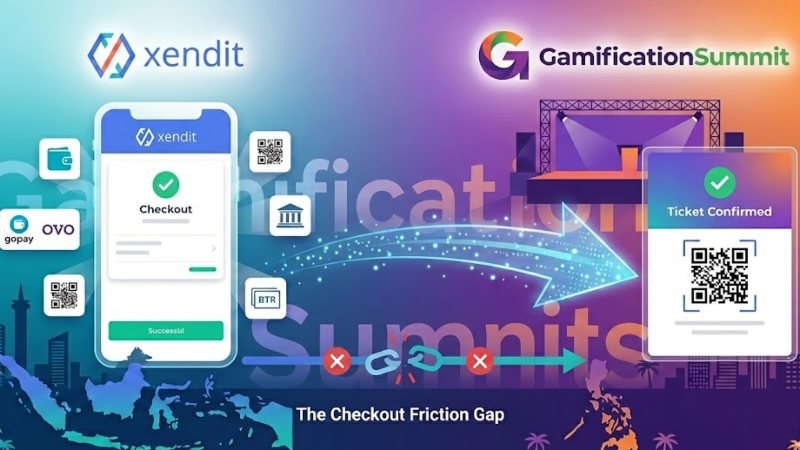
You built a great event. Speakers confirmed. Venue booked. Then your payment page started rejecting cards at checkout, attendees dropped off, and revenue walked out the door. I’ve seen this happen to conference organizers many times, and it hurts every time.
That’s why understanding how Xendit fits into event ticketing matters. Xendit is a Southeast Asian payment infrastructure provider, and when it’s set up properly behind a ticketing checkout, it can noticeably reduce payment drop-off. If you’re still comparing where to sell tickets, start with our guide to the websites for ticket GamificationSummit, then come back here for the payments side.
What Is Xendit, and Why Should Event Organizers Care?
Stripe and PayPal are global giants, but Xendit was built for Southeast Asia, where people often pay by bank transfer, e-wallet, or QR code rather than card. As of 2026, merchants can onboard in Hong Kong, Indonesia, Malaysia, Philippines, Singapore, Thailand and Vietnam. It advertises 100+ payment methods through one API.
Gaming, esports, and digital-economy events skew young, tech-forward, and regionally concentrated, which is exactly the audience that card-only checkouts lose. Xendit supports virtual accounts, QR codes (including QRIS), cards, and e-wallets such as GoPay, OVO, and GCash, so one checkout can work for most of your regional buyers.
⚡ Pro-Tip: In my experience, the biggest reason organizers lose ticket sales in Southeast Asia isn’t price. It’s payment friction. If your checkout has no local e-wallet option, you lose buyers before they even decide.
The Good, the Bad, and the Ugly
The good
- Many channels, one integration: virtual accounts, cards, e-wallets, and QR under one checkout.
- Settlement depends on the channel: some channels settle instantly, others in T+1 or T+2 business days. For example, BCA virtual accounts settle T+1. Check the channel table for the methods you enable.
- Real-time webhooks: payment confirmations reach your ticketing system immediately, so tickets go out without delay.
The bad
- Documentation can be inconsistent, and I’ve seen outdated examples confuse junior developers.
- Support response times vary during high-volume periods.
- Refund support differs by payment method (details below).
The ugly: refunds and cross-border payouts
Refunds are where organizers get caught. E-wallet refunds are available through the API: they can be full or partial, and same-day voids are possible, but refunds aren’t available for OVO one-time payments or AstraPay. Some virtual account channels don’t support refunds at all, so those cases need a manual payout flow. Read Xendit’s official guide on refunding and voiding e-wallet transactions via API before you go live, and write your refund policy first.
Cross-border payouts are improving but still need planning. Xendit’s Global Account, launched in beta in August 2025, supports IDR, PHP, MYR, THB, VND, USD and HKD, with caveats. If you collect in Rupiah but pay a speaker in USD, confirm your settlement currency and conversion fees before launch. Don’t assume it converts automatically.
🔍 Expert Insight: Integrate the refund API from day one and ask your platform provider to enable it explicitly. It rarely comes pre-configured.
Technical Breakdown: How the Checkout Flow Works
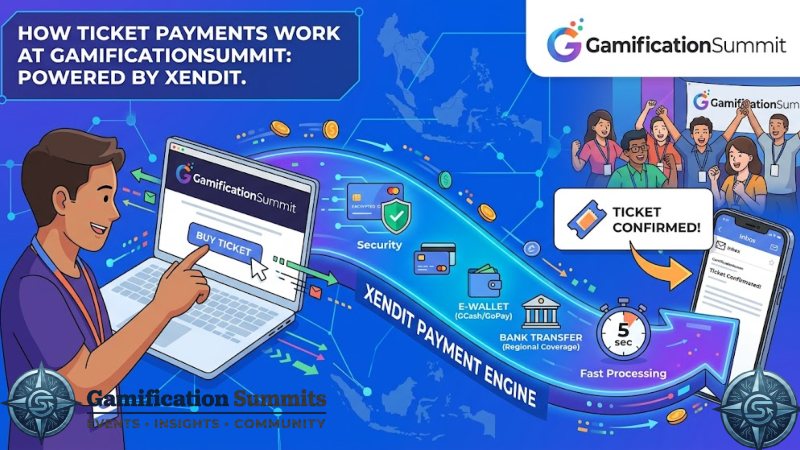
Here is the typical flow when a buyer clicks “Purchase Ticket”:
- The ticketing platform sends a payment request to Xendit’s API with price, buyer details, and payment method.
- Xendit returns a payment URL or virtual account number.
- The buyer pays by bank, e-wallet, QR, or card.
- Xendit sends a webhook to the ticketing server confirming payment.
- The platform issues the ticket, usually a QR code or PDF by email.
Headers, authentication, and webhook verification matter a lot in practice. The full specs are in the official Xendit API Documentation.
On security, Xendit lists PCI DSS compliance, which reduces your own card-data burden. You’re still responsible for securing your integration, especially API keys and webhook endpoints.
Xendit vs. Other Gateways for Event Ticketing
| Feature | Xendit | Stripe | PayPal |
|---|---|---|---|
| SE Asia e-wallets | ✔ GoPay, OVO, GCash, DANA | Partial (e.g., GrabPay in SG/MY) | ✘ |
| Virtual bank accounts | ✔ | ✘ | ✘ |
| QR payments | ✔ QRIS and others | Emerging (QRIS in Preview for Indonesia) | ✘ |
| Settlement speed | Instant to T+2 by channel | Varies by country | Varies |
| USD cross-border payouts | Improving (Global Account beta) | Strong | Strong |
| PCI DSS | ✔ | ✔ | ✔ |
| Best for | SE Asian audiences | Global and Western markets | Consumer familiarity |
⚡ Pro-Tip: If your audience spans Southeast Asia and the West, consider running Xendit alongside Stripe, not instead of it. One handles local methods, the other handles international cards.
Who Is This Actually For?
Xendit is a good fit if your attendees are mainly in Indonesia, the Philippines, Malaysia, Thailand, or Vietnam. It also suits you if you want local payment methods without custom integrations, expect high ticket volume, and have a developer comfortable with REST APIs and webhooks.
It may not fit if your audience is mainly in North America or Europe, if you need fully automated refunds across every payment method, or if your event is small enough that a simple built-in checkout is less work.
Want to know who is behind these guides? Learn more about our team and mission.
Final Verdict
When Xendit is matched to the right audience, it works. It cuts payment drop-off, speeds up settlement on many channels, and handles the local payment landscape better than most international gateways. The setup takes effort, the documentation has rough edges, and refunds and cross-border payouts need planning. But if your attendees are in Southeast Asia, it’s one of the strongest options available.
If your last event lost sales at checkout, do you know which payment method your buyers tried and failed to use?

Julian Thorne is a distinguished Technical Strategist and Fintech Analyst with over 6 years of experience in digital payment architectures. Specializing in the integration of high-performance gateways like Xendit, he focuses on optimizing the intersection of gamification and online ticketing systems. Julian’s expertise lies in deconstructing complex payment flows and enhancing sales effectiveness through data-driven insights. His recent work deeply explores the evolution of digital event platforms in 2026, providing actionable strategies for global summits and large-scale ticketing infrastructures.
Learn more about our team OR Get in touch