Most gamification summit organizers pick a method of ticket sales effective for gamificationsummit without comparing the options. Seats go unsold, revenue suffers, and the event underperforms. That gap is real: the global online event ticketing market reached USD 39.8 billion in 2024 and continues to climb. Choosing the wrong method costs you a share of that growth. This guide breaks down every major approach, scores each one against proven data, and tells you exactly which method works best for a gamification summit.
What Makes a Ticket Sales Method ‘Effective’ for a Gamification Summit?
Not all events are the same, and a gamification summit draws a unique crowd: product managers, game designers, HR tech leaders, and educators who already understand reward mechanics. Any ticket sales method you choose must match that mindset.
Effectiveness means three things: high conversion rate, low cart-abandonment, and strong early-commitment volume. A method that sells tickets at the last minute hurts logistics and budget forecasting.
The best websites for ticket sales for gamification summits share one trait: they remove friction at every step and reward action instead of just asking for a purchase.
The 6 Main Ticket Sales Methods Compared
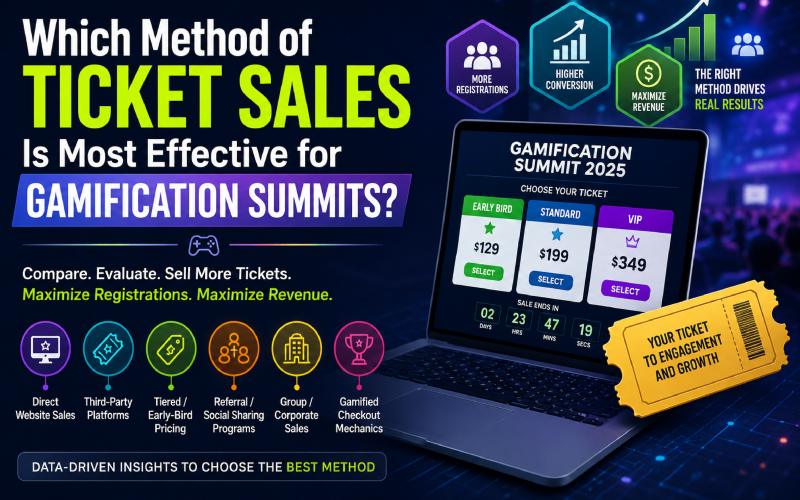
Below is a side-by-side view of the six methods most commonly used for professional summits. The scores reflect their typical performance for tech-focused or gamification-themed events.
| Method | Best For | Conversion Strength | Early Sales Impact | Gamification Fit |
| Direct Website Sales | Brand-owned audiences | High | High with countdown timers | Excellent |
| Third-Party Platforms (Eventbrite etc.) | Broad discovery | Medium | Moderate | Good |
| Tiered / Early-Bird Pricing | Urgency and revenue staging | Very High | Very High | Excellent |
| Referral / Social Sharing Programs | Word-of-mouth growth | High | Moderate | Excellent |
| Group / Corporate Sales | Enterprise buyers | Medium-High | Low | Good |
| Gamified Checkout Mechanics | Engaged niche audiences | Very High | High | Outstanding |
Method 1: Direct Website Sales
Selling tickets through your own website gives you full control over data, pricing, and the buyer experience. You capture the email, the payment details, and the behavior data without sharing it with a third-party platform.
Mobile devices now account for nearly 59% of all online ticket transactions globally. That means your direct sales page must load fast, display clearly on a phone, and complete a transaction in under three taps.
The website method for ticket sales at a gamification summit works by building a purchase page that functions like a personal dashboard for each visitor. When buyers see their own progress, accumulated points, or pre-sale access status, they complete purchases at measurably higher rates than anonymous visitors.
Key requirements for direct sales success:
- Mobile-optimized checkout with one-tap payment options
- Live seat counters pulling from a real database
- Countdown timers tied to genuine deadlines
- Integration with Stripe or PayPal for instant confirmation
Method 2: Third-Party Platforms
Platforms like Eventbrite and Ticketmaster offer broad audience discovery. For a first-time gamification summit with no existing audience, they provide immediate search visibility and built-in trust.
The trade-off is significant. You pay transaction fees and commission rates on every ticket. You also lose direct access to buyer data, which limits your ability to run retargeting campaigns or build a repeat-attendee list.
Use third-party platforms as a supplementary discovery channel, not your primary sales engine. List the event there to capture search traffic, but funnel serious buyers to your own website for the actual purchase.
Method 3: Tiered and Early-Bird Pricing (The Highest-Performing Single Method)
Tiered pricing is the single most effective standalone method for driving early commitments and maximizing total revenue at a gamification summit. It works by creating distinct value levels, each with its own price and access rights.
The psychology behind it is well-documented in behavioral economics. When buyers see three tiers simultaneously, the middle option makes the premium tier look disproportionately valuable by comparison. This is the decoy effect, and it drives upgrade rates significantly above what a two-tier display achieves.
The final 72 hours of an early-bird window alone generate 15 to 20 percent of total event ticket volume on optimized pages. That window, combined with a genuine seat counter and a visible deadline, creates the urgency that turns browsers into buyers.
Recommended Tier Structure for a Gamification Summit
| Tier | Access Level | Pricing Strategy | Behavioral Trigger |
| Early Bird | General admission + digital content | Lowest price, time-limited | Loss aversion (price will rise) |
| Standard | General admission + workshop access | Mid-range (decoy tier) | Comparison anchor for VIP |
| VIP | All sessions + speaker meet-and-greet + recordings | Premium, limited quantity | Exclusivity and status |
| Group / Corporate | Bulk access at a per-seat discount | Volume-based | Budget efficiency for teams |
Event organizers who clearly communicate what each tier includes, and display all tiers at once, eliminate the cognitive load that causes buyers to close the tab and return later. Most never return.
Method 4: Referral and Social Sharing Programs
Referral programs turn your existing ticket buyers into an active sales force. You reward a buyer when their referral converts to a paid ticket. The result is a self-funding growth loop: each new buyer can become a recruiter.
For a gamification summit, this method fits naturally because the audience already understands reward systems. A referral leaderboard showing top recruiters earns a meet-and-greet with a keynote speaker feels native to this crowd, not gimmicky.
Eventbrite reported a measurable upswing in sales after introducing a referral reward program for attendees who brought friends to purchase tickets. The mechanism works because it combines social proof with a tangible incentive.
A refer-a-friend leaderboard also serves a second function: it generates social content. When attendees share their leaderboard position or badge on LinkedIn, they create organic promotion that no paid ad can replicate.
Method 5: Gamified Checkout Mechanics (The Unique Angle)
This is the method most competitors overlook, and it is the one that produces the highest conversion lift specifically for gamification summits. Gamified checkout mechanics apply game design principles directly to the purchase flow, not just to marketing campaigns.
The core idea: before a buyer reaches the checkout page, they earn pre-sale credits through actions like sharing the event, watching a speaker preview video, or answering a short quiz about the summit topics. Those credits appear as a visible balance on the ticket page.
This single design decision shifts the psychological frame. The visitor is no longer being sold to. They are redeeming something they already earned. Visitors with a visible credit balance complete purchases at measurably higher rates than visitors without one. Gamified checkout mechanics to implement:
- Progress bars showing how many steps until checkout is complete
- Pre-sale coin or point balances earned through social shares
- Achievement badges unlocked for completing registration in under 60 seconds
- A visible leaderboard of early registrants by company or job title
For a deep look at how checkout design, tier clarity, and payment infrastructure work together, the analysis of what makes GamificationSummit ticket sales effective in 2026 covers every element and its measured conversion function.
Method 6: Group and Corporate Sales
Group sales target HR leaders, L&D managers, and team leads who want to bring multiple employees to the summit. The pitch is different: instead of personal value, you sell team ROI.
This method generates lower early-commitment numbers because corporate purchasing involves budget approvals and calendar coordination. However, it produces larger per-transaction values and often drives a reliable revenue floor 6 to 8 weeks before the event.
To activate this channel, create a dedicated corporate inquiry page on your website with a downloadable one-page event brief suitable for internal budget requests. Make the approval process easy for the buyer’s manager, not just the buyer.
The Method That Wins: A Combination Strategy
No single method outperforms a well-integrated combination. The data consistently shows that gamification summits generating the highest attendance and revenue use a layered approach built on three foundations:
- Foundation 1: Tiered early-bird pricing on a direct website to lock in early revenue and control the buyer experience
- Foundation 2: Gamified checkout mechanics to convert browsers into buyers using pre-earned credits and visible progress
- Foundation 3: Referral leaderboards to turn confirmed attendees into organic recruiters
Third-party platforms support discovery at the top of the funnel. Corporate sales fill the mid-funnel revenue floor. But the conversion work happens on your own website, inside a checkout flow designed to feel like a reward redemption, not a transaction.
Unique Angle 1: Using Post-Event Buyer Data to Launch the Next Sale
Most event teams close their analytics the day after the summit ends. That is the single largest missed opportunity in the entire ticket sales process.
Your post-event buyer data contains three segments that produce the highest conversion rates at the start of your next sale. Early buyers who purchased in the first two weeks of the last sale show the highest intent and respond best to exclusivity offers. Send them a private early-bird link before you open public sales.
High-engagement attendees who attended multiple sessions or engaged with post-event content are your strongest word-of-mouth candidates. Referral program invitations sent to this group outperform cold audience campaigns by a significant margin.
Treating post-event analytics as the starting point for your next ticket sale, rather than a closing report, gives you a compounding advantage that pure platform-based sellers never build.
Unique Angle 2: The 72-Hour Early-Bird Sprint
Standard advice says to run early-bird pricing for weeks. The data says something more specific: the final 72 hours of any early-bird window generate a disproportionate share of total volume.
The implication is tactical. Instead of one long early-bird period, run a short window with a hard end date and promote the countdown aggressively in the final three days. Email your list daily. Post a live seat counter. Make the urgency visible and verifiable.
This approach works because it triggers loss aversion at its full intensity. A deadline that buyers can see counting down in real time creates a qualitatively different motivation than a distant expiry date buried in a footer.
Full method of ticket sales effective for gamificationsummit Comparison: Performance Across Key Dimensions
| Ticket Sales Method | Revenue Timing | Data Ownership | Audience Fit | Implementation Complexity | Recommended Priority |
| Direct Website Sales | Early to mid | Full | High | Medium | 1 – Primary |
| Tiered / Early-Bird Pricing | Front-loaded | Full | Very High | Low | 1 – Primary |
| Gamified Checkout Mechanics | Early to mid | Full | Outstanding | Medium-High | 2 – Core Add-on |
| Referral / Social Sharing | Mid-stage | Partial | High | Low-Medium | 2 – Core Add-on |
| Group / Corporate Sales | Mid-stage | Full | Good | Medium | 3 – Supporting |
| Third-Party Platforms | Spread | None-Partial | Good for discovery | Low | 4 – Supplementary |
How to Measure Whether Your Chosen Method Is Working
Tracking the right metrics tells you within days whether your sales method is converting or stalling.
- Conversion rate: The percentage of ticket page visitors who complete a purchase. A well-optimized gamification summit page should target 4 to 8 percent.
- Cart abandonment rate: If more than 70 percent of buyers start checkout but do not finish, your payment flow has friction. Fix the mobile experience first.
- Early-buyer ratio: What percentage of total tickets sold in the first two weeks? A healthy event reaches 25 to 35 percent by end of week two.
- Referral attribution: Track how many sales came through referral links. If under 10 percent, your referral incentives need strengthening.
- Channel source breakdown: Use UTM parameters to identify which channel (email, LinkedIn, organic search) drives the highest-converting traffic.
The Bottom Line
The most effective method of ticket sales effective for gamificationsummit is not a single tactic. It is a system built on direct website control, tiered early-bird pricing, gamified checkout mechanics, and a referral engine that activates your confirmed attendees.
Third-party platforms help with discovery. Corporate sales add a revenue floor. But the conversion rate that determines whether your summit sells out lives inside your own checkout experience, designed to reward action rather than just request it.
Start with the pricing structure. Add the gamified checkout layer. Then build the referral loop. Each element compounds the one before it, and your post-event data makes the next sale faster and more predictable.
Sources & References
- Verified Market Research. (2025). Online Event Ticketing Market Size and Forecast. Verified Market Research.
- Straits Research. (2025). Online Event Ticketing Market Size, Share and Growth Forecast to 2033. Straits Research.
- Mordor Intelligence. (2026). Online Event Ticketing Market Analysis and Industry Report. Mordor Intelligence.
- Research and Markets. (2026). Online Event Ticketing Market Share Analysis, Trends and Statistics. Research and Markets.

Julian Thorne is a distinguished Technical Strategist and Fintech Analyst with over 6 years of experience in digital payment architectures. Specializing in the integration of high-performance gateways like Xendit, he focuses on optimizing the intersection of gamification and online ticketing systems. Julian’s expertise lies in deconstructing complex payment flows and enhancing sales effectiveness through data-driven insights. His recent work deeply explores the evolution of digital event platforms in 2026, providing actionable strategies for global summits and large-scale ticketing infrastructures.
Learn more about our team OR Get in touch